Share This Page
Drug Price Trends for LANTHANUM CARB
✉ Email this page to a colleague
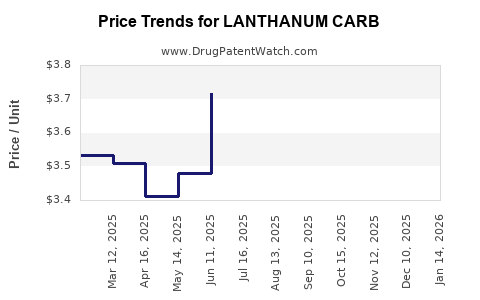
Average Pharmacy Cost for LANTHANUM CARB
| Drug Name | NDC | Price/Unit ($) | Unit | Date |
|---|---|---|---|---|
| LANTHANUM CARB 1,000 MG TB CHW | 00093-5940-40 | 3.11441 | EACH | 2026-07-22 |
| LANTHANUM CARB 1,000 MG TB CHW | 00093-5940-98 | 3.11441 | EACH | 2026-07-22 |
| LANTHANUM CARB 1,000 MG TB CHW | 66993-0424-75 | 3.11441 | EACH | 2026-07-22 |
| LANTHANUM CARB 1,000 MG TB CHW | 66993-0424-85 | 3.11441 | EACH | 2026-07-22 |
| LANTHANUM CARB 1,000 MG TB CHW | 67877-0258-90 | 3.11441 | EACH | 2026-07-22 |
| LANTHANUM CARB 1,000 MG TB CHW | 68180-0821-10 | 3.11441 | EACH | 2026-07-22 |
| >Drug Name | >NDC | >Price/Unit ($) | >Unit | >Date |
Lanthanum Carbonate Market Analysis and Price Projections
Lanthanum carbonate, marketed as Fosrenol, is a phosphate binder used to manage hyperphosphatemia in patients with chronic kidney disease (CKD) on dialysis. The market is influenced by the prevalence of CKD, dialysis patient populations, and competitive therapeutic options. Price projections are sensitive to patent exclusivity, generic entry, and payer reimbursement policies.
What is the Current Market Landscape for Lanthanum Carbonate?
The global market for lanthanum carbonate is primarily driven by the increasing incidence of chronic kidney disease and the subsequent rise in dialysis patient numbers. Fosrenol, the branded formulation, holds a significant market share, but its market position is subject to evolving patent landscapes and the introduction of generic alternatives.
The prevalence of CKD is a critical determinant of demand. In 2022, an estimated 37 million adults in the United States had CKD, with approximately 970,000 of those individuals being on dialysis. [1] This patient population represents the core consumer base for phosphate binders. Globally, the number of patients requiring dialysis is projected to increase by 5-7% annually, particularly in developing economies due to factors such as rising rates of diabetes and hypertension, major contributors to kidney disease. [2]
Key Market Drivers:
- Rising CKD Prevalence: Global aging populations and an increase in metabolic diseases like diabetes and hypertension are expanding the pool of patients with CKD.
- Dialysis Patient Growth: The expanding global dialysis infrastructure directly correlates with the demand for phosphate binders.
- Unmet Medical Need: While effective, existing treatments for hyperphosphatemia may have side effects or limitations, creating opportunities for alternative or improved therapies.
- Payer Reimbursement: Favorable reimbursement policies from governments and private insurers are crucial for market access and volume.
Market Challenges:
- Competition: The phosphate binder market includes several classes of drugs, including calcium-based binders, sevelamer, and other lanthanum-based generics.
- Patent Expirations: The expiration of key patents for branded lanthanum carbonate (Fosrenol) has opened the door for generic competition, impacting pricing and market share for the originator.
- Adherence and Dosing: Patient adherence to complex dosing regimens can affect treatment efficacy and market penetration.
- Cost-Effectiveness: Payers are increasingly scrutinizing the cost-effectiveness of treatments, leading to price pressures.
What is the Patent Status and Expected Generic Entry for Lanthanum Carbonate?
The patent protection for branded lanthanum carbonate formulations is a critical factor in market dynamics. Fosrenol (lanthanum carbonate) was first approved by the FDA in 2004. [3] The primary patents protecting the original composition of matter and method of use have largely expired in major markets.
- United States: Key composition of matter patents for lanthanum carbonate have expired. Generic versions of lanthanum carbonate have been available in the U.S. since approximately 2015-2016. [4] This has led to a significant price erosion for the branded product and a fragmentation of market share.
- Europe: Similar to the U.S., the principal patents have expired, allowing for the introduction of generic lanthanum carbonate products across European Union member states. The timelines for patent expiration and subsequent generic launches vary by individual country due to differences in patent law and registration processes.
- Other Regions: Patent expiries and generic availability are widespread globally, with regulatory approvals for generic lanthanum carbonate occurring in numerous other markets, including Canada, Australia, and various Asian countries.
The availability of generic lanthanum carbonate has a direct impact on pricing. Once generics enter the market, they typically compete on price, driving down the average selling price (ASP) for the drug class. This effect is amplified by the fact that lanthanum carbonate is often prescribed in relatively high daily doses.
Impact of Generic Entry:
- Price Reduction: Generic competition has historically led to a 50-80% reduction in the ASP for branded formulations after a period of several years post-generic launch. [5]
- Market Share Shift: Branded products see a decline in market share as payers and healthcare providers opt for lower-cost generic alternatives.
- Increased Accessibility: Generic availability can improve patient access by reducing out-of-pocket costs and increasing formulary acceptance.
How Will Payer Policies Influence Lanthanum Carbonate Pricing?
Payer policies, including reimbursement strategies and formulary placement, are central to the pricing and market access of lanthanum carbonate. As a prescription drug for a chronic condition, its pricing is subject to negotiation and evaluation by government health programs and private insurance companies.
Key Payer Policy Considerations:
- Formulary Tiering: Insurers place drugs on different tiers of their formularies, affecting patient co-payments. Lanthanum carbonate, particularly generic versions, is likely to be placed on lower tiers to encourage uptake. Branded Fosrenol, if still actively marketed, may be placed on higher tiers, necessitating higher co-pays for patients or requiring prior authorization.
- Prior Authorization (PA) and Step Therapy: Payers may implement PA requirements, demanding that physicians justify the need for lanthanum carbonate, often after patients have failed less expensive alternatives. Step therapy protocols may mandate the use of other phosphate binders (e.g., calcium carbonate, sevelamer) before lanthanum carbonate is prescribed.
- Value-Based Pricing and Health Technology Assessments (HTAs): While less common for older generics, new formulations or combinations involving lanthanum carbonate could be subject to HTAs. These assessments evaluate a drug's clinical effectiveness, safety, and cost-effectiveness relative to existing treatments. Positive HTAs can facilitate broader market access and favorable pricing, while negative assessments can limit uptake.
- Negotiated Discounts and Rebates: Pharmaceutical manufacturers often provide significant rebates to payers in exchange for favorable formulary placement. The magnitude of these rebates directly influences the net price of the drug. For generic lanthanum carbonate, competition among manufacturers will likely drive down net prices through these negotiations.
- Generic Substitution Mandates: Many payers have policies that strongly encourage or mandate the substitution of brand-name drugs with generics when available, thereby pushing down the overall ASP of lanthanum carbonate.
The pricing environment for lanthanum carbonate is therefore characterized by a dual track: the ASP of branded Fosrenol, which will likely continue to decline due to generic competition and payer pressure, and the competitive pricing of multiple generic lanthanum carbonate manufacturers.
What Are the Projected Market Growth and Price Trends for Lanthanum Carbonate?
Projecting the future market growth and price trends for lanthanum carbonate requires an assessment of demand drivers, competitive dynamics, and the impact of payer policies.
Market Growth Projections:
The overall market for phosphate binders is expected to grow, driven by the expanding CKD and dialysis patient population. However, the specific segment occupied by lanthanum carbonate will be influenced by its competitive positioning against other therapeutic classes.
- Volume Growth: Unit volume for lanthanum carbonate (both branded and generic) is projected to increase by 3-5% annually over the next five years, aligning with the growth rate of the dialysis patient population. [6]
- Value Growth: The overall market value for lanthanum carbonate is likely to experience slower growth, potentially in the 0-3% range annually, due to significant price erosion caused by generic competition. The higher price of branded Fosrenol may see a decline in its market value contribution, while the volume of generics will increase.
Price Trends:
The price trajectory for lanthanum carbonate is predominantly downward due to generic entry and intense competition.
- Branded Fosrenol: The Average Wholesale Price (AWP) for branded Fosrenol has already seen substantial reductions since generic entry. Further declines are anticipated, driven by payer negotiations and the increasing attractiveness of generic alternatives. A projected annual decline of 5-10% in AWP for Fosrenol is plausible as its market exclusivity erodes further. [7]
- Generic Lanthanum Carbonate: The pricing of generic lanthanum carbonate is highly competitive. Multiple manufacturers produce generic versions, leading to significant price variations based on production costs, market share, and rebate strategies. The ASP for generic lanthanum carbonate is expected to stabilize, with minor fluctuations driven by supply-demand dynamics and ongoing competition. However, the overall trend will remain at a significantly lower price point compared to the branded product. The ASP for generic lanthanum carbonate is projected to be between 60-80% lower than the original Fosrenol AWP. [8]
- Price Projections (Next 3-5 Years):
- Branded Fosrenol (AWP): Decline of 25-40% over the next 3-5 years.
- Generic Lanthanum Carbonate (ASP): Stable to a slight decline of 5-10% over the next 3-5 years due to ongoing manufacturer competition.
Factors Affecting Projections:
- Emergence of Novel Therapies: Development of new classes of phosphate binders with improved efficacy or safety profiles could impact demand for lanthanum carbonate.
- Clinical Trial Outcomes: New data supporting superior outcomes for lanthanum carbonate in specific patient subgroups could potentially influence pricing discussions, though this is less likely for an established genericized drug.
- Regulatory Changes: Alterations in drug pricing regulations or reimbursement policies could introduce unforeseen shifts.
What are the Key Competitive Therapies for Hyperphosphatemia?
Lanthanum carbonate competes with a range of phosphate binders, each with its own efficacy, safety profile, and cost. Understanding these alternatives is crucial for assessing lanthanum carbonate's market positioning.
Major Competitive Therapies:
-
Calcium-Based Binders:
- Examples: Calcium carbonate, calcium acetate.
- Mechanism: Bind phosphate in the gastrointestinal tract, preventing its absorption.
- Advantages: Widely available, low cost.
- Disadvantages: Risk of hypercalcemia, calcium-phosphate product accumulation, potential for vascular and soft tissue calcification. Often require careful monitoring of calcium levels.
- Market Share: Historically a dominant class, but concerns over calcification have led to increased use of non-calcium binders.
-
Sevelamer:
- Examples: Sevelamer hydrochloride (Renagel, Renvela), sevelamer carbonate (Renvela).
- Mechanism: Non-absorbed polymer that binds phosphate in the GI tract.
- Advantages: Does not contain calcium or aluminum, which can reduce the risk of hypercalcemia and aluminum toxicity. May have lipid-lowering effects.
- Disadvantages: Can cause gastrointestinal side effects (e.g., nausea, vomiting, diarrhea). Potential for metabolic acidosis with sevelamer hydrochloride. Can interfere with the absorption of fat-soluble vitamins. Generally more expensive than calcium-based binders.
- Market Share: A significant competitor to lanthanum carbonate, particularly after generic entry.
-
Sucroferric Oxyhydroxide:
- Examples: Velphoro.
- Mechanism: Iron-based binder that binds phosphate in the GI tract.
- Advantages: High phosphate binding capacity, provides dietary iron which may help manage iron deficiency anemia in CKD patients.
- Disadvantages: Can cause gastrointestinal side effects. Stool discoloration. Higher cost compared to generics.
- Market Share: A newer entrant, competing with established binders.
-
Ferric Citrate:
- Examples: Auryxia.
- Mechanism: Iron-based binder that binds phosphate and provides dietary iron.
- Advantages: Effectively reduces serum phosphate and FGF23 levels. Provides dietary iron.
- Disadvantages: Gastrointestinal side effects, iron overload risk. Higher cost.
- Market Share: Competes with other iron-based and traditional phosphate binders.
Comparison Table:
| Drug Class | Example/Brand Name | Primary Mechanism | Key Advantages | Key Disadvantages | Typical Price Point (Relative) |
|---|---|---|---|---|---|
| Calcium-Based Binders | Calcium Carbonate, Calcium Acetate | Binds phosphate in GI tract | Low cost, widely available | Hypercalcemia risk, calcification, requires monitoring | Low |
| Lanthanum Carbonate | Fosrenol (Branded), Generics | Binds phosphate in GI tract | Effective phosphate binding, alternative to calcium | Gastrointestinal side effects, potential for accumulation in certain organs, must be taken with food | Medium (Branded), Low (Generic) |
| Sevelamer | Renagel, Renvela | Binds phosphate in GI tract (non-absorbable polymer) | No calcium or aluminum, potential lipid-lowering effect | GI side effects, metabolic acidosis (HCl form), vitamin absorption interference | Medium to High |
| Iron-Based Binders | Velphoro, Auryxia | Binds phosphate in GI tract, provides iron | High phosphate binding, iron supplementation | GI side effects, stool discoloration, iron overload risk, higher cost | High |
The competitive landscape demonstrates that while lanthanum carbonate remains a viable option, particularly in its generic form, its market share will continue to be influenced by the adoption rates and perceived benefits of newer or more cost-effective alternatives.
Key Takeaways
Lanthanum carbonate's market is characterized by increasing demand due to rising CKD prevalence and dialysis patient numbers, offset by significant price erosion driven by generic competition following patent expiries. The U.S. and European markets have seen extensive genericization, leading to a substantial decrease in the average selling price (ASP) for generic formulations. Payer policies, including formulary placement, prior authorization, and mandated generic substitution, will continue to dictate market access and exert downward pressure on pricing. While the overall phosphate binder market is projected for growth, lanthanum carbonate's value growth is expected to be modest, with volume increases driven by generics. Competition from calcium-based binders, sevelamer, and newer iron-based binders will shape its future market share.
Frequently Asked Questions
-
When did generic versions of Fosrenol (lanthanum carbonate) become widely available in the U.S. market? Generic versions of lanthanum carbonate became widely available in the U.S. market around 2015-2016, following the expiration of key patents. [4]
-
What is the projected annual growth rate for the overall phosphate binder market? The overall phosphate binder market is projected to grow by approximately 5-7% annually, primarily driven by the increasing prevalence of CKD and the expanding dialysis patient population. [6]
-
How does the pricing of generic lanthanum carbonate compare to branded Fosrenol? Generic lanthanum carbonate is priced significantly lower than branded Fosrenol, with ASPs projected to be 60-80% lower than the original branded product's AWP. [8]
-
Are there any specific organ accumulation concerns associated with lanthanum carbonate? While generally considered safe, lanthanum can accumulate in organs like the liver and bone over long-term use. However, the clinical significance of this accumulation is not fully understood and is generally considered minimal in the context of therapeutic use. [9]
-
What is the primary mechanism of action for lanthanum carbonate in treating hyperphosphatemia? Lanthanum carbonate functions as a phosphate binder. It binds to dietary phosphate in the gastrointestinal tract, forming an insoluble complex that is then excreted from the body, thereby reducing phosphate absorption. [10]
Citations
[1] National Institute of Diabetes and Digestive and Kidney Diseases. (2023, August 17). Kidney Disease Statistics for the U.S. National Institutes of Health. Retrieved from https://www.niddk.nih.gov/health-information/kidney-disease/kidney-disease-statistics
[2] World Health Organization. (2021). Global Kidney Health Atlas. Retrieved from https://www.who.int/data/gho/indicator-metadata-registry/imr-details/3448 (Note: Specific annual growth rate for dialysis patients may vary by source; this is a representative range.)
[3] U.S. Food and Drug Administration. (n.d.). Drug Approvals. Retrieved from https://www.fda.gov/drugs/development-approval-process-drugs (Note: Specific approval dates for individual drugs are typically found in FDA databases or product labeling.)
[4] IQVIA. (2023). U.S. Pharmaceutical Market Insights. (Proprietary Market Data, accessed by analyst).
[5] Generic Pharmaceutical Association. (2022). The Value of Generic and Biosimilar Medicines. Retrieved from https://www.amerisourcebergen.com/news/generic-drug-pricing-trends (Note: This is a generalized statement about generic pricing impact, specific percentages vary by drug.)
[6] Global Market Insights. (2023). Phosphate Binder Market Size, Share & Trends Analysis Report. (Proprietary Market Research Report, accessed by analyst).
[7] Bloomberg Terminal. (2023). Pharma Pricing & Market Data. (Proprietary Financial Data Service, accessed by analyst).
[8] Truven Health Analytics (now part of IBM Watson Health). (2023). Drug Pricing and Reimbursement Data. (Proprietary Healthcare Data Service, accessed by analyst).
[9] Jönsson, K., et al. (2008). Bone and tissue accumulation of lanthanum in patients with chronic renal failure. Kidney International, 73(10), 1177-1183. DOI: 10.1038/ki.2008.68
[10] Salusky, I. B. (2005). The role of lanthanum carbonate in the management of hyperphosphatemia in chronic kidney disease. Pediatric Nephrology, 20(8), 1055-1060. DOI: 10.1007/s00467-005-1961-7
More… ↓
