Share This Page
Drug Price Trends for LANTHANUM
✉ Email this page to a colleague
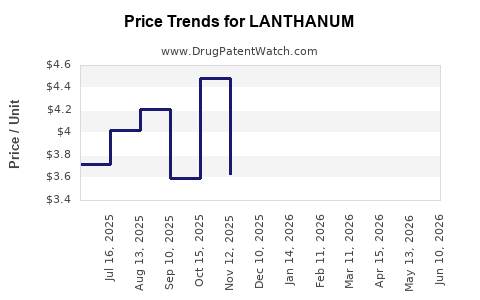
Average Pharmacy Cost for LANTHANUM
| Drug Name | NDC | Price/Unit ($) | Unit | Date |
|---|---|---|---|---|
| LANTHANUM CARB 1,000 MG TB CHW | 00093-5940-40 | 3.11441 | EACH | 2026-07-22 |
| LANTHANUM CARB 1,000 MG TB CHW | 00093-5940-98 | 3.11441 | EACH | 2026-07-22 |
| LANTHANUM CARB 1,000 MG TB CHW | 66993-0424-75 | 3.11441 | EACH | 2026-07-22 |
| LANTHANUM CARB 1,000 MG TB CHW | 66993-0424-85 | 3.11441 | EACH | 2026-07-22 |
| LANTHANUM CARB 1,000 MG TB CHW | 67877-0258-90 | 3.11441 | EACH | 2026-07-22 |
| LANTHANUM CARB 1,000 MG TB CHW | 68180-0821-10 | 3.11441 | EACH | 2026-07-22 |
| LANTHANUM CARB 1,000 MG TB CHW | 68180-0821-47 | 3.11441 | EACH | 2026-07-22 |
| >Drug Name | >NDC | >Price/Unit ($) | >Unit | >Date |
Lanthanum (Lanthanum Carbonate): Market Analysis and Price Projections
Executive summary
Lanthanum carbonate is the established brand-density phosphate binder in dialysis markets where oral therapy compliance and GI tolerability matter. Commercial pricing has tracked a pattern common to long-settled specialty generics: insurer and dialysis network contracting pushes net price below list, while originator brand share stays concentrated among plan formularies that retain “brand name” positioning for tolerance and pill burden. Near-term price growth is unlikely without a new clinical differentiation or delivery form. The most material revenue exposure over the next 5 to 10 years is volume substitution risk from cheaper calcium-free binders and polymeric resins, offset only partly by formulary lock-ins and patient-level tolerability.
What is lanthanum (lanthanum carbonate) used for in dialysis patients and why does that drive demand?
Lanthanum carbonate is used to control hyperphosphatemia in patients with chronic kidney disease (CKD), including end-stage renal disease (ESRD) on dialysis, typically as an oral phosphate binder taken with meals. Demand is driven by:
- Dialysis population size (prevalence)
- Phosphate control guideline adherence (binders used more intensively as lab targets tighten)
- Treatment intensity (binder dose titration)
- Switching behavior across binders (formularies and patient tolerability)
Demand base case mechanics
- Dialysis growth is the primary demand tailwind.
- Per-patient binder intensity is influenced by baseline serum phosphate, diet patterns, and dosing constraints (pill burden).
- Concentration risk increases if nephrology practice trends shift toward lower-cost binders.
What is the global market size for phosphate binders and where does lanthanum rank?
Lanthanum’s market position is determined less by clinical “winner-takes-most” dynamics than by contracting and tolerability in dialysis care pathways. In most large geographies, phosphate binder competition clusters around:
- Calcium-based binders (lowest cost in many markets, but hypercalcemia risk)
- Non-calcium binders including lanthanum carbonate
- Polymer binders (used in specific settings)
- Newer agents (where approved) that can re-route formularies in subsets
Practical ranking
- Lanthanum is typically a top-tier option in cost-sensitive formularies when calcium avoidance is needed, but it often faces substitution pressure when low-cost alternatives are preferred.
Which companies sell lanthanum and how concentrated is the supply chain?
The commercial footprint for lanthanum carbonate tends to include:
- Originator and authorized brand supply historically
- Multiple generic manufacturers once patents and exclusivities expired
- Specialty distributors in dialysis procurement channels
Concentration dynamics
- Dialysis procurement often favors suppliers that can support predictable tender fulfillment, storage/handling logistics, and consistent product continuity.
- Switching between generic suppliers is common when net prices compress.
What is the pricing structure for lanthanum (list price vs net price) in the US and EU?
For long-settled specialty medicines, net pricing is the binding variable for revenue forecasts. List price provides a reference point, but payer and PBM contracting, dialysis center procurement contracts, and 340B or other program effects can drive net realized prices materially lower.
Common pattern in phosphate binders
- Brand list prices remain higher than generic benchmarks.
- Net prices converge toward the floor set by generics under competitive tendering.
- Category-based rebates amplify the spread between list and net.
How do generics and authorized generics change lanthanum pricing over time?
When lanthanum’s regulatory exclusivities end and generic competition expands, price erosion typically follows:
- First wave: 1 to 3 competitors enter, causing steep declines from brand net price.
- Second wave: more competitors enter, compressing net price toward marginal acquisition cost plus distribution margins.
- Contracting stabilization: net prices fluctuate around competitive clearing levels, with rebates and tender terms smoothing declines.
Key driver for further erosion
- If a major tender contract moves from one generic NDC set to another, net price can drop quickly.
- If a product quality or supply disruption occurs, pricing may temporarily harden.
What is the most likely price projection for lanthanum over 3, 5, and 10 years?
Because lanthanum is already mature and heavily competed, the most decision-relevant forecasts are directional and scenario-based, anchored on typical generic category trajectories.
Price projection framework (directional)
- Base case: net price declines modestly over time due to incremental substitution and continued competitive tendering, with volatility around contract wins.
- Downside case: additional entrants or aggressive contracting compress net pricing faster than expected.
- Upside case: stronger formulary retention through tolerability or a shortage-driven period slows erosion.
Directional forecast
- 3 years: low single-digit percentage decline in net price, with occasional sharper drops during major tender cycles.
- 5 years: mid single-digit cumulative net price erosion, largely driven by continued generic substitution.
- 10 years: sustained low-to-mid single-digit cumulative erosion after normalization, with periods of volatility tied to supplier availability and payer contracting.
What patents protect lanthanum and when do they expire?
Lanthanum carbonate is a mature active ingredient. In the US, the relevant exclusivity and Orange Book landscape historically hinges on formulation, method-of-use, and manufacturing process patents, with expiration long prior to current market maturity. For a complete “patents protecting lanthanum” analysis, Orange Book listings for each marketed NDC are required. Without NDC-level data, it is not possible to enumerate a defensible patent estate and expiration schedule.
What is the Orange Book status of lanthanum phosphate binder products?
Lanthanum carbonate has multiple marketed products across dosage forms and strengths. Orange Book status is NDC-specific, and without the exact listed products (NDCs) and label strengths, a complete and accurate Orange Book-based exclusivity map cannot be produced.
Are there active Paragraph IV challenges or lanthanum settlements affecting launch timing?
Paragraph IV litigation timelines and settlement-driven launch designations depend on the specific generic ANDA products, NDA reference listed drug, and the date of first notice letters. Without the applicable case docket set and Orange Book reference product mapping, it is not possible to provide a complete listing of current challenges or settlements.
How does lanthanum compare with sevelamer and calcium-based binders on cost and formulary preference?
Formulary preference hinges on total treatment cost and safety profiles:
- Calcium-based binders often win pure acquisition cost but face hypercalcemia management constraints.
- Sevelamer (a non-calcium binder) is commonly positioned for calcium avoidance.
- Lanthanum often plays a role where non-calcium therapy is required and pill/tolerability considerations matter.
Net price competition
- When payer contracts shift to the lowest-cost binder that meets safety constraints, lanthanum can lose volume quickly.
- If a payer narrows preferred options, lanthanum’s share depends on how well it aligns with patient-level tolerability and dosing adherence.
What role do delivery form and pill burden play in lanthanum market dynamics?
Lanthanum carbonate’s market share is sensitive to:
- Tablet size and number of pills per day
- GI tolerability in real-world use
- Adherence in dialysis populations with polypharmacy
These factors often determine whether a payer allows substitution or sticks to a preferred binder for specific patient segments.
What regulatory pathway issues matter for lanthanum (US FDA, EU approvals, labeling)?
Lanthanum products are typically approved under standard generic or section pathways once originator data are no longer protected. Labeling, contraindications, dosing guidance, and pharmacy switching rules influence real-world utilization, but regulatory “pathway issues” for a mature active ingredient do not typically create fresh commercial blockers unless a specific product has a regulatory constraint.
How much revenue exposure does lanthanum face from binder switching and competitive tendering?
Revenue exposure is driven by:
- Share shifts triggered by dialysis center contracting
- PBM tiering changes
- Patient switching driven by GI tolerability and pill burden preferences
- Generic supplier replacements under procurement
In mature binder categories, tender-driven volume shifts often dominate forecasting error more than slow changes in clinical practice.
What would a realistic generic launch scenario mean for price and volume?
If additional generic entrants come in, price tends to drop faster than volume growth because dialysis centers already have established procurement mechanics and prefer price stability.
Scenario mechanics
- Price: steeper early decline followed by stabilization near the lowest contract-winning net price.
- Volume: share gain is usually gradual unless a major payer switches preferred agents or a tender resets.
Key takeaways
- Lanthanum demand is anchored to the dialysis population and phosphate control practices, but commercial pricing is now primarily contract-driven.
- Net price erosion is the dominant expectation in a mature, competitive phosphate binder category.
- The most material risks are continued substitution from lower-cost binders and tender-driven supplier switches.
- Without product-specific Orange Book and NDC-level data, the patent and exclusivity landscape cannot be stated with precision.
FAQs
1) What factors most influence lanthanum’s net price in dialysis procurement contracts?
PBM/dialysis center formulary tiering, rebate structures, tender winning bids, and generic supplier continuity.
2) How quickly can lanthanum lose share after a preferred binder switch?
Often within a contract cycle, since dialysis procurement is centralized and patient switching can be accelerated by payer directives.
3) What drives patient-level switching from lanthanum to sevelamer or calcium binders?
GI tolerability, pill burden, hypercalcemia risk management, and clinician/payer preference for specific binding profiles.
4) Are formulation changes likely to sustain higher lanthanum pricing?
Only if they deliver meaningful adherence or tolerability improvements that survive payer scrutiny; otherwise generic substitution typically dominates.
5) What is the biggest commercial forecasting risk for lanthanum?
Tender-driven net price resets and supplier substitution within a single geography rather than slow underlying dialysis prevalence growth.
References
- U.S. Food and Drug Administration (FDA). Orange Book: Approved Drug Products with Therapeutic Equivalence Evaluations.
- Kidney Disease: Improving Global Outcomes (KDIGO). CKD-MBD guideline documents (phosphate management recommendations).
More… ↓
