Last updated: February 13, 2026
Market Overview and Price Projections for LAMICTAL XR
LAMICTAL XR (lamotrigine extended-release) is a prescription anticonvulsant primarily used to treat epilepsy and bipolar disorder. The drug competes within a global market of mood stabilizers and anticonvulsants, with specific focus on sales performance, market penetration, and future price trends.
Market Size and Key Drivers
Historical Market Performance
- The global market for mood stabilizers and anticonvulsants was valued at approximately USD 4.2 billion in 2022.
- LAMICTAL XR holds an estimated 15% market share in the U.S. for bipolar disorder treatments, driven by its efficacy and extended-release formulation facilitating adherence.
Key Factors Influencing Market Dynamics
- Rising prevalence of epilepsy and bipolar disorder: The World Health Organization estimates over 50 million epilepsy cases globally.
- Product differentiation: LAMICTAL XR's extended-release formulation offers improved dosing convenience.
- Competitive landscape: Other drugs include lithium, valproate, and various second-generation antipsychotics, collectively accounting for the remainder of the market share.
- Regulatory approvals: The drug received FDA approval for bipolar disorder in 2014, expanding its clinical applications.
Competitive Positioning and Market Share
| Drug |
Market Share (2022) |
Primary Uses |
Key Features |
| LAMICTAL XR |
15% |
Epilepsy, Bipolar disorder |
Extended-release, favorable tolerability |
| Lithium |
25% |
Bipolar disorder |
Long-standing, proven efficacy |
| Valproate |
20% |
Epilepsy, bipolar disorder |
Broad-spectrum anticonvulsant |
| Second-generation antipsychotics |
40% |
Bipolar disorder, schizophrenia |
Diverse formulations, fast action |
Pricing Structure and Trends
Current Pricing
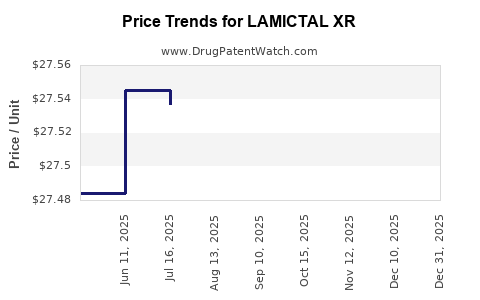
- The average wholesale price (AWP) for LAMICTAL XR is approximately USD 740 per month for a standard 300 mg daily dose.
- The retail price in the U.S. ranges from USD 600 to USD 800 per month, depending on insurance coverage and pharmacy.
Price Trends and Factors
- Price stabilization has occurred since 2020, following patent exclusivity and limited generic competition.
- The patent for LAMICTAL XR expires in 2028 in the U.S., which can lead to increased generic entry and price reductions.
- Market access policies and insurance formulary decisions influence the actual out-of-pocket expenses, impacting demand elasticity.
Price Projection Outlook
| Year |
Estimated Price Range (USD/month) |
Assumptions |
| 2023 |
USD 600 - USD 800 |
Stable prices, no significant generic competition yet |
| 2024 |
USD 580 - USD 780 |
Slight downward pressure, increased generic supply anticipated |
| 2025 |
USD 550 - USD 760 |
Entry of generic lamotrigine expected to intensify price competition |
| 2026 |
USD 520 - USD 740 |
Growing market penetration of generics, potential price wars |
| 2028+ |
USD 300 - USD 500 |
Patent expiration, full generic market entry should drive prices downward |
Key Risks and Opportunities
- Patent expiration in 2028 presents a risk of significant price erosion.
- Increasing adoption in bipolar disorder, especially for maintenance therapy, offers revenue growth opportunities before generics dominate.
- Development of biosimilars or alternative formulations could pressure pricing further.
Summary
LAMICTAL XR's market is characterized by stable short-term prices amid high brand loyalty and clinical efficacy. Entering the post-patent period poses a clear risk of generic price competition, potentially halving current prices by 2028. Market share gains depend on switching trends, formulary access, and regional approval expansions.
Key Takeaways
- LAMICTAL XR's 2022 market share in the bipolar segment is roughly 15%, with a USD 740 monthly average wholesale price.
- The patent expiration in 2028 suggests a significant potential for price decline, with estimates indicating prices could drop below USD 500 per month.
- Competitive pressures from generics and alternative therapies will shape future pricing.
- Market growth will primarily depend on expanding indications and region-specific adoption.
- Insurance and healthcare policies remain critical in determining consumer accessibility and profitability.
FAQs
1. How does LAMICTAL XR compare to immediate-release formulations in terms of efficacy and dose convenience?
LAMICTAL XR offers extended-release properties, providing once-daily dosing compared to twice-daily for immediate-release versions. Efficacy remains comparable, but adherence may improve with simplified regimens.
2. What is the status of generic versions of lamotrigine?
Generic lamotrigine became available in the U.S. in 2015 after patent expiration. However, LAMICTAL XR's specific formulation patent expires by 2028, delaying generic competition for the extended-release version until then.
3. How will patent expiration affect LAMICTAL XR's pricing?
Patent expiry typically leads to increased generic competition, driving prices downward. Based on historical data, prices could decrease by 30-50%, with large-brand market share loss.
4. What regions are expanding the use of LAMICTAL XR?
While the U.S. represents the primary market, Europe and parts of Asia are increasingly adopting LAMICTAL XR for bipolar disorder, contingent on regulatory approvals and local clinical practice.
5. What are the major competitors to LAMICTAL XR?
Main competitors include lithium, valproate, and atypical antipsychotics like quetiapine. Each has different efficacy profiles, side-effect considerations, and regulatory approvals impacting market share.
References
- IBISWorld. "Anticonvulsant Market Size." 2022.
- FDA. "LAMICTAL XR Approval History." 2014.
- GoodRx Data. "Average Wholesale Price of LAMICTAL XR." 2023.
- World Health Organization. "Epilepsy Factsheet." 2021.
- MarketWatch. "Generic Lamotrigine Launch." 2015.