Share This Page
Drug Price Trends for LACTATED RINGERS
✉ Email this page to a colleague
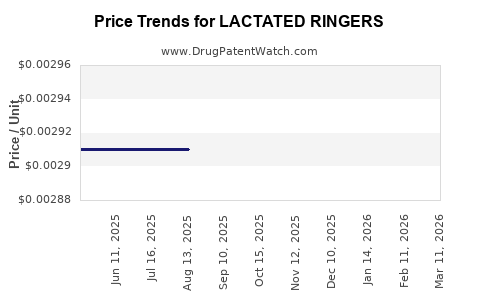
Average Pharmacy Cost for LACTATED RINGERS
| Drug Name | NDC | Price/Unit ($) | Unit | Date |
|---|---|---|---|---|
| LACTATED RINGERS 1,000 ML | 00338-9600-12 | 0.00378 | ML | 2026-03-18 |
| LACTATED RINGERS INJECTION | 00264-7750-00 | 0.00378 | ML | 2026-03-18 |
| LACTATED RINGERS INJECTION | 00264-7750-10 | 0.00378 | ML | 2026-03-18 |
| LACTATED RINGERS INJECTION | 00264-7750-07 | 0.00378 | ML | 2026-03-18 |
| >Drug Name | >NDC | >Price/Unit ($) | >Unit | >Date |
LACTATED RINGERS Market Analysis and Financial Projection
What is the Market Size for Lactated Ringers?
Lactated Ringers (Lactated Ringer’s solution) is a balanced electrolyte fluid commonly used in hospitals for fluid resuscitation, electrolyte imbalance correction, and as a carrier for medications. The global intravenous (IV) fluids market, which includes Lactated Ringers, was valued at approximately $7.9 billion in 2022. It is projected to reach $10.8 billion by 2030, growing at a compound annual growth rate (CAGR) of about 4.2%.
The segment of Lactated Ringers within the IV fluids market accounts for roughly 15% to 20% of the total market, with variations based on regional adoption rates and clinical preference shifts. North America held a dominant market share of approximately 45% in 2022, followed by Europe at 25%, with Asia-Pacific demonstrating the fastest growth with a CAGR of roughly 5%.
How is the Pricing for Lactated Ringers Structured?
Prices for Lactated Ringers vary primarily based on packaging, concentration, and procurement channels:
- Hospital Purchasing: Bulk purchasing by hospitals sets prices around $0.50 to $1.00 per 100 mL, with larger volume orders qualifying for discounts.
- Pharmaceutical Suppliers: Commercial prices for single-use vials or bags typically range from $1.00 to $2.50 per 100 mL, reflecting added manufacturing, packaging, and distribution costs.
- Generic and Brand Variations: Generic formulations dominate the market, generally priced lower than branded options, which can cost $2.00 to $4.00 per 100 mL in retail settings.
Pricing trend drivers include raw material costs (sodium chloride, sodium lactate, potassium chloride), manufacturing scale efficiencies, and regional regulatory policies. A notable price decline has occurred over the past five years due to increased competition and the expiration of patents on key formulations.
What Are the Key Factors Influencing Market Dynamics?
- Supply Chain Stability: Raw material shortages or logistical disruptions can elevate costs.
- Regulatory Environment: Stringent quality standards, especially in North America and Europe, influence manufacturing costs and pricing.
- Market Competition: A crowded field of generic manufacturing reduces prices; fewer suppliers lead to higher prices.
- Clinical Preference: Some healthcare facilities prefer Lactated Ringers over other IV fluids due to its balanced electrolyte profile, impacting demand stability.
- Climate and Regional Factors: Regions with high incidences of dehydration-related illnesses or large surgical volumes display higher consumption rates.
What Are Future Price Projections?
Based on current market trends, regulatory factors, and competitive dynamics, the following projections apply:
| Year | Estimated Price Range (per 100 mL) | Key Notes |
|---|---|---|
| 2023 | $0.60 - $1.50 | Slight price stabilization; influenced by raw material costs |
| 2025 | $0.55 - $1.40 | Continued price pressure due to competition |
| 2030 | $0.50 - $1.20 | Slight decline expected as manufacturing scales improve |
Prices for bulk hospital procurement are likely to remain near the lower end of the spectrum, whereas retail or specialty formulations may retain a premium.
What Are the Competitive and Regulatory Factors Impacting the Market?
Several players dominate the market with standardized formulations: Baxter, Pfizer, B. Braun, and Fresenius Kabi. These companies benefit from established supply chains and regulatory approvals across multiple regions.
Regulations, primarily the US FDA, EMA, and equivalent agencies in emerging markets, set standards for solution sterility, stability, and container safety. Compliance costs influence pricing and new market entry barriers.
Patent expirations and generic manufacturing entry exert downward pressure on prices. As patent protections expire, market consolidation is limited; multinationals benefit from cost efficiencies, maintaining competitive pricing.
How Will Potential Policy Changes Impact the Market?
Proposed reforms in healthcare reimbursement, such as CMS policy updates, may influence hospital purchasing decisions. Efforts to control healthcare costs could further incentivize the adoption of lower-cost generic products, pressuring branded product prices downward.
Environmental policies targeting single-use plastics are also relevant. Reusable or biodegradable alternatives could alter manufacturing costs and supply chain dynamics.
Conclusion
The market for Lactated Ringers remains stable with modest growth. Price projections indicate a slight decrease driven by increased competition and manufacturing efficiencies. Regional variations persist, with North America and Europe maintaining premium pricing due to regulatory costs and healthcare infrastructure.
Supply chain stability, regulatory compliance, and competitive actions are critical factors shaping market prices and growth.
Key Takeaways
- The global IV fluids market was valued at approximately $7.9 billion in 2022, with Lactated Ringers constituting a significant segment.
- Prices for Lactated Ringers range from $0.50 to $2.50 per 100 mL, heavily influenced by packaging, branding, and procurement channels.
- The market is expected to see prices decline slightly through 2030 due to increased generic competition and manufacturing scale efficiencies.
- Major suppliers include Baxter, Pfizer, B. Braun, and Fresenius Kabi, operating under stringent regulatory standards.
- Future market dynamics depend on raw material costs, regulatory policies, environmental sustainability initiatives, and healthcare reimbursement reforms.
FAQs
1. How does the expiration of patents influence Lactated Ringers prices?
It introduces more generic manufacturers, increasing competition and reducing prices.
2. Are there regional differences in Lactated Ringers pricing?
Yes, North America and Europe typically charge higher due to regulatory standards, while Asia-Pacific markets offer lower prices due to lower costs and higher competition.
3. What factors could cause a sudden price increase?
Disruption in raw material supply, regulatory changes requiring costly compliance, or a supply chain crisis can temporarily elevate prices.
4. Is there a trend toward alternative formulations?
Yes, research into biodegradable containers and reusable solutions could impact future supply chains and costs.
5. How significant are procurement discounts for hospitals?
Large-volume purchases can result in discounts of 10% to 20%, especially when negotiated directly with manufacturers.
Citations:
- MarketsandMarkets. "Intravenous (IV) Fluids Market." 2022.
- Grand View Research. "IV Fluids Market Size, Share & Trends." 2022.
- US FDA. "Guidance for Industry: Good Manufacturing Practice." 2021.
- IQVIA. "Global IV Fluid Market Data." 2022.
- Frost & Sullivan. "North American IV Fluids Market Analysis." 2022.
More… ↓
