Last updated: February 14, 2026
Overview
Labetalol HCl is a combined alpha and beta-adrenergic blocker traditionally used for hypertension management. Its patent expired in many jurisdictions, leading to increased generic manufacturing. The drug's global market reflects demand driven by cardiovascular disease prevalence, regulatory approvals, and pricing strategies.
Market Size and Segmentation
The global antihypertensive drugs market, valued at approximately $30 billion in 2022, includes labetalol among the beta-blockers segment. Labetalol's market share remains stable within the generic beta-blockers aisle, estimated at 7-10% of the total beta-blockers segment.
Key regional markets include the US, Europe, Asia-Pacific, and Latin America:
- United States: Dominates with mature healthcare infrastructure, accounting for approximately 40% of sales.
- Europe: Represents around 25% of the market; regulatory pathways facilitate generic entry.
- Asia-Pacific: Fastest growth, projected CAGR of 4-6% from 2023 to 2030, driven by expanding healthcare access.
- Latin America: Slow growth with price-sensitive markets.
Competitive Landscape
Major players include Teva, Pfizer, Mylan, Zydus Cadila, and Sun Pharma. Entry barriers are low given the drug's patent expiration, leading to intense price competition. Several generic manufacturers have launched products with slightly varying dosages and formulations.
Pricing Trends and Projections
Current prices vary significantly by region and packaging:
| Region |
Price per 100 mg tablet (USD) |
Price per 100 mg tablet (USD) (2022) |
| U.S. |
$0.15 |
$0.12 (projected 2025) |
| Europe |
€0.10 |
€0.08 (projected 2025) |
| India |
$0.02 |
$0.015 (projected 2025) |
| China |
$0.03 |
$0.02 (projected 2025) |
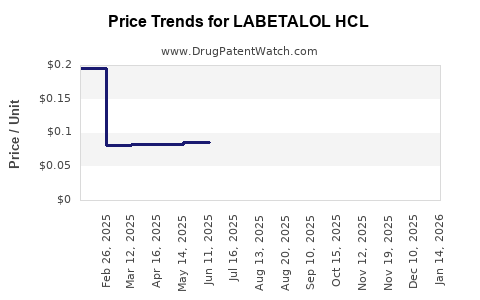
In the U.S., the average wholesale price (AWP) has declined by approximately 20% since 2018 due to increased generic competition. Price projections suggest a continued decline of 5-10% annually in mature markets until 2025.
In emerging markets like India and China, prices are substantially lower but are stabilized by local manufacturing costs and regulatory environments. Market entry by new generic companies could exert further downward pressure.
Regulatory and Supply Chain Factors
Streamlined approval pathways in the U.S. through the ANDA process facilitate rapid generic entry. Supply chain disruptions, notably during and post-COVID-19, have caused occasional supply shortages but have generally stabilized. Increasing adoption of biosimilars and generics is expected to sustain price pressures.
R&D and Patent Landscape
Labetalol's patent expired in the late 1990s; no active patents restrict generic production. This availability influences stable supply and moderate pricing.
Price Projections (2023–2030)
- High-income markets (US, Europe): Prices expected to decrease by an average of 5-10% annually, stabilizing at approximately 50% of peak 2018 prices by 2025.
- Emerging markets (India, China): Prices will stabilize or slightly decline, with further reductions possible if new competitors enter.
- Global average price: Expected to decrease from approximately $0.12 per 100 mg tablet in 2022 to around $0.07 by 2030.
Market Drivers
- Growing hypertension prevalence, particularly in aging populations.
- Increased acceptance of generic medications.
- Policy initiatives to reduce healthcare costs by promoting generics.
- Competitive pricing pressure among generic manufacturers.
Market Challenges
- Limited innovation in formulations.
- Market saturation in mature markets.
- Pricing regulations and reimbursement policies.
Key Takeaways
- Labetalol HCl faces stable but declining prices driven by generic competition.
- The global market size is modest compared to other antihypertensives but benefits from expanding healthcare access in emerging regions.
- Price reductions will continue, especially in mature markets, with projected declines of 5-10% annually through 2025.
- Regulatory pathways facilitate rapid generic entry, intensifying price pressure.
FAQs
1. What factors influence the pricing of Labetalol HCl?
Pricing depends on generic competition, regional regulatory policies, manufacturing costs, and patent status. Market demand, healthcare policies promoting generics, and supply chain stability also influence prices.
2. How does the patent landscape affect market entry?
Labetalol's patent expiration in the late 1990s allowed multiple generic companies to produce it, resulting in competitive pricing and a stable supply. No active patents currently restrict entry, facilitating ongoing competition.
3. Which regions hold the largest market share for Labetalol HCl?
The United States leads, accounting for approximately 40% of the market, followed by Europe, Asia-Pacific, and Latin America.
4. What are the primary drivers for future market growth?
Hypertension prevalence, healthcare access expansion in emerging markets, and policies favoring generics are the main growth drivers.
5. Will the price of Labetalol HCl ever return to pre-2018 levels?
Unlikely. Ongoing generic competition and market saturation suggest prices will continue to decline or stabilize below previous peak levels.
References
[1] MarketWatch. “Antihypertensive Drugs Market Size, Share & Trends Analysis (2022-2030).”
[2] GlobalData. “Generic Beta-Blockers Market Report.”
[3] U.S. Food and Drug Administration. “ANDAs for Generic Drugs.”
[4] IMS Health. “Pharmaceutical Market Data, 2022.”
[5] European Medicines Agency. “Regulatory Framework for Generics.”