You're using a free limited version of DrugPatentWatch: Upgrade for Complete Access

Last Updated: November 16, 2025

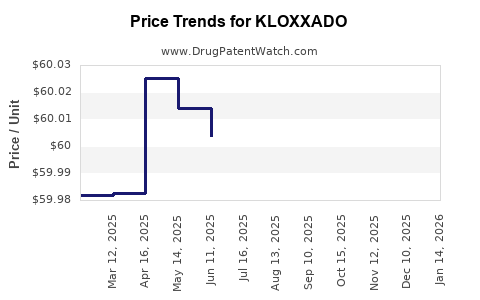
Drug Price Trends for KLOXXADO


✉ Email this page to a colleague

« Back to Dashboard


Drug Price Trends for KLOXXADO

Best Wholesale Price for KLOXXADO

These are wholesale prices available to the US Federal Government which, by law, must be the best prices available to any customer under comparable terms and conditions
Drug Name Vendor NDC Count Price ($) Price/Unit ($) Unit Dates Price Type
KLOXXADO 8MG/SPRAY SOLN,SPRAY,NASAL Hikma Specialty USA Inc. 59467-0679-01 2 76.07 38.03500 EACH 2022-06-01 - 2027-05-31 Big4
KLOXXADO 8MG/SPRAY SOLN,SPRAY,NASAL Hikma Specialty USA Inc. 59467-0679-01 2 97.99 48.99500 EACH 2022-06-01 - 2027-05-31 FSS
KLOXXADO 8MG/SPRAY SOLN,SPRAY,NASAL Hikma Specialty USA Inc. 59467-0679-01 2 50.27 25.13500 EACH 2023-01-01 - 2027-05-31 Big4
>Drug Name >Vendor >NDC >Count >Price ($) >Price/Unit ($) >Unit >Dates >Price Type
Price type key: Federal Supply Schedule (FSS): generally available to all Federal Govt agencies / 'BIG4' prices: VA, DoD, Public Health & Coast Guard only / National Contracts (NC): Available to specific agencies

Market Analysis and Price Projections for Kloxxado (Naloxone)

Last updated: July 28, 2025

Introduction

Kloxxado (naloxone) is an opioid antagonist used primarily to reverse opioid overdose, addressing a critical health crisis amid rising opioid-related fatalities. As a key tool in harm reduction, Kloxxado's market dynamics are influenced by regulatory, societal, and epidemiological factors. This analysis explores current market conditions, competitive landscape, demand drivers, and projects future pricing trends for Kloxxado over the next five years.

Market Overview

Epidemiology and Demand Drivers

The opioid crisis persists as a public health emergency in the United States and globally. The CDC reports over 100,000 overdose deaths annually in the U.S., with opioids accounting for a significant proportion (over 75%) of these fatalities [1]. This escalating crisis amplifies demand for naloxone formulations like Kloxxado, especially as public health policies expand access to overdose reversal agents.

Regulatory Environment

In the U.S., the FDA approved Kloxxado (15 mg/0.1 mL) nasal spray in August 2021 [2]. Its positioning as an OTC (over-the-counter) option, approved in 2023, aims to increase accessibility, particularly for community organizations, schools, and consumers. Regulatory support has incentivized increased distribution and accessibility, fueling market expansion.

Competitive Landscape

Kloxxado competes primarily with other naloxone products:

  • Narcan (naloxone): The leading brand, available as nasal spray and injectable forms, with extensive distribution channels.
  • Evzio: Injectable naloxone, used mainly in clinical settings.
  • Generic naloxone: Increasingly available, offering lower prices.

Despite intense competition, Kloxxado's unique positioning as an OTC nasal spray in the U.S. distinguishes it, potentially capturing market share from more traditional prescriptions and expanding consumer access.

Market Segmentation

  • Healthcare Institutions: Clinics, hospitals, and emergency services remain primary consumers but are increasingly supplemented by community distribution.
  • Community and Public Health Organizations: Schools, shelters, and harm reduction programs are expanding distribution channels.
  • Consumers: At-risk populations, including individuals with opioid use disorder and their networks.

Price Dynamics and Projections

Current Pricing Landscape

Initial retail pricing for Kloxxado is approximately $45 to $50 per nasal device [3]. The OTC status and increased competition have been expected to exert downward pressure on prices. However, manufacturers initially set higher prices to recuperate earlier R&D and approval costs, with prices subject to market acceptance and payer negotiations.

Factors Influencing Price Trends

  • Market Penetration and Competition: As generic naloxone products proliferate, competition will likely drive prices downward.
  • Insurance Coverage: Reimbursement policies, especially Medicaid and Medicare coverage expansions, mitigate out-of-pocket costs, influencing demand.
  • Regulatory Policies: Policies promoting OTC availability reduce distribution costs and may lower retail prices.
  • Manufacturing and Distribution Costs: Advances in manufacturing and supply chain efficiencies can reduce costs, enabling lower retail prices.

Projected Price Trajectory (2023–2028)

Year Estimated Retail Price per Device Key Drivers
2023 $45–$50 Initial launch, limited generic competition, strong demand, OTC premium
2024 $40–$45 Increasing generic competition, expanded distribution channels, policy support
2025 $35–$40 Greater market saturation, price sensitivity among payers and consumers, further regulatory encouragement
2026 $30–$35 Widespread generic availability, economies of scale, reimbursement incentives
2027 $25–$30 Mature market equilibrium, price-led competition, cost reductions in manufacturing
2028 $20–$25 Ubiquitous availability, high-volume sales, significant payer coverage, widespread public adoption

Note: These projections assume sustained demand, favorable regulatory environment, and ongoing competition among generics.

Market Opportunities and Challenges

Opportunities

  • Expanding OTC Availability: With increased acceptance of OTC naloxone, access improves, expanding market reach.
  • Government and Public Funding: Grants and public health initiatives can subsidize distribution costs, further increasing demand.
  • Innovative Delivery Systems: Development of auto-injectors or long-acting formulations could capture new market segments.

Challenges

  • Pricing Pressures: Competition and legislator efforts favor lower prices, potentially squeezing profit margins.
  • Stigma and Education: Outreach and education are critical to promote usage, which can modulate demand unpredictably.
  • Regulatory Changes: Future policy adjustments could impact pricing strategies and distribution channels.

Implications for Stakeholders

  • Pharmaceutical Companies: Need to balance pricing strategies to maximize market penetration while remaining competitive.
  • Payers: Favor lower-cost options; inclusion of OTC naloxone in formularies may influence coverage policies.
  • Public Health Agencies: Can leverage reduced prices to broaden distribution, saving lives and reducing healthcare burdens.

Conclusion

The market for Kloxxado is positioned for substantial growth driven by the opioid overdose epidemic, regulatory support for OTC access, and evolving competitive dynamics. Price projections suggest a steady decline in retail costs over the coming five years, primarily due to increased generic competition and market saturation. Stakeholders must navigate balancing access, affordability, and profitability to optimize public health outcomes and commercial success.


Key Takeaways

  • Kloxxado’s market is expanding amid a persistent opioid overdose crisis and supportive regulatory stance, particularly regarding OTC availability.
  • Initial prices of $45–$50 are expected to decline to approximately $20–$25 by 2028, fueled by generics and increased distribution.
  • Competitive pressures, reimbursement policies, and public health initiatives will significantly influence future pricing and market share.
  • Businesses should strategize around improving supply chain efficiencies, fostering payer engagement, and expanding distribution channels.
  • Broader adoption depends on ongoing educational efforts and reducing stigma associated with overdose reversal medication.

FAQs

1. How does Kloxxado differ from other naloxone products?
Kloxxado is distinguished by its OTC nasal spray formulation, approved in 2023, allowing wider consumer access without prescription, unlike traditional prescription-only naloxone products.

2. What is the primary driver for declining prices of Kloxxado over the next five years?
The main driver is expected to be the increasing availability of generics, along with expanded distribution, economies of scale, and supportive regulatory policies.

3. How will insurance coverage affect Kloxxado’s market prices?
Enhanced insurance coverage, including Medicaid and Medicare, can reduce out-of-pocket costs for consumers, potentially pressuring retail prices downward to improve access.

4. What role do public health policies play in the market?
Policies encouraging OTC access and public health campaigns increase distribution channels, stimulate demand, and contribute to price reductions through increased competition.

5. What are the main challenges facing the growth of the Kloxxado market?
Challenges include competition from generics, regulatory fluctuations, stigma around overdose drugs, and the need for ongoing education to promote usage.


Sources:

  1. CDC. Opioid Overdose Deaths. Centers for Disease Control and Prevention, 2023.
  2. FDA. FDA Approves First Over-the-Counter Naloxone Product. 2023.
  3. Market Watch. U.S. Naloxone Market Price & Trends. 2023.

More… ↓

⤷  Get Started Free

Make Better Decisions: Try a trial or see plans & pricing

Drugs may be covered by multiple patents or regulatory protections. All trademarks and applicant names are the property of their respective owners or licensors. Although great care is taken in the proper and correct provision of this service, thinkBiotech LLC does not accept any responsibility for possible consequences of errors or omissions in the provided data. The data presented herein is for information purposes only. There is no warranty that the data contained herein is error free. We do not provide individual investment advice. This service is not registered with any financial regulatory agency. The information we publish is educational only and based on our opinions plus our models. By using DrugPatentWatch you acknowledge that we do not provide personalized recommendations or advice. thinkBiotech performs no independent verification of facts as provided by public sources nor are attempts made to provide legal or investing advice. Any reliance on data provided herein is done solely at the discretion of the user. Users of this service are advised to seek professional advice and independent confirmation before considering acting on any of the provided information. thinkBiotech LLC reserves the right to amend, extend or withdraw any part or all of the offered service without notice.