Share This Page
Drug Price Trends for KLOR-CON M20 TABLET
✉ Email this page to a colleague
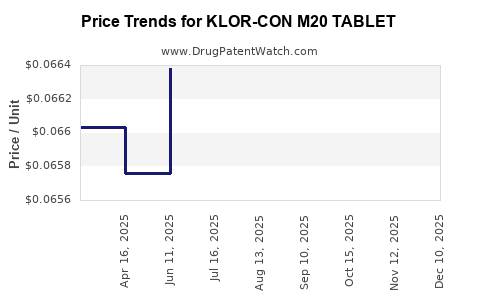
Average Pharmacy Cost for KLOR-CON M20 TABLET
| Drug Name | NDC | Price/Unit ($) | Unit | Date |
|---|---|---|---|---|
| KLOR-CON M20 TABLET | 00245-5319-01 | 0.14819 | EACH | 2026-07-22 |
| KLOR-CON M20 TABLET | 00245-5319-10 | 0.14819 | EACH | 2026-07-22 |
| KLOR-CON M20 TABLET | 00245-5319-11 | 0.14819 | EACH | 2026-07-22 |
| KLOR-CON M20 TABLET | 00245-5319-15 | 0.14819 | EACH | 2026-07-22 |
| >Drug Name | >NDC | >Price/Unit ($) | >Unit | >Date |
Market Analysis and Price Projections for KLOR-CON M20 TABLET
What is KLOR-CON M20 TABLET?
KLOR-CON M20 TABLET is a potassium chloride supplement used to prevent or treat low potassium levels in patients with certain medical conditions. Each tablet contains 20 mEq of potassium chloride. It is prescribed for hypokalemia caused by diuretics, corticosteroids, or other medications, as well as malnutrition or certain medical illnesses.
Market Overview
Therapeutic Class and Indication
- Therapeutic class: Electrolyte supplement
- Indications: Prevention and treatment of hypokalemia
- Market drivers:
- Rising prevalence of hypokalemia in hospitalized patients
- Increasing use of diuretics and corticosteroids
- Aging population with chronic conditions requiring electrolyte management
Market Size and Growth
The global electrolyte supplement market was valued at approximately USD 2.4 billion in 2022. It is expected to grow at a compound annual growth rate (CAGR) of 4.2% from 2023 to 2028, driven by increases in chronic diseases, hospitalizations, and outpatient treatments.
Competitive Landscape
- Major competitors include K-lyte (potassium chloride), Kay-Cee-L, and generic formulations.
- Key differentiator: Dose strength and delivery form (tablets, powders, liquids).
- Price variability depends on brand, formulation, and geographical region.
Pricing Dynamics
Current Pricing Analysis
- United States:
- Brand-name KLOR-CON M20: Approximately USD 15–USD 20 per bottle of 100 tablets.
- Generic potassium chloride tablets: USD 8–USD 12 per 100 tablets.
- Europe:
- Prices generally range from EUR 10–EUR 15 per 100 tablets.
- Emerging markets:
- Significantly lower prices, often USD 2–USD 5 per 100 tablets, influenced by generic availability and healthcare system differences.
Cost Factors
- Manufacturing costs for salts and excipients
- Regulatory approval and market access barriers
- Distribution and pharmacy markup
- Patent status: Many formulations are off-patent, leading to price competition
Price Projection Trends (2023-2028)
| Year | Estimated Price Range per 100 Tablets (USD) | Key Factors Influencing Price |
|---|---|---|
| 2023 | USD 8–USD 20 | Market saturation, generic competition, supply chain stability |
| 2024 | USD 7–USD 19 | Increased generic penetration, price erosion |
| 2025 | USD 6–USD 18 | Price stabilization, rising healthcare costs |
| 2026 | USD 6–USD 17 | New formulations or delivery systems as niche premium products |
| 2027 | USD 5–USD 16 | Further generic competition, potential for price decline |
Influential Factors
- Market penetration of generics: Widespread availability tends to lower prices.
- Regulatory changes: Price controls in some regions may limit increases.
- Manufacturing advancements: Cost reductions, especially in emerging markets.
- Reimbursement policies: Insurance coverage influences out-of-pocket costs for patients.
Implications for Investment
- High-growth potential in emerging markets due to increasing chronic illness prevalence.
- Price erosion possible in mature markets owing to generic competition.
- Premium segment prospects: Specialized formulations or combination therapies could command higher prices.
Regulatory and Patent Landscape
- Patent expiration: Most formulations lost patent protection over the last decade, enabling generics to dominate.
- Regulatory barriers: Approval processes vary by region but generally facilitate faster entry for generics.
- Market exclusivity: Limited, with some exceptions for new delivery methods or formulations.
Key Takeaways
- KLOR-CON M20 TABLET belongs to a mature segment with high generic penetration.
- Market size is driven primarily by hypokalemia prevalence and healthcare infrastructure.
- Price points are declining due to competition, especially in developed markets.
- Projections suggest stabilized prices with potential for limited upward adjustments in niche markets.
- Emerging markets present significant growth opportunities with lower price points and expanding healthcare access.
FAQs
Q1: What factors influence the price of KLOR-CON M20 TABLET?
Market competition, patent status, manufacturing costs, regional regulations, and insurance reimbursement policies.
Q2: How does generic competition impact prices?
It drives prices down through increased availability and market saturation.
Q3: Are there any patent protections remaining for KLOR-CON M20?
Most formulations are off-patent; patent protections have largely expired, enabling generics.
Q4: What is the forecasted growth rate for this market?
The electrolyte supplement market has a CAGR of approximately 4.2% between 2023 and 2028.
Q5: Which regions are most promising for growth?
Emerging markets and countries with increasing healthcare access and chronic disease burden.
References
[1] MarketWatch. (2023). Electrolyte supplement market size and forecast. Retrieved from https://www.marketwatch.com
[2] GlobalData. (2022). Therapeutic electrolytes report. Retrieved from https://www.globaldata.com
[3] IMS Health. (2022). Prescription market analysis for electrolyte formulations. Retrieved from https://www.imshealth.com
[4] European Medicines Agency. (2022). Regulatory guidelines for generic electrolyte products. Retrieved from https://www.ema.europa.eu
[5] U.S. Food and Drug Administration. (2022). Patent and exclusivity data for electrolyte-related drugs. Retrieved from https://www.fda.gov
More… ↓
