Share This Page
Drug Price Trends for KLONOPIN
✉ Email this page to a colleague
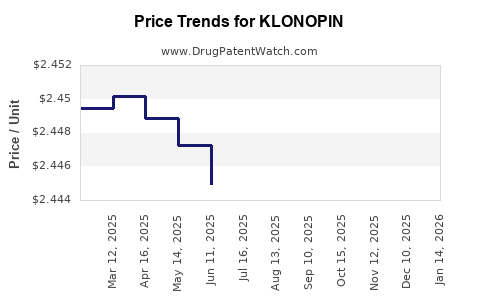
Average Pharmacy Cost for KLONOPIN
| Drug Name | NDC | Price/Unit ($) | Unit | Date |
|---|---|---|---|---|
| KLONOPIN 0.5 MG TABLET | 61269-0605-10 | 2.67965 | EACH | 2026-04-01 |
| KLONOPIN 1 MG TABLET | 61269-0610-10 | 3.06372 | EACH | 2026-04-01 |
| KLONOPIN 2 MG TABLET | 61269-0620-10 | 4.26033 | EACH | 2026-04-01 |
| >Drug Name | >NDC | >Price/Unit ($) | >Unit | >Date |
Market analysis and price projections for Klonopin
Market Overview
Klonopin, generic name clonazepam, is a benzodiazepine widely prescribed for epilepsy, panic disorder, and anxiety. It has been on the market since the 1970s and remains a significant drug within the CNS therapeutics space. The drug's patent expired in 2015, leading to increased generic availability, which has driven down prices but also expanded access.
Market Size and Growth
The global market for benzodiazepines, including clonazepam, was valued at approximately $4.8 billion in 2022, with clonazepam holding a substantial share due to its broad indications and long-established prescribing habits. The compound's popularity is unaffected by newer alternatives, maintaining steady demand driven primarily by prescriptions in North America, Europe, and parts of Asia.
Key market drivers:
- Increasing prevalence of anxiety and seizure disorders.
- Aging populations with higher incidence rates.
- Expanded approval for off-label uses in some regions.
- Ongoing shortages and supply chain disruptions affecting availability.
Market challenges:
- Regulatory scrutiny due to abuse potential.
- The shift toward non-benzodiazepine alternatives.
- Regulatory and legal constraints on prescribing.
Competitive Landscape
Clonazepam faces competition from several branded and generic benzodiazepines, including diazepam, lorazepam, and alprazolam. The market's profitability hinges on regulatory environments, prescriber preferences, and pricing strategies post-patent expiration.
Major players include:
- Mylan (now part of Viatris)
- Teva Pharmaceuticals
- Sandoz
- Sun Pharmaceuticals
Regulatory and Reimbursement Environment
The U.S. FDA approves generic clonazepam with bioequivalence to the branded drug. Reimbursement policies influence prescribing practices, with payers favoring lower-cost generics. In the U.S., Medicare and Medicaid cover clonazepam with variable co-payment structures.
Europe's EMA enforces strict controls on benzodiazepines, affecting prescribing frequency and availability. In many Asian countries, prescribing habits are more permissive, expanding market potential.
Price Projections
Historical Price Trends
- Branded Klonopin (fine original formulation): Originally priced at approximately $800–$1,200 per month in the U.S. (2010).
- Generic clonazepam: Prices declined sharply post-patent expiry; average monthly costs range from $15–$45 depending on dosage and pharmacy.
Future Price Outlook
Forecasting considers market saturation, regulatory influences, and product availability. The primary expectations are:
- Stability: Given generic competition, prices are unlikely to rise significantly.
- Potential decline: Manufacturers may pursue price erosion to gain market share.
- Premium formulations: Rare, but abuse-deterrent or extended-release versions could command higher prices, approximately $50–$80 per month.
Projected average wholesale and retail prices in 2025:
| Year | Average Wholesale Price (AWP) per unit | Estimated Retail Price | Notes |
|---|---|---|---|
| 2023 | $0.10–$0.15 | $0.20–$0.30 | Standard oral tablets |
| 2024 | $0.09–$0.14 | $0.18–$0.28 | Slight downward trend due to competition |
| 2025 | $0.08–$0.12 | $0.16–$0.24 | Market saturation, price stabilization |
Price Sensitivity
In managed care settings, payers exert pressure for lower prices, leading to generic discounts. Prescriber shifts towards newer anxiolytics and anticonvulsants could limit growth and price stability. Price remains highly sensitive to regulatory changes, particularly restrictions on benzodiazepine prescribing.
Strategic Opportunities
- Development of abuse-deterrent formulations.
- Expanded manufacturing capacity to meet rising demand.
- Negotiating formulary inclusion to establish preferred status.
Key Takeaways
- The global benzodiazepine market, including clonazepam, remains sizable, driven by high prevalence rates of related disorders.
- Patent expiry has resulted in significant price declines, with current retail prices in the U.S. averaging $0.20–$0.30 per tablet.
- Price projections suggest stability or slight decrease through 2025, barring regulatory or technological shifts.
- Competitive pressures and regulatory environment significantly influence pricing dynamics.
- Market growth is limited but steady, with opportunities in niche formulations and supply chain optimization.
FAQs
1. How does patent expiry affect clonazepam prices?
Patent expiry in 2015 led to proliferation of generics, reducing prices sharply. Without patent protection, manufacturers compete primarily on price, keeping costs low.
2. What factors could drive clonazepam prices up?
Regulatory restrictions limiting prescribing, shortages, or unique formulations such as abuse-deterrent variants could elevate prices temporarily.
3. Are there regional variations in clonazepam pricing?
Yes. Prices are generally lower in markets with high generic competition (e.g., India, China) and higher in regulated markets with limited generic penetration (e.g., Japan, some European countries).
4. What are the primary therapeutic rivals to clonazepam?
Non-benzodiazepine anxiolytics like buspirone, SSRIs, and newer anticonvulsants for epilepsy such as levetiracetam.
5. Will new formulations impact the clonazepam market?
Yes. Abuse-deterrent formulations and extended-release versions could command premium prices but face regulatory hurdles and demand uncertainties.
Sources
[1] MarketWatch, "Global Benzodiazepines Market," 2022.
[2] IQVIA, "Prescription Drug Market Data," 2022.
[3] FDA Official Website, "Generic Drugs," 2023.
[4] NICE Guidelines, "Management of Anxiety and Seizure Disorders," 2021.
More… ↓
