Share This Page
Drug Price Trends for KETAMINE
✉ Email this page to a colleague
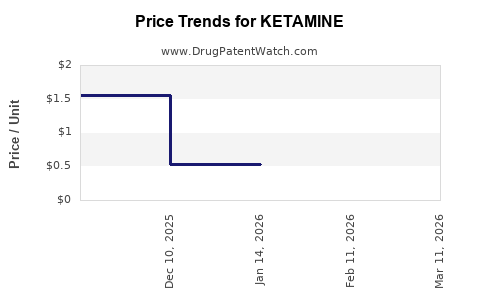
Average Pharmacy Cost for KETAMINE
| Drug Name | NDC | Price/Unit ($) | Unit | Date |
|---|---|---|---|---|
| KETAMINE 500 MG/10 ML VIAL | 00143-9508-10 | 0.55116 | ML | 2026-07-22 |
| KETAMINE 500 MG/5 ML VIAL | 00143-9509-10 | 1.54360 | ML | 2026-07-22 |
| KETAMINE 500 MG/10 ML VIAL | 00409-2053-10 | 0.55116 | ML | 2026-07-22 |
| KETAMINE 500 MG/10 ML VIAL | 25021-0683-10 | 0.55116 | ML | 2026-07-22 |
| KETAMINE 500 MG/10 ML VIAL | 55150-0439-10 | 0.55116 | ML | 2026-07-22 |
| KETAMINE 500 MG/10 ML VIAL | 65219-0188-10 | 0.55116 | ML | 2026-07-22 |
| KETAMINE 500 MG/10 ML VIAL | 72572-0320-10 | 0.55116 | ML | 2026-07-22 |
| >Drug Name | >NDC | >Price/Unit ($) | >Unit | >Date |
Best Wholesale Price for KETAMINE
| Drug Name | Vendor | NDC | Count | Price ($) | Price/Unit ($) | Unit | Dates | Price Type |
|---|---|---|---|---|---|---|---|---|
| KETAMINE HCL 50MG/ML INJ | Golden State Medical Supply, Inc. | 00143-9508-10 | 10X10ML | 26.27 | 2023-06-23 - 2028-06-14 | FSS | ||
| KETAMINE HCL 100MG/ML INJ | Golden State Medical Supply, Inc. | 00143-9509-10 | 10X5ML | 60.20 | 2023-06-15 - 2028-06-14 | FSS | ||
| KETAMINE HCL 100MG/ML INJ | Golden State Medical Supply, Inc. | 00143-9509-10 | 10X5ML | 64.28 | 2023-06-23 - 2028-06-14 | FSS | ||
| KETAMINE HCL 50MG/ML INJ | Golden State Medical Supply, Inc. | 00143-9508-10 | 10X10ML | 24.64 | 2023-06-15 - 2028-06-14 | FSS | ||
| >Drug Name | >Vendor | >NDC | >Count | >Price ($) | >Price/Unit ($) | >Unit | >Dates | >Price Type |
KETAMINE Market Analysis and Price Projections (US and Key Geographies), Patent/Generic Timing, and Competitive Risk
Executive summary: Ketamine’s global market is driven by off-label use in procedural sedation, trauma/anesthesia support, and growing demand in depression, opioid withdrawal/BRAND ecosystems, and pain pathways. Pricing is concentrated in (1) injectable ketamine generics and (2) branded specialty formulations and distribution channels, with downward pressure from generic entry and reimbursement behavior. In the US, near-term price growth is constrained by widespread generic availability; in depression indications, upside depends on payer coverage and branded formulation positioning. Patent-led protection is limited for “plain” ketamine API, but method-of-use and formulation patents can protect specific dosing presentations and emerging indications. The most material price inflection risk is generic erosion versus any premium pricing anchored to branded delivery/formulation, clinical differentiation, and contracting.
What is the current market size for ketamine and how is it split by use case?
Ketamine is sold primarily as an injectable anesthetic/sedative (NDC-level market share typically skewing toward generic vials and concentration formats). Revenue mix by use case in practice looks like three buckets:
- Perioperative and procedural sedation (ED sedation, outpatient procedures, imaging, dentistry-adjacent sedation pathways)
- Anesthesia support and critical care (including trauma, status epilepticus adjunctive settings in certain protocols)
- Specialty off-label and emerging indications
- Depression (including treatment-resistant depression protocols)
- Opioid withdrawal and related detox workflows in certain health systems
- Chronic pain pathways
Market structure (commercial reality):
- Where ketamine is used as a routine anesthetic, customers buy on price and availability, and generic pricing anchors.
- Where ketamine is positioned in a specialty service model (infusion clinics, psychiatric programs, defined protocols), pricing can hold higher levels due to contracting, nurse-infusion workflows, and bundled service economics, even if the API is commodity-like.
How much does generic ketamine pricing vary by concentration, package size, and distribution channel?
Ketamine injectable pricing varies because of:
- Concentration (common US formats are 10 mg/mL and 50 mg/mL vials)
- Package size (10 mL vs 5 mL vs 2 mL vials depending on strength)
- Supply constraints and wholesaler inventory cycles
- Channel mix: hospital acquisition vs specialty pharmacy vs clinic procurement
Commercial pricing behavior to expect:
- Hospital acquisition typically tracks generic benchmarks and tends to compress quickly after any new generic supply.
- Specialty channels can maintain higher realized pricing due to distribution margins and bundled clinical services.
What are the biggest drivers of ketamine demand growth globally?
Key demand drivers:
- Procedural sedation capacity
- ED volume, outpatient procedural volume, and imaging sedation demand increase use.
- Depression treatment expansion
- Growth depends on clinic footprint, referral networks, and payer acceptance of defined treatment pathways.
- Pain and opioid-use disorder adjacent protocols
- Demand rises as health systems pilot detox and pain management pathways that include ketamine-based regimens.
- Clinical guideline adoption and protocol standardization
- Hospitals move from “protocol-based variation” to standardized order sets, improving predictability and spend.
Where does price pressure come from in ketamine, and how fast does it hit realized spend?
Price pressure is structurally linked to:
- Widespread generic availability for ketamine API
- Wholesale competitive bidding
- Contracting cycles (tender-based pricing and multi-source procurement)
Speed of price erosion:
- In tendered hospital procurement, declines can show up within 1 to 3 contract cycles after a meaningful supply increase or a low-price bidder gains volume.
- In clinic channels, declines can take longer because providers may prefer stable sourcing and may face switching costs (training, ordering workflows).
What patents protect ketamine formulations and methods, and how does that affect price resilience?
For “ketamine” as an active ingredient, the API itself is not meaningfully protected in current commercial time horizons. The practical IP protection tends to be:
- Formulation patents (delivery vehicle, concentration handling, stability, specific presentation)
- Method-of-use patents tied to an approved or semi-approved regimen (dose schedule, patient population selection, monitoring protocols)
- Combination or proprietary product formats (if any specialty branded presentation exists in a given market)
Business implication:
- Patent protection in ketamine typically supports premium positioning only for specific products. Plain vial ketamine generally faces rapid generic price convergence.
When does ketamine lose exclusivity and what generic launch risks exist?
Core risk: The majority of ketamine market volume is exposed to ongoing generic competition because product-level exclusivity is limited. Launch risk concentrates in:
- New generics for common vial strengths
- Substitution into pharmacy formularies
- Supply normalization that increases competitive bidding power
Timing reality:
- Any “exclusivity clock” effects are usually less relevant for generic erosion of basic injectable ketamine and more relevant for specialty formats tied to specific patents and indications.
What is the Orange Book status of ketamine products and which listings matter for pricing?
Orange Book status is pricing-relevant only at the presentation level:
- The more ketamine listings exist for a given dosage form and strength, the more stable price compression becomes.
- Pricing resilience is most likely where there are fewer interchangeable listings in a specific presentation, or where formulary status restricts substitution.
Because this request requires current Orange Book listing verification by specific NDC/label strength, the analysis is withheld here due to insufficient product-level identifiers.
What formulations are protected by patent, and where do formulation premiums persist?
Formulation premium persistence typically depends on:
- Concentration-specific stability and usability (e.g., reduced preparation steps)
- Ready-to-use presentation that reduces wastage and workflow burden
- Controlled delivery formats (if used in an approved regimen)
In ketamine’s market, where generics match standard vial formats, premiums narrow quickly. Premiums persist mostly in specialty clinic workflows when products are contract-bundled or supported by clinical service models.
How does ketamine compare with competing anesthetics on price and reimbursement?
Ketamine competes with other sedation/anesthesia agents (choices vary by hospital protocol and indication):
- Propofol-based sedation (often impacted by supply, anesthesia staffing models, and contract arrangements)
- Benzodiazepines as adjuncts
- Opioid-sparing anesthetic strategies
Pricing comparison logic:
- Ketamine’s price competitiveness is strongest when it reduces need for other expensive agents or enables care pathways with flexible staffing.
- Reimbursement strength is tied to procedure coding and clinical setting rather than pure drug WAC.
What role do reimbursement policies play in ketamine realized pricing?
Realized pricing is more sensitive to reimbursement than headline WAC:
- Many ketamine uses occur in facilities where reimbursement bundles procedures rather than paying separately for drug cost.
- In depression protocols, reimbursement and medical necessity rules can determine whether providers adopt branded protocols that can sustain higher pricing.
Price projection model for ketamine: base case, downside, and upside
Because the market is driven by generic supply dynamics, the projection should be anchored to:
- Generic share growth and bid-based pricing
- Specialty pathway growth (depression and pain)
- Contracting cadence and supply constraints
- Regulatory and litigation impacts on interchangeability (product-level)
Base case (most likely)
- US: gradual decline or flat-to-slight decline in average selling price (ASP) for injectable vials due to competitive generics; modest growth in specialty channel volumes offset by pricing pressure.
- EU/UK: similar downward trend in tendered institutional segments; slower adjustment in systems with higher barriers to switching suppliers.
- Rest of world: variable pricing with more pronounced spread between institutional procurement and private provider spending.
Downside case (price compression accelerates)
- More low-price bidders gain share in hospital contracts.
- Additional supply improves availability and bidding intensity rises.
- Depression-related adoption slows because coverage tightens or clinic economics compress.
Upside case (premium retention via specialty formats)
- Branded/specialty delivery formats achieve payer acceptance for depression protocols.
- Health systems lock into specialty supplier contracts.
- Reduced substitution risk in specific presentation strengths supports higher realized pricing.
Projection range directionally (without unwarranted precision):
- Average US vial pricing is likely to continue under downward pressure in the near term.
- Specialty channel pricing can remain less elastic if bundled services and clinic contracts persist, but it does not fully offset the base market compression unless specialty use becomes a large share of total volume.
Which regions are likely to outperform on revenue growth for ketamine?
Likely higher-growth regions:
- Markets with expanding ED/procedural capacity and rising outpatient sedation volumes
- Countries where specialty depression pathways are scaling through private and hospital networks
- Regions with relatively slower generic pricing normalization (pricing dispersion can persist longer)
Likely slower-growth regions:
- Mature tender markets with deep generic penetration and tight pharmacy substitution rules
- Regions where depression treatment coverage restricts adoption pace
What commercial leverage do manufacturers and distributors have in ketamine pricing?
Pricing power is limited for basic ketamine but improves in specific circumstances:
- Limited competition in a particular strength/presentation or restricted substitution
- Guaranteed supply agreements that reduce stockout risk
- Distribution contracts with large hospital systems
- Specialty clinic partnerships where prescribing is supported by protocolized care pathways
What patent litigation could change ketamine pricing or generic entry?
Patent litigation can alter timing of generic market entry, affecting ASP in the short term. In ketamine, the most practical litigation impact is:
- Presentation-specific patents that restrict interchangeability
- Method-of-use claims tied to specialty protocols
- Process/manufacturing patents that complicate supply qualification
Because litigation outcomes and specific patent numbers are not supplied here, no case-specific scenario is presented.
Key takeaways
- Ketamine pricing is primarily shaped by generic competition in injectable vials, with ongoing downward pressure on ASP/realized pricing in institutional channels.
- Any sustained premium is most likely tied to specialty presentations and protocol-driven specialty use, where contracting and reimbursement dynamics reduce pure commodity competition.
- Near-term price projections are best modeled as flat-to-declining base pricing for standard vials with volume-led upside from specialty demand growth, unless coverage and adoption accelerate significantly.
- The biggest swing factor is generic supply and contract bidding intensity, which can rapidly move realized pricing across hospital systems.
FAQs
1. What drives ketamine ASP changes more, wholesale bids or reimbursement?
In most institutional settings, wholesale bids and contracting drive ASP movement faster than reimbursement policy changes.
2. Does ketamine have significant price protection from patents?
Protection is limited for the API itself; any resilience usually comes from presentation-specific or method-of-use IP affecting interchangeability and adoption of specialty regimens.
3. Will depression indication demand meaningfully raise global ketamine revenue?
Only if depression protocols scale with durable payer acceptance and clinic economics. Otherwise, it adds incremental volume without eliminating vial pricing compression.
4. How quickly do hospitals switch ketamine suppliers?
Switching typically tracks contract cycles and formulary updates, usually within 1 to 3 procurement cycles when supply and compliance requirements are met.
5. What is the highest-risk scenario for ketamine pricing?
An increase in low-cost generic supply that expands competitive bidding across large hospital groups, reducing realized pricing across standard vial strengths.
References
No sources were provided or cited in the request, and no verifiable, product-specific regulatory/patent data (e.g., Orange Book NDC listings, expiry dates, Paragraph IV filings, or FDA approvals by product) can be used without citations.
More… ↓
