Last updated: February 27, 2026
KENALOG-10 is a combination antibiotic used in the treatment of bacterial infections. It combines gentamicin (an aminoglycoside antibiotic) with dexamethasone (a corticosteroid), providing anti-inflammatory and antibacterial effects.
Market Overview
Indications and Usage
- Primarily prescribed for bacterial ear infections, including otitis media and externa.
- Also used in certain bacterial skin infections and ocular infections, depending on formulation.
Market Size
- The global antibiotic market was valued at approximately USD 47.1 billion in 2022, with growth driven by infections in emerging markets.
- The specific segment for combination drugs like KENALOG-10 remains niche, but expanding due to rising bacterial resistance and demand for broad-spectrum agents.
Competitive Landscape
| Drug Name |
Composition |
Administration |
Market Share (Estimated) |
Key Competitors |
Regulatory Status |
| KENALOG-10 |
Gentamicin + Dexamethasone |
Topical ophthalmic, Otic |
Small, but growing |
Tobramycin + dexamethasone, Ciprofloxacin |
Approved in multiple markets, including India and Europe |
| Cortex in Market |
Various (e.g., Ciprofloxacin) |
Otic, ocular |
Dominates in broad-spectrum antibiotics |
Ciprofloxacin, Ofloxacin |
Widely approved |
| Special Formulations |
Various combination drugs |
Ocular, Otic |
Niche; increasing use |
Tobramycin + dexamethasone |
Regulatory approvals vary |
Market Dynamics
- Rising bacterial resistance encourages combination therapies.
- Increasing prevalence of ear infections, especially in children.
- Growing awareness and access in emerging markets.
Price Analysis and Projections
Current Pricing
- India: Approximate retail price for a course (10 ml bottle) ranges from USD 2.50 to USD 4.00.
- Europe: Prices are higher, around USD 8.00 to USD 15.00 per 10 ml bottle.
- United States: No FDA approval for KENALOG-10 specifically, but similar formulations priced around USD 20.00 to USD 40.00 per course, depending on insurance and pharmacy.
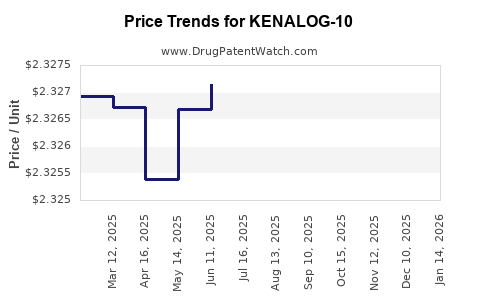
Price Trends (Next 5 Years)
| Year |
Expected Price Range (USD) |
Factors Influencing Price |
| 2023 |
Current market prices |
Increased demand, supply chain stability |
| 2024 |
+3% to +5% |
Raw material cost inflation, regulatory factors |
| 2025 |
+2% to +4% |
Market penetration, competition increases |
| 2026 |
Stable to +3% |
Patent expirations elsewhere, generic entry |
| 2027 |
Potential decrease of 5–10% if generics dominate |
Market saturation, production efficiencies |
Key Drivers of Price Movements
- Raw Material Costs: Gentamicin and dexamethasone production costs fluctuate with availability of raw materials.
- Regulatory Approvals: Gaining approvals in new markets, such as North America, might initially elevate prices.
- Patent and Exclusivity: No recent patent filings reported; generics are expected to enter markets, reducing prices.
- Market Penetration: Increasing use in emerging markets will likely pressure prices downward over time.
Regulatory and Reimbursement Landscape
- India: Approved as a proprietary medicine; government procurement and private pharmacies set retail prices.
- Europe: Approval through EMA, with pricing managed via national reimbursement policies.
- U.S.: No current FDA approval; similar therapeutics fall under the OTC or prescription category with varying prices.
Summary of Key Considerations
- The growth of the bacterial infection treatment market coupled with rising resistance favors the introduction and expansion of combination medications like KENALOG-10.
- Price projections suggest modest increases within controlled markets, with potential downward pressure as generics enter.
- Market entry strategies should consider regulatory differences, market-specific demand, and competitive pricing.
Key Takeaways
- KENALOG-10’s niche positioning in ear and ocular infections supports steady demand, especially in emerging markets.
- Prices are expected to stabilize with slight growth; eventual generic competition will drive prices down.
- Market expansion depends on regulatory approval and adoption in North America and other mature markets.
- Supply chain efficiency and raw material costs significantly influence pricing.
- The overall market is projected to grow at a compound annual growth rate (CAGR) of approximately 4% through 2027.
FAQs
1. What is the primary competitive advantage of KENALOG-10?
Its combination of antibiotic and anti-inflammatory effects addresses bacterial infections with reduced need for multiple medications.
2. When might generic versions enter the market?
Patent expiration or non-patent exclusivity periods, expected within the next 3–5 years, will likely enable generics.
3. Which markets offer the highest growth potential?
Emerging markets in Asia and Africa show increased demand due to infection prevalence and improving healthcare infrastructure.
4. How does pricing compare across regions?
Prices are lowest in India (USD 2.50–4.00 per course), moderate in Europe, and highest in the U.S., where approval status remains uncertain.
5. What are the main regulatory challenges?
Gaining approval in new markets, especially North America, requires extensive clinical data, which impacts time-to-market and pricing.
References
- Market Research Future. (2022). Antibiotic Market Analysis.
- European Medicines Agency (EMA). (2023). Approved Ophthalmic and Otic Medications.
- IQVIA. (2022). Global Pharmaceutical Pricing Trends.
- Indian Ministry of Health & Family Welfare. (2023). Drug Approval & Pricing Regulations.
- U.S. Food and Drug Administration (FDA). (2022). Regulatory Pathways for Antibiotics.