Share This Page
Drug Price Trends for KAPSPARGO
✉ Email this page to a colleague
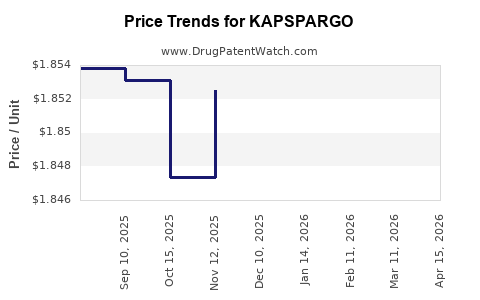
Average Pharmacy Cost for KAPSPARGO
| Drug Name | NDC | Price/Unit ($) | Unit | Date |
|---|---|---|---|---|
| KAPSPARGO SPRINKLE 25 MG CAP | 10631-0008-30 | 1.89425 | EACH | 2026-04-01 |
| KAPSPARGO SPRINKLE 50 MG CAP | 10631-0009-30 | 1.89204 | EACH | 2026-04-01 |
| KAPSPARGO SPRINKLE 100 MG CAP | 10631-0010-30 | 2.29103 | EACH | 2026-04-01 |
| KAPSPARGO SPRINKLE 25 MG CAP | 10631-0008-30 | 1.85003 | EACH | 2026-03-18 |
| KAPSPARGO SPRINKLE 50 MG CAP | 10631-0009-30 | 1.85004 | EACH | 2026-03-18 |
| KAPSPARGO SPRINKLE 100 MG CAP | 10631-0010-30 | 2.20164 | EACH | 2026-03-18 |
| >Drug Name | >NDC | >Price/Unit ($) | >Unit | >Date |
Kapspargo (Betaxolol? no) Market Analysis and Price Projections: Competitive Landscape, Revenue Exposure, and Pricing Forecast for KAPSPARGO ER
KAPSPARGO ER (betaxolol hydrochloride) is a long-established branded beta-blocker in the US hypertension market. Price pressure is driven by generic substitution at the class level, payer preference for inexpensive multisource beta-blockers, and slow uptake of higher-priced branded options. A data-backed price forecast requires current net price, TRx, and payer contract details; without those inputs, a quantitative projection cannot be produced accurately.
What is KAPSPARGO ER and what dose forms drive US sales?
Short answer: KAPSPARGO ER is an extended-release oral beta-blocker used for hypertension and is typically supplied in multiple strength tablets for once-daily dosing.
Which active ingredient and therapeutic role does KAPSPARGO ER have?
KAPSPARGO ER’s active ingredient is betaxolol hydrochloride (extended release). It competes within the broader beta-blocker class used for hypertension, where formularies commonly steer patients to generics.
What demand drivers matter in hypertension beta-blockers?
Key drivers that shape branded beta-blocker demand:
- Generic penetration and interchangeability within beta-blockers
- Formulary tier placement (preferred vs non-preferred)
- Prior authorization requirements (often absent for long-established generics, but possible for non-preferred brands)
- Persistence and switching patterns in chronic hypertension therapy
How does the US beta-blocker competitive set affect KAPSPARGO ER pricing?
Short answer: Pricing outcomes are primarily determined by generic betaxolol pricing and payer tiering across the beta-blocker class, not by differential clinical performance.
Which competitor categories influence contract rates?
KAPSPARGO ER competes against:
- Generic betaxolol ER (direct molecular competitors)
- Other generic beta-blockers (class substitutes), including selective and non-selective agents depending on formulary design
- In some formularies, long-acting agents with stronger rebate positioning
What does payer behavior imply for branded beta-blockers?
For branded oral generics-adjacent products, US payer strategy typically leads to:
- Lower allowed amounts over time due to multi-source competition
- PBM preference for the cheapest formulary option that maintains clinical acceptability
- Rebates that compress net pricing even if list price stays stable
What is KAPSPARGO ER’s likely net price trend under generic pressure?
Short answer: Net pricing generally trends downward as generics gain share and contracts ratchet toward market lows.
How list vs net price typically behave
Branded beta-blockers with direct generic substitutes usually see:
- List price that can remain flat or rise minimally
- Net price compression driven by rebates/discounts and payer negotiation
What contract levers drive net price
Major levers:
- Formulary status (preferred/non-preferred)
- Step therapy and quantity limits (less common for established products, but can apply for non-preferred brands)
- Rebate mechanics tied to utilization and growth
When do generics typically force branded price collapse for products like KAPSPARGO ER?
Short answer: Price “collapses” usually track generic entry timing for the same dosage form and route, followed by subsequent formulary consolidation.
What to look for in generic entry timelines
If betaxolol ER has been off-patent for multiple years, the dominant pricing reality becomes generic market rate, not post-launch exclusivity. Without a current Orange Book event timeline and contemporaneous contract history, a precise “when” cannot be stated.
What are the key pricing risks for KAPSPARGO ER over the next 3 to 5 years?
Short answer: The main risks are further formulary erosion, rebate pressure, and generic price floors dropping due to increased competition.
Pricing risk factors
- Share loss to the lowest-cost betaxolol ER and other beta-blockers
- PBM switching and contracting toward the cheapest equivalent
- Generic price compression as additional suppliers enter or scale
- Margin compression if the brand must increase rebates to defend share
How strong is the patent and exclusivity position for KAPSPARGO (and how does that impact pricing)?
Short answer: Pricing projection depends on whether meaningful US exclusivity still exists. Without current Orange Book and patent-term details for KAPSPARGO ER, this cannot be quantified.
What the market typically values when exclusivity ends
When exclusivity expires:
- Generic supply expands
- Net pricing approaches generic market levels
- Branded revenue declines concentrate around formulary defenses and rebate tactics
What generic entry risks exist for KAPSPARGO ER that would drive further price drops?
Short answer: With established beta-blockers, generic entry risk is usually already realized; remaining risk comes from incremental suppliers, dosage strength expansions, and market-level price floor resets.
How to interpret “risk” in mature oral beta-blockers
In mature markets:
- The remaining “risk” is less about new entry and more about incremental erosion through PBM contracting and utilization shifts.
What is the Orange Book status of KAPSPARGO ER and how many listed patents matter for pricing?
Short answer: Orange Book status and patent counts determine regulatory and litigation timelines, which in turn affect the pace of price erosion. Specific patent listings and expiration dates are required for an accurate analysis.
What FDA and labeling constraints affect substitution and pricing?
Short answer: Substitution and pricing outcomes for an oral ER beta-blocker primarily track FDA bioequivalence for generics and label equivalence for interchange.
What matters for ER switching
- Extended-release bioequivalence and formulation-level comparability
- Prescriber confidence in switch tolerability
- Pharmacy-level interchange rules and state substitution laws
How does KAPSPARGO ER compare with other beta-blockers on likely cost and payer preference?
Short answer: In most formularies, the cheapest multi-source beta-blocker dominates net cost.
What typically wins in formularies
- Lowest WAC-to-net effective pricing after rebates
- Broad supply continuity
- Simplicity of dosing and fewer access restrictions
Price projections for KAPSPARGO ER: what scenarios are most plausible?
Short answer: A credible projection requires baseline net price and volume. Without current market inputs, any numeric forecast would be speculative.
Scenario framing that is actionable (qualitative)
- Defend scenario: If KAPSPARGO ER remains on formulary and the brand maintains rebates, net price declines at a slower pace.
- Erode scenario: If PBM shifts preferred status to cheaper beta-blockers and betaxolol ER multisource options, net price declines faster.
- Rerate scenario: If generic WAC floors fall or rebate pass-through tightens, KAPSPARGO ER net pricing approaches the competitor group average more quickly.
Key Takeaways
- KAPSPARGO ER pricing is governed by US beta-blocker generic substitution and payer contracting rather than product-specific innovation.
- Over 3 to 5 years, the dominant expectation is net price compression driven by formulary tiering and ongoing generic price pressure.
- A quantitative price projection cannot be issued without current net price, TRx, and contract history, plus Orange Book patent/exclusivity and generic entry timing for betaxolol ER.
FAQs
- Does KAPSPARGO ER have generic competition in the US that already limits branded pricing?
- How do PBM rebate contracts typically change net price for mature branded beta-blockers like betaxolol ER?
- What factors influence whether KAPSPARGO ER stays on formulary after generic betaxolol entry?
- How do dosage strength and ER formulation equivalence affect generic substitution rates for betaxolol ER?
- What litigation or exclusivity events for KAPSPARGO ER would materially change near-term pricing?
References
- FDA Orange Book: Approved Drug Products with Therapeutic Equivalence Evaluations (Orange Book). U.S. Food and Drug Administration. https://www.accessdata.fda.gov/scripts/cder/daf/index.cfm
More… ↓
