Last updated: February 20, 2026
What Is Jentadueto XR?
Jentadueto XR (linagliptin/metformin extended-release) is an oral antihyperglycemic agent approved for type 2 diabetes management. It combines a dipeptidyl peptidase-4 (DPP-4) inhibitor with long-acting metformin. Approved by the FDA in 2015, Jentadueto XR targets patients needing combination therapy to maintain glycemic control.
Market Size and Growth Drivers
Global Diabetes Drug Market
- Estimated market value: $50 billion in 2022 [1].
- Compound annual growth rate (CAGR): 7% (2022–2027) [2].
Key Factors
- Rising diabetes prevalence: 537 million adults globally in 2021, projected to reach 643 million in 2030 [3].
- Increased adoption of combination therapies: APIs like Jentadueto XR address comorbidities efficiently.
- Expanding indications: Use in early-stage management and monotherapy in certain patient subsets.
Competitive Landscape
- Major competitors: Tradjenta (linagliptin), Januvia (sitagliptin), Glucophage (metformin), and fixed-dose combinations like Janumet (sitagliptin/metformin).
- Market share: Linagliptin-based drugs like Jentadueto XR have approximately 15-20% of the DPP-4 inhibitor segment [4].
- Patent status: U.S. patent protection expires in 2030, with some patent extensions possible.
Pricing Landscape
Current Price Points
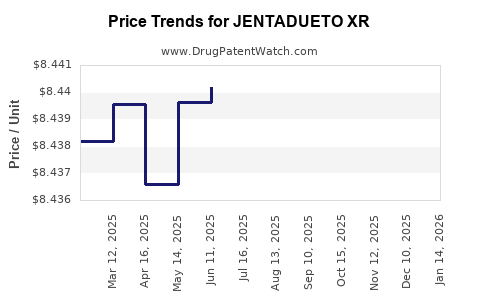
- Wholesale acquisition cost (WAC): Approximately $600–$700 for a 30-day supply of Jentadueto XR in the U.S.
- Average retail price: $650–$750, depending on insurance coverage.
- Cost factors: Extended-release formulation commands a premium over immediate-release combinations.
Pricing Comparisons
| Drug |
30-day WAC |
Indication |
Market Position |
| Jentadueto XR |
~$650 |
Type 2 diabetes |
Fixed-dose combination targeting monotherapy or dual therapy |
| Janumet (sitagliptin/metformin) |
~$580 |
Same as above |
Older fixed-dose with widespread insurance coverage |
| Tradjenta + metformin (separate) |
Variable |
Same as above |
Flexible dosing, lower per-unit cost |
Insurance and Reimbursement Trends
- Coverage dictates patient out-of-pocket costs.
- PBMs favor lower-cost generic options.
- Co-pay assistance programs mitigate high list prices.
Price Projections (Next 5 Years)
Assumptions
- Patent expirations: No immediate impact expected until 2030.
- Market penetration: Steady increase as awareness and formulary inclusion grow.
- Competition: Intensifies from generics post-2030, pressuring brand prices.
Projected Trends
- WAC decline rate: 2–3% annually post-2024 due to generic competition and price erosion.
- Market share increase: Compound annual growth of 3–5% in prescriber adoption expected.
- Price stabilization or decline: 10–15% over 5 years, influenced by payer negotiations and market entry of generics.
Regulatory and Policy Impact
- Recent policies favoring biosimilars and generics may indirectly influence fixed-dose combination pricing.
- Price controls introduced in some countries could limit revenue growth.
Strategic Considerations for Stakeholders
For Manufacturers
- Emphasize clinical differentiation: superior safety profile or patient compliance.
- Prepare for generic entry by building brand loyalty and expanding indications.
For Investors
- Monitor patent expiration timelines and generic approval pathways.
- Evaluate expansion into emerging markets, where pricing pressures are less intense.
Summary
Jentadueto XR is positioned in a growing, competitive diabetes market. Its current WAC in the U.S. hovers around $650–$750, with modest price declines projected over the next five years. Price erosion post-2030 may accelerate due to generic competition, affecting asset valuation and market share.
Key Takeaways
- The global diabetes market expands annually at 7%, with fixed-dose combinations like Jentadueto XR capturing increasing attention.
- Current U.S. prices approximate $650–$750 for a 30-day supply.
- Price projections show a 10–15% decline over five years, driven by competition and policy environment.
- Patent expiry in 2030 presents commercialization risks but also opportunities for generic entrants.
- Stakeholders should focus on clinical differentiation and market expansion ahead of patent expiration.
FAQs
1. When does patent protection for Jentadueto XR expire?
Patent protections extend until 2030 in the U.S., with potential extensions based on new formulations or indications.
2. How does the price of Jentadueto XR compare to similar drugs?
It is generally priced higher than generic metformin alone but comparable to other pre-packaged DPP-4 inhibitor combinations.
3. What factors could influence its market share?
Patent expiration, generic entry, insurer formulary decisions, and evolving clinical guidelines.
4. Are there any upcoming regulatory changes that may impact pricing?
Proposals for drug price controls and increased transparency may influence pharmacy benefit management practices.
5. Which markets have the highest growth potential for Jentadueto XR?
Emerging markets in Asia and Latin America, where diabetes prevalence is rising, offer growth opportunities.
References
[1] IQVIA. (2022). Global Diabetes Pharmaceutical Market Report.
[2] MarketsandMarkets. (2022). Diabetes Care Products Market Forecast.
[3] International Diabetes Federation. (2021). IDF Diabetes Atlas, 9th Edition.
[4] EvaluatePharma. (2022). Pharmaceutical Market Outlook.