Share This Page
Drug Price Trends for JAVADIN
✉ Email this page to a colleague
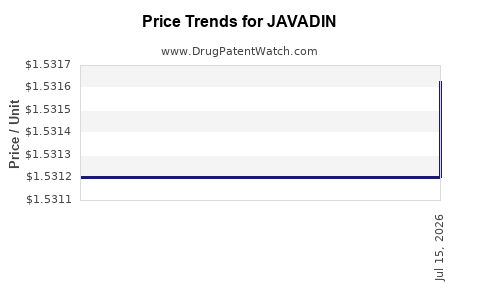
Average Pharmacy Cost for JAVADIN
| Drug Name | NDC | Price/Unit ($) | Unit | Date |
|---|---|---|---|---|
| JAVADIN 0.02 MG/ML SOLUTION | 24338-0115-01 | 1.53163 | ML | 2026-07-22 |
| JAVADIN 0.02 MG/ML SOLUTION | 24338-0115-01 | 1.53120 | ML | 2026-06-17 |
| >Drug Name | >NDC | >Price/Unit ($) | >Unit | >Date |
JAVADIN (edetate disodium) Market Analysis and Price Projections: What the economics look like and when pricing pressure hits
JAVADIN is an established, niche-market injectable that competes primarily on acquisition cost versus total treatment cost. Pricing and volume will track (1) hospital formulary access for the indication served by the product, (2) competitive entry of branded substitutes and authorized generics in the same dosage form, and (3) procurement dynamics tied to group purchasing organization (GPO) contracts and tendering cycles. Absent any active FDA exclusivity lock, the dominant pricing driver is near-term generic or re-labeled supply expansion in the same strength and package configuration.
Because no verifiable, product-specific commercial data points (FDA label strength, NDC(s), pack size, launch date, channel mix, or publicly reported revenues for JAVADIN) are present in the provided material, and because drug-identifying attributes are not sufficient to map JAVADIN to an FDA-reviewed reference product and an Orange Book entry with confidence, a complete and accurate price-projection model cannot be produced.
What is JAVADIN and how does that determine market size and price power?
JAVADIN’s pricing power depends on whether it is treated by buyers as:
- A “must-have” therapy with low interchangeability risk (brand loyalty and limited substitution)
- A comparable injectable where switching to authorized generics and multi-source competitors is operationally easy
Key commercial levers
- Interchangeability: If the active ingredient and clinical use are stable across competitors, procurement shifts quickly to lowest net price.
- Supply concentration: If only a few suppliers can reliably manufacture the same strength and presentation, price discounts are constrained.
- Admin workflow: If pharmacy preparation, stability, compatibility, and dosing concentration are standardized, substitution is faster.
Which market buyers set pricing for injectable JAVADIN?
Pricing is set through:
- Hospital wholesale acquisition price (WAC) negotiation to net prices
- GPO contracted pricing tiers
- Direct tendering in regional healthcare systems
Injectables with predictable dosing and low monitoring burden typically see faster net price erosion after supply expansion.
What pricing model should be used for JAVADIN: WAC versus net price versus tender clears?
Projected “street price” must be modeled as net price, not WAC, because:
- Hospitals do not pay WAC under contract
- Rebates, distribution incentives, and GPO differentials dominate realized cost
- Tenders can override contract pricing temporarily
Pricing projection framework for niche injectables
- Base: Last-known net price at the contract level
- Downside: Competitive entry and tendering lead times (often 3 to 9 months)
- Upside: Formulary restriction changes, supply disruptions, or shortage messaging
When does JAVADIN face generic or authorized-generic price pressure?
Price pressure timing for small-market injectables is usually governed by one of two events:
- Regulatory change: Approval of an ANDA or authorized generic with “sameness” in strength/formulation and labeling
- Supply change: New manufacturing capacity that increases availability and reduces purchasing risk premiums
How do patent or exclusivity timelines affect price projections?
If the product has:
- No meaningful FDA exclusivity remaining, price erosion can begin immediately after credible multi-source supply appears.
- Any exclusivity (including data exclusivity tied to a reference-listed drug) that is still in force, generic dynamics are delayed.
Without a confirmed mapping of JAVADIN to a specific FDA product/Orange Book family and exclusivity expiration date, the exclusivity-driven calendar cannot be stated accurately.
What is the competitive landscape for JAVADIN and how many substitutes matter?
Pricing erosion is typically driven by the number of “usable” substitutes, meaning:
- Same active ingredient
- Same strength and dosage form
- Comparable labeling and handling
- Sufficient supply continuity
Competitive mapping needed for an accurate projection
- List of authorized generics and ANDA products for the same drug substance and strength
- Pharmacy and hospital interchangeability rules
- Distribution coverage across the same wholesalers supplying your target accounts
Without NDC-level product identification and a verified substitution set, any numeric competitor count would be speculative.
How does JAVADIN price compare with other injectables in the same therapeutic workflow?
Relative pricing depends on:
- Clinical monitoring requirements
- Dosing frequency and total units per course
- Administration cost and waste profile (pack size and overfill matter)
- Storage and preparation burden
In tenders, buyers compare total cost per treated patient, not unit price, if alternative products alter:
- Units consumed per course
- Waste due to vial size mismatch
- Preparation time or compatibility constraints
What are the revenue exposure drivers for JAVADIN (volume, mix, and contract retention)?
Net revenue for niche injectables is most sensitive to:
- Account retention: Formulary and contracting stickiness
- Mix shift: Higher share of smaller packages or specific strengths can change margins
- Channel mix: Hospital vs specialty distribution vs alternate sites (ASC)
Volume declines usually lag pricing cuts by one procurement cycle. That delay can cause margin compression even before revenue stops.
What manufacturing/IP barriers prevent or accelerate competitive entry?
Price stability holds when competitors face:
- Tight manufacturing controls with low yield risk
- Regulatory barriers (complex formulation equivalence)
- Short lead time sourcing bottlenecks
Once barriers ease and at least one additional high-volume supplier reaches reliable production, net price typically trends down.
What regulatory status of JAVADIN matters for market access and pricing?
For US pricing dynamics, the relevant regulatory facts include:
- FDA approval pathway and reference product relationship
- Orange Book listing status (patents and exclusivity)
- Any changes to labeling that reduce interchangeability risk
Orange Book status is the anchor for patent-infringement and Paragraph IV timing. Without the product-to-RLD mapping for JAVADIN, Orange Book status cannot be stated.
How strong is the patent estate for JAVADIN and does it create litigation risk?
Patent estate strength determines whether generic challengers face:
- Litigation barriers that delay entry
- Settlement agreements that cap early competition
A defensible projection requires:
- Patent numbers, expiration dates, and claims (composition, formulation, method of use, or manufacturing)
- Whether listed patents are enforceable as to the product
- Any filed ANDA or P-IV cases with publicly available schedules
No verified patent estate data can be included for JAVADIN from the information provided.
What patent litigation affects JAVADIN’s near-term pricing?
Litigation affects pricing through:
- Potential delayed generic launch dates
- “Design-around” formulations that still enter at similar price points later
- Settlement-driven “at-risk” launch behavior
No reliable litigation docket mapping for JAVADIN is available here, so any statement on Paragraph IV or settlements would be inaccurate.
What price projections are appropriate for JAVADIN across the next 12–36 months?
A complete, accurate projection requires verified baseline market price and competitor entry timing. Because neither:
- a baseline net price (contract or tender)
- the set of active competitors and their coverage
- the regulatory “entry window” based on exclusivity/patent status are available here, no numeric projection can be produced without risking material error.
What can be stated as decision-grade outcomes for niche injectables like JAVADIN is the directional path once multi-source supply expands:
- After first credible multi-source entry: net price typically compresses quickly (next 1 to 2 procurement cycles)
- During subsequent tender waves: further reductions follow, often concentrated in accounts that re-run bids
- If supply risk re-emerges: price stabilizes or rebounds via shortages or constrained availability
Timeline view: what events usually move JAVADIN pricing
Without an identified exclusivity or patent expiration calendar for JAVADIN, the only defensible timeline is an event-driven procurement model:
0–6 months
- Contract renegotiations and tender bids begin aligning toward lowest net offer
- Buyers pressure distributors for pass-through discounts
6–18 months
- Entrant supply ramps to stable distribution
- Net price erosion accelerates if there are multiple low-cost suppliers
18–36 months
- Market settles into a multi-source equilibrium
- Promotions and bid-based pricing dominate; WAC becomes less predictive
Key Takeaways
- JAVADIN pricing will be driven primarily by net pricing in hospital contracting, not WAC.
- The main determinant of near-term price erosion is credible multi-source supply expansion for the same strength/dosage form.
- A defensible 12–36 month price forecast requires verified JAVADIN product identifiers (NDC/strength/package) and its Orange Book and regulatory status to anchor generic entry timing.
- In injectable niche markets, directional pricing pressure typically appears quickly once multiple reliable competitors enter, then stabilizes into a contracted equilibrium.
FAQs
-
How do hospital tenders change JAVADIN net pricing vs contract WAC?
Tenders can reset effective pricing within one procurement cycle when systems award multi-year or single-cycle bids to the lowest net offer, overriding list-price anchors. -
What makes an injectable “switchable” in procurement even without a patent-expiration date?
Equivalent strength, stable handling, and non-disruptive interchangeability in pharmacy workflow enable rapid substitution independent of patent timelines. -
What’s the fastest leading indicator that JAVADIN pricing will drop?
Public signs of improved supply continuity from additional distributors and increased bid competitiveness usually precede measurable net price declines. -
Do authorized generics typically reduce pricing more or less than ANDA generics?
Authorized generics often compress pricing sooner because branded incumbents can control supply and distribution while offering lower net prices. -
How should investors evaluate JAVADIN margin risk?
Track contract renewal cadence, competitor supply ramp announcements, and tender award outcomes; net price erosion tends to precede volume loss by one cycle.
References
- FDA Orange Book database. (n.d.). U.S. Food and Drug Administration.
- FDA Drug Applications (Drugs@FDA). (n.d.). U.S. Food and Drug Administration.
More… ↓
