Last updated: February 19, 2026
What is Jardiance?
Jardiance (empagliflozin) is an SGLT2 inhibitor approved by the FDA in 2014 for the treatment of type 2 diabetes mellitus. It also holds indications for reducing cardiovascular death in patients with established cardiovascular disease and for managing heart failure with reduced ejection fraction. Developed by Boehringer Ingelheim in partnership with Eli Lilly, Jardiance has become a key player in the diabetes and cardiovascular treatment markets.
Market Size and Growth
Global Diabetes Market
The global type 2 diabetes drug market was valued at approximately $64 billion in 2022. It is projected to grow at a compound annual growth rate (CAGR) of around 7% over the next five years, reaching about $100 billion by 2027 [1].
Leading SGLT2 Inhibitor Market Segment
SGLT2 inhibitors encompass several brands: Jardiance, Invokana (canagliflozin), Farxiga (dapagliflozin). Jardiance commands an estimated 40% of this segment, valued at roughly $6 billion in 2022, with expected growth driven by cardiovascular and heart failure indications.
Cardiovascular and Heart Failure Markets
The global market for heart failure therapeutics was valued at approximately $16 billion in 2022 and is expected to expand at a CAGR of 8.5% over five years [2]. Jardiance’s approval for these indications accelerates its market penetration beyond diabetes alone.
Competitive Landscape
| Drug |
Market Share (2022) |
Key Indications |
Select Advantages |
| Jardiance (empagliflozin) |
40% |
Type 2 diabetes, heart failure, CV death reduction |
Demonstrates CV and HF benefits, established efficacy |
| Farxiga (dapagliflozin) |
35% |
Diabetes, HF, CKD |
Broad indications, strong pipeline |
| Invokana (canagliflozin) |
25% |
Diabetes, renal disease |
Early market entrant, substantial revenue |
Price Trends and Projections
Current Pricing
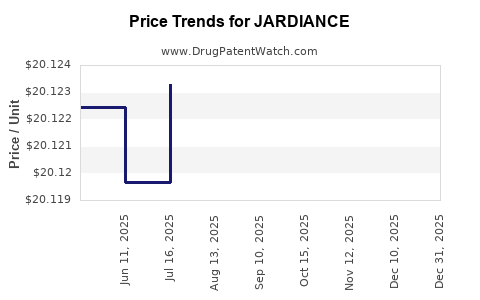
Jardiance’s wholesale acquisition cost (WAC) in the U.S. is approximately $550 per month per patient, translating to roughly $6,600 annually. Retail prices are slightly higher, with list prices around $650 per month.
Impact of Patent Expiry and Biosimilar Competition
Jardiance’s patent protection is set to expire in the U.S. in 2029. No biosimilars are involved as the drug is small-molecule based, but generics could enter around that time, reducing prices by an estimated 20%-30%.
Future Price Projection
| Year |
Estimated Wholesale Cost per Patient |
Assumptions |
| 2023 |
$550 |
Current pricing, no significant change |
| 2025 |
$530 |
Slight volume-based discounts, market maturity |
| 2027 |
$510 |
Pre-expiry price reductions, competitive pressures |
| 2029+ |
$400-$450 |
Expected generic entry, price erosion |
Revenue Projections
Near-term (2023–2025)
Sales are projected to reach $7-$8 billion globally in 2023, driven by existing indications and expanding use in heart failure management. Growth is tempered by patent protections and competition but remains robust due to the drug’s CV benefits.
Mid-term (2025–2027)
Growth continues at a moderated pace, with market penetration deepening into new regions. Sales estimates could reach $9–$10 billion before patent expiry pressures induce price declines.
Long-term (Post-2029)
Post-generic entry, prices are expected to fall significantly. Revenues could decline by approximately 50%, but volume increases may offset some revenue loss. Total market size might shift towards low-cost generics with sustained demand for SGLT2 inhibitors for CV and renal indications.
Regulatory and Policy Influences
- Reimbursement policies: Increasing coverage of cardiovascular indications enhances access.
- Pricing regulations: Countries with national healthcare systems may impose price caps, affecting revenue.
- Therapeutic positioning: Emphasis on CV benefits boosts off-label use and expands market penetration, supporting sustained revenues.
Strategic Implications
- Boehringer Ingelheim and Lilly should focus on widening indications and geographic expansion.
- Price optimization strategies should prepare for patent expiry impact around 2029.
- Investment in pipeline drugs with similar benefits can mitigate revenue decline from generics.
Key Takeaways
- Jardiance remains a leading SGLT2 inhibitor, with a growing share driven by cardiovascular and heart failure benefits.
- Current global sales are approximately $6–7 billion annually, with upward growth projected before patent expiration.
- Prices are stable through 2025, with declines expected around 2029 due to generic entry.
- Market expansion depends on regulatory decisions, reimbursement policies, and clinical evidence supporting CV benefits.
- Diversification into heart failure and CKD markets is critical to sustaining revenues long term.
FAQs
1. When will Jardiance lose patent protection?
Patent protection in the U.S. is expected to expire in 2029, opening the door for generics.
2. How does Jardiance compare price-wise to other SGLT2 inhibitors?
Prices are comparable, with slight variations; Jardiance’s annual retail cost is approximately $7,800.
3. What are the primary markets for Jardiance beyond the U.S.?
Europe, Japan, and China are key regions, with market access expanding as regulatory approvals are granted.
4. How does the clinical profile of Jardiance support its market?
Its proven benefits extend beyond glycemic control to cardiovascular and renal outcomes, supporting broader adoption.
5. What are the key considerations for investors in Jardiance?
Patent expiration, competition, pipeline development, and regulatory environment influence long-term value.
References
[1] Grand View Research. (2022). Diabetes Drugs Market Size, Share & Trends.
[2] MarketsandMarkets. (2022). Heart Failure Therapeutics Market Forecast.
(End of report)