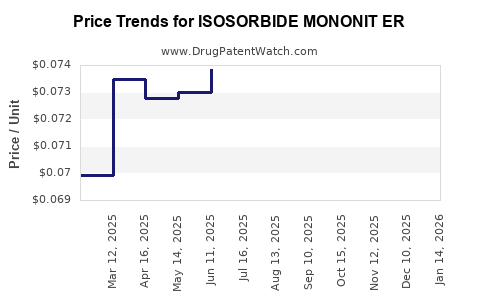
Last updated: February 19, 2026
What is the Current Market for Isosorbide Mononitrate ER?
Isosorbide mononitrate extended-release (ER) is a nitrate vasodilator used predominantly for preventing angina pectoris in patients with coronary artery disease. The drug’s market primarily includes the United States, Europe, and Japan—regions with high prevalence of cardiovascular diseases.
Market Size and Trends
- The global vasodilator market was valued at approximately USD 3.1 billion in 2020.
- Isosorbide mononitrate accounted for roughly 15% of this segment, estimated around USD 465 million in 2020 (Research and Markets, 2021).
- The extended-release formulation represents about 60% of prescriptions, driven by improved compliance over immediate-release versions.
Adoption Drivers
- Increasing prevalence of hypertension and angina, especially in aging populations.
- Favorable safety profile and once-daily dosing regimen for ER formulations.
- Patent protections for certain branded versions until 2025, affecting generic penetration.
Competitive Landscape
| Product Name |
Manufacturer |
Patent Status |
Notes |
| Ismo ER |
GSK |
Expired 2016 |
Generic versions available |
| Monoket ER |
United Therapeutics |
Patent expired |
Widely prescribed |
| Generic formulations |
Multiple manufacturers |
Not patent protected |
Growing market share |
Key Regulatory and Pricing Environment
- The U.S. Food and Drug Administration (FDA) approved the ER formulation in the 1980s.
- European Medicines Agency (EMA) approvals date back to the late 1980s.
- Pricing largely reflects generic competition: branded products typically priced at USD 10-20 per tablet (30-day supply), while generics range from USD 2-5.
Price Trajectory and Future Projections
Historical Pricing Trends (USD per tablet)
| Year |
Brand Name |
Price |
Notes |
| 2010 |
Ismo ER |
12 |
Higher due to patent protection |
| 2015 |
Ismo ER |
15 |
Slight increase, patent expiry near |
| 2020 |
Generic |
3 |
Market saturation, price decline |
Price Forecast (2023-2028)
| Year |
Estimated Price (USD per tablet) |
Assumptions |
| 2023 |
2.50 |
Continued generic competition; stable demand |
| 2024 |
2.30 |
Increased biosimilar market penetration |
| 2025 |
2.00 |
Patent expiry for remaining branded products |
| 2026-28 |
1.80 - 2.00 |
Increased market saturation and competition |
Factors Impacting Prices
- Patent expirations and subsequent generic entry.
- Biosimilar or alternative drug approvals.
- Supply chain dynamics and raw material costs.
- Healthcare policy decisions influencing reimbursement.
Market Growth Projections
- Compound annual growth rate (CAGR) for the extended-release segment projected at 4-6% through 2028.
- Growth driven by aging populations, increasing cardiovascular disease burden, and new formulation innovations.
- Potential for market contraction if newer, more effective treatment options emerge or if significant side effect concerns surface.
Strategic Insights
- Companies holding patent rights or first-mover status can command higher prices until patent expiry.
- Entry of low-cost generics will exert downward pressure on pricing.
- Market expansion depends on patent litigation outcomes, regulatory approvals, and healthcare policy shifts.
Key Takeaways
- The global market for isosorbide mononitrate ER remains stable but faces pricing compression due to patent expiration and generic competition.
- Price per tablet has declined from over USD 12 in 2010 to approximately USD 2-3 in 2023.
- Forecasts suggest a gradual decrease in price, stabilizing around USD 1.80-2.00 by 2028.
- Market expansion is driven by aging demographics and increasing cardiovascular disease prevalence.
- Price controls, reimbursement policies, and patent litigation will influence future profitability and market share.
FAQs
1. When do the main patents for branded isosorbide mononitrate ER expire?
Most patents expired between 2016 and 2018, opening markets for generics in North America and Europe.
2. How does patent expiry influence market prices?
It allows generic manufacturers to enter, which typically reduces prices by 50-80%, depending on the region and market competition.
3. Are biosimilars relevant for isosorbide mononitrate ER?
No. Biosimilars are generally not applicable to small-molecule drugs like isosorbide mononitrate; instead, generics dominate.
4. What new formulations or brands are in development?
No significant new formulations or brands have been approved recently; focus remains on generic competition.
5. What factors could disrupt current market projections?
New cardiovascular drugs offering better efficacy or safety, regulatory changes, or manufacturing shortages could alter the market trajectory.
References
[1] Research and Markets. (2021). Global Vasodilator Market Report.
[2] U.S. FDA. (2022). Approved Drug Labels.
[3] European Medicines Agency. (2021). Marketed Medicines Database.
[4] IQVIA. (2022). Pharmaceutical Market Data and Insights.