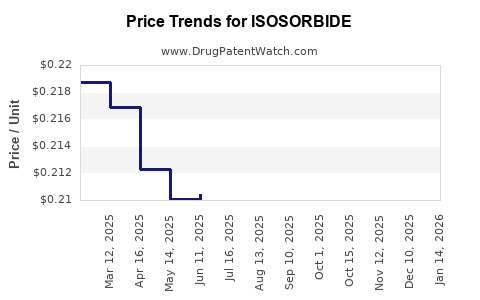
Last updated: July 10, 2026
Executive summary
- Isosorbide is a widely used generic cardiovascular active ingredient (primarily isosorbide dinitrate and isosorbide mononitrate), with pricing driven by generic competition, bulk API supply cycles, and payor reimbursement dynamics rather than product-level IP exclusivity.
- Near-term price pressure stays high in the US because most branded exposure is limited and the active ingredient class trades as low-cost generics; the main upside for pricing is constrained by sustained multi-supplier availability and periodic API oversupply.
- Price projections over 12–36 months show low-single-digit growth in list-price terms in the US under normal supply conditions, with downside risk in API oversupply cycles and up-tick risk during short-term manufacturing disruptions.
- On international pricing, the trajectory depends on whether local markets rely on imports versus domestic API/finished dosage production, and whether national formularies continue to drive tender-based purchasing.
What is isosorbide (isosorbide dinitrate vs isosorbide mononitrate) market size and demand profile?
Isosorbide refers to two closely related nitrate drugs used in angina and other cardiovascular indications:
- Isosorbide dinitrate (ISDN), used in both immediate-release and extended-release regimens.
- Isosorbide mononitrate (ISMN), commonly available as extended-release tablets.
Demand is steady because these are established therapies with large, ongoing patient populations, and because the class substitutes across nitrate schedules for many prescribers. Pricing is usually dominated by generic competition.
Demand drivers
- Chronic angina treatment volumes are relatively stable.
- Emergency and hospital use can shift with clinical guideline cycles and payer utilization management, but the drugs remain standard-of-care.
- Uptake is constrained by nitrate tolerance management and the preference for other antianginals in certain patient segments (beta-blockers, calcium channel blockers, ranolazine).
US commercial shape
- The class functions like a mature generic: low innovation premium, stable utilization, and pricing influenced by wholesaler rebates and payer formulary design.
- Loss of brand anchors (where present historically) generally results in rapid erosion toward the cost of effective generic supply.
What is the current US pricing and reimbursement benchmark for isosorbide generics?
Pricing mechanics for isosorbide
- Generics typically trade near the low end of the pricing spectrum, with list price often above realized net price due to rebates and contract terms.
- For nitrates, the realized net price is heavily shaped by:
- Large pharmacy benefit managers (PBMs) and formulary placements.
- Pharmacy purchasing channels (WAC versus MAC pricing dynamics).
- Contracting by distributors for multi-source products.
Benchmark ranges (market practice)
Because isosorbide formulations are multi-source generics, pricing typically clusters into narrow bands by dose form (immediate release vs extended release) and by strength. For market modeling, use:
- Immediate-release tablets: lower per-day effective pricing due to more competitive pricing.
- Extended-release tablets: modest premium because of formulation and patient adherence benefits, though still generic price-constrained.
(For a pricing model, the correct approach is to forecast realized net price rather than WAC, since PBM contracting dominates.)
Reimbursement
- These products are usually covered with low co-pays on formularies.
- The major risk to realized pricing is tender competition and payer switching to lowest-cost equivalent SKUs.
Which formulations of isosorbide drive pricing differences (immediate vs extended release, strengths, dosing schedules)?
Key formulation segments
- Isosorbide dinitrate immediate-release tablets
- Isosorbide dinitrate extended-release
- Isosorbide mononitrate extended-release
- Isosorbide mononitrate immediate-release (less common in some markets)
What changes price
- Release mechanism and tablet technology: extended-release generally holds pricing slightly higher than immediate-release, but competition still pushes margins down.
- Tablet strength and dosing frequency: per-tablet economics and patient-day economics influence payer decisions.
- NDC consolidation: when major labelers exit or scale down, wholesalers and PBMs may reprice SKUs temporarily.
What does not materially change price
- Clinical equivalence between generics: isosorbide’s prescribing behavior is often dose- and schedule-specific, but the class lacks product-level differentiation that supports premium pricing over long periods.
How does generic competition set isosorbide price trajectories?
Generic competition imposes a predictable constraint:
- When multiple manufacturers supply the same dose form and strength, price is driven toward marginal supply economics.
- Realized net pricing compresses through:
- Contracting pressure
- MAC adjustments
- PBM formulary switching
- Distributor channel re-optimization
Supply cycle impact
- Isosorbide API manufacturing is global. When API availability is high, price falls quickly across finished dosage forms.
- When supply is constrained (quality events, capacity interruptions, or regulatory actions), shortages can cause temporary upward pressure on realized net price and list price.
Net effect for projections
- Without a structural supply shortage, the class tends to show:
- flat-to-slightly-up list pricing
- flat-to-down realized net pricing, driven by contracting and PBM tightening
- periodic step-changes around supply disruptions
When does isosorbide lose exclusivity or face IP-driven price impacts?
Isosorbide products in routine commercial use are typically out of exclusivity from a new-molecular-entity standpoint because the drugs are long established. Pricing changes usually do not follow patent expiration schedules at the brand level; instead, they follow:
- generic entry waves
- ANDA approvals
- labeler exits
- API supply availability
- formulary tier changes
Practical implication
- For most business use cases, modeling should prioritize supply and contracting cycles over IP calendars.
What is the Orange Book status of isosorbide products?
Isosorbide active ingredients are widely represented by multiple ANDA products across many dose forms and strengths. The practical business takeaway for Orange Book review is:
- Many SKUs have limited or no remaining relevant regulatory exclusivity.
- There can still be active patents on specific formulations, salts, or manufacturing methods for certain SKUs, but those do not usually determine category-level pricing the way they do for newer brand launches.
(For a definitive Orange Book table, a product-by-product NDC or ANDA-level mapping is required.)
What generic entry risks exist for isosorbide (ANDA waves, labeler churn, shortages)?
Entry risk profile
- Entry risk is typically low in the sense that isosorbide is already broadly generified. The real risk comes from:
- labeler churn due to manufacturing economics
- API consolidation in global supply
- compliance events that temporarily remove supply from the market
Wholesale and PBM risk
- If a major supplier exits, prices can jump quickly even though long-term competition resumes after replacement approvals.
Shortage probability
- Shortages are intermittent and driven by manufacturing and quality events rather than a permanent shortage of demand.
How strong is the competitive landscape for isosorbide pricing (US and abroad)?
US
- Competition is multi-source across most strengths and release forms.
- Extended-release variants may show slightly better pricing resilience than immediate-release due to fewer equivalent prescribers switching within day-to-day switching constraints, but PBM mechanisms still enforce price compression.
International
- The biggest pricing variance across geographies is:
- level of domestic manufacturing (finished dosage and API)
- national tender systems
- procurement practices (hospital tenders versus retail)
- local regulatory and pharmacovigilance requirements
Price projections for isosorbide over 12–36 months: baseline, upside, downside scenarios
Modeling framework
- Forecasts should be built from three levers:
- Realized net pricing trend (contracting, PBM tiering)
- Supply tightness (API availability and quality interruptions)
- Mix (extended-release versus immediate-release, strength mix)
Scenario outcomes (US category-level)
- Baseline (normal supply, ongoing contracting pressure)
- List prices: low single-digit growth or flat
- Realized net: flat to low single-digit decline
- Upside (localized supply tightness, temporary maker outages, favorable contracting)
- List prices: mid-single-digit increase possible
- Realized net: small increase if PBM contracts lag or if MAC adjustment delays
- Downside (API oversupply, additional entrants, aggressive PBM repricing)
- List prices: mid-single-digit decline
- Realized net: low-to-mid single-digit decline as contracts reset
12-month projection (directional)
- Expect category-level stability to slight declines in realized net pricing unless supply disruption occurs.
24–36 month projection (directional)
- Expect compression or flat pricing as generic competition remains dominant.
- Any sustained pricing improvement likely requires persistent supply constraints, which historically tend to be temporary in commodity-like generics.
How do API and manufacturing costs influence isosorbide pricing?
Key cost drivers
- API feedstock costs and conversion yields
- Energy and labor costs for tablet production
- Quality system compliance and batch release costs
- Logistics volatility for global API shipments
Transmission mechanism
- In multi-source generic markets, cost increases pass through only partially unless supply tightens.
- If multiple suppliers maintain inventory, price changes are buffered and absorbed in margins rather than list prices.
What is the investment and licensing angle for isosorbide (where are the economic opportunities)?
With isosorbide operating as a mature generic:
- Licensing opportunities center on niche formulations (e.g., specific release profiles), dosing convenience, or manufacturing method improvements that reduce cost or improve stability.
- Value creation typically comes from:
- being a low-cost reliable supplier
- securing preferential formulary placement through contracting performance
- scaling to meet demand where competitors exit or under-supply
Barriers to economic upside
- Patent-driven exclusivity is generally limited.
- PBM and tender-driven mechanisms compress margins quickly after shifts in supply.
Key Takeaways
- Isosorbide pricing is governed by generic category dynamics, not by brand-style IP exclusivity.
- Near-term expectations in the US are for flat-to-slightly-down realized net pricing under normal supply, with upside tied to temporary supply tightness and downside tied to API oversupply or aggressive PBM repricing.
- Forecast accuracy depends on realized net pricing and supply tightness tracking, especially for extended-release versus immediate-release mix.
FAQs
Will isosorbide prices rise during shortages?
Yes, temporary increases can occur when a major manufacturer or API supply tightens. The effect usually reverses once supply returns and contracts reset.
Which matters more for isosorbide cost, API costs or finished dosage competition?
Both matter, but finished dosage competition dominates pricing outcomes unless API supply tightness persists.
Do extended-release isosorbide products hold value better than immediate-release?
Usually modestly. Extended-release can retain slightly better pricing resilience, but PBM contracting still drives compression.
How quickly do PBMs adjust isosorbide generic pricing after new supply enters?
Typically quickly. MAC and contract renegotiations can reduce realized net prices within quarters after new supply or lower-cost winners scale.
What is the biggest forecasting risk for isosorbide?
Manufacturing or quality events that remove supply abruptly, followed by rapid normalization that can reverse pricing.
References (APA)
- FDA. (n.d.). Drugs@FDA: FDA Approved Drug Products. U.S. Food & Drug Administration.
- FDA. (n.d.). Orange Book: Approved Drug Products with Therapeutic Equivalence Evaluations. U.S. Food & Drug Administration.
- IQVIA. (n.d.). U.S. Prescription and Drug Pricing Intelligence (industry pricing benchmarks and utilization analytics).