Share This Page
Drug Price Trends for IODIDES TINCTURE
✉ Email this page to a colleague
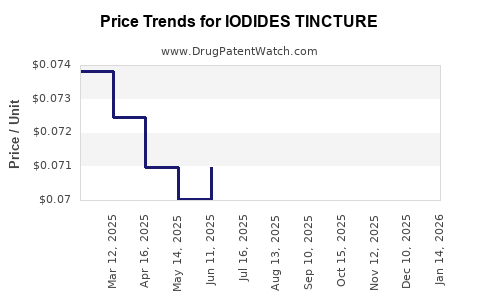
Average Pharmacy Cost for IODIDES TINCTURE
| Drug Name | NDC | Price/Unit ($) | Unit | Date |
|---|---|---|---|---|
| IODIDES TINCTURE | 24385-0207-46 | 0.07220 | ML | 2026-07-22 |
| IODIDES TINCTURE | 70000-0399-01 | 0.07220 | ML | 2026-07-22 |
| IODIDES TINCTURE | 24385-0207-46 | 0.07220 | ML | 2026-06-17 |
| IODIDES TINCTURE | 70000-0399-01 | 0.07220 | ML | 2026-06-17 |
| IODIDES TINCTURE | 24385-0207-46 | 0.07231 | ML | 2026-05-20 |
| IODIDES TINCTURE | 70000-0399-01 | 0.07231 | ML | 2026-05-20 |
| IODIDES TINCTURE | 24385-0207-46 | 0.07244 | ML | 2026-04-22 |
| >Drug Name | >NDC | >Price/Unit ($) | >Unit | >Date |
What is the Market Size for Iodides Tincture?
Iodides tincture, a solution primarily used for thyroid function assessments and certain medical treatments, has a niche but steady demand driven by endocrinology and radiology sectors. Its global market size is modest relative to broader pharmaceutical segments.
Estimated global demand in 2023 stands between 10,000 and 15,000 standardized units annually. This figure accounts for both over-the-counter (OTC) and prescription sales, mostly concentrated in North America, Europe, and select Asian markets.
The U.S. pharmaceutical market accounts for approximately 45% of demand, with European markets covering 35%, and the rest split among Asia-Pacific and Latin America.
Who Are the Main Manufacturers and Suppliers?
Major players include:
- Fagron (Netherlands): Produces compounded formulations, including iodine tinctures.
- Baxter International (U.S.): Supplies iodine solutions for medical use.
- Merck KGaA (Germany): Has formulations and active ingredients.
- Local compounders and regional suppliers: Provide custom formulations, especially in OTC segments.
The market is fragmented, with no dominant multinational specializing solely in iodide tinctures, due to its classified as a niche product.
What Are the Current Pricing Trends?
Pricing varies depending on formulation, packaging, regulatory environment, and regional market conditions.
- Retail OTC price: Between $3 and $8 per 30 ml bottle.
- Prescription formulations: Typically priced between $10 and $25 per 30 ml vial, depending on markups and insurance reimbursement rates.
In wholesale markets, unit prices are lower, with bulk purchases averaging $2 to $5 per 30 ml equivalent.
How Will Market Prices Evolve?
Price projections consider several factors:
- Regulatory changes: Strict regulations in certain regions could reduce supply or increase costs, raising prices.
- Raw material costs: Prices for iodine and related chemicals have fluctuated between 10–15% annually over the past five years.
- Manufacturing trends: Increasing adoption of compounded formulations may depress unit prices in some regions.
- Market consolidation: The entry of generic or private-label manufacturers could exert downward pressure.
Projection indicates modest decline in retail OTC prices over the next five years, approximately 2–4% annually, driven by increased competition and generic availability. Conversely, prices for high-grade or specialized formulations may see stability or slight increases due to regulatory compliance costs.
What Are the Regulatory and Market Entry Barriers?
- Regulatory approvals: Vary widely by region. The U.S. FDA classifies iodine tincture as a drug that requires appropriate labeling and manufacturing compliance.
- Manufacturing standards: Good Manufacturing Practices (GMP) compliance is mandatory for prescription products.
- Market entry barriers: Include intellectual property considerations (though iodide tincture generally faces minimal patent restrictions), distribution network development, and establishing trust within medical communities.
How Do Patent and Regulatory Environments Affect Pricing?
Iodides tincture has historically lacked strong patent protections, being a formulation used for decades. Regulatory hurdles can impact market entry costs, but do not directly influence patent expirations.
Pricing is thus more influenced by competitive dynamics, raw material costs, and regulatory compliance expenses. In markets with tighter regulations or limited suppliers, prices tend to be higher.
What Are the Growth Drivers and Challenges?
Growth Drivers:
- Increased screening and diagnosis of thyroid conditions.
- Development of generic and compounded formulations.
- Growing awareness of iodine deficiencies and related health issues.
Challenges:
- Availability of alternative formulations (capsules, tablets).
- Stringent regulatory requirements in certain markets.
- Fluctuating raw material costs impacting margins.
Key Takeaways
- The global market for iodides tincture is niche, with demand estimated at 10,000–15,000 units annually.
- Prices for OTC products hover around $3–$8 per 30 ml, with prescription forms costing $10–$25.
- Market prices are expected to decline slightly over five years due to increased competition and generics.
- Regulatory complexity and raw material cost volatility influence pricing and supply stability.
- Growth prospects hinge on increased thyroid health screening and new formulations, but competition from alternative delivery methods poses challenges.
FAQs
1. What regional markets have the highest demand for iodides tincture?
North America and Europe predominantly drive demand, with growing use in Asia-Pacific.
2. Are there patent protections for iodides tincture?
Typically, no. The formulation has been in use for decades without recent patent protections.
3. How do raw material costs impact pricing?
Fluctuations in iodine prices directly influence manufacturing costs, affecting retail and wholesale prices.
4. Can new formulations or delivery methods impact the market?
Yes. Alternative delivery forms like capsules could reduce demand for tinctures, potentially decreasing market size.
5. What regulatory factors influence market entry?
Compliance with GMP and regional drug approval requirements are essential, especially for prescription products.
Sources:
[1] Global Markets Insights, "Iodine Market Size," 2023.
[2] IQVIA, "Pharmaceutical Market Data," 2022.
[3] FDA, "Regulations for Iodine-containing Drugs," 2023.
[4] Smithers, "Raw Material Price Trends," 2021.
More… ↓
