Share This Page
Drug Price Trends for INSULIN ASPART FLEXPEN
✉ Email this page to a colleague
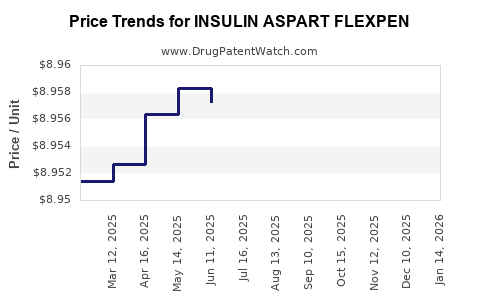
Average Pharmacy Cost for INSULIN ASPART FLEXPEN
| Drug Name | NDC | Price/Unit ($) | Unit | Date |
|---|---|---|---|---|
| INSULIN ASPART FLEXPEN 100 UNIT/ML PEN | 73070-0103-15 | 8.96069 | ML | 2026-05-20 |
| INSULIN ASPART FLEXPEN 100 UNIT/ML PEN | 73070-0103-15 | 8.96454 | ML | 2026-04-22 |
| INSULIN ASPART FLEXPEN 100 UNIT/ML PEN | 73070-0103-15 | 8.96079 | ML | 2026-03-18 |
| >Drug Name | >NDC | >Price/Unit ($) | >Unit | >Date |
Insulin Aspart FlexPen Market Analysis and Price Projections
Insulin Aspart FlexPen, a rapid-acting insulin analog, faces a competitive landscape driven by biosimilar competition and evolving treatment guidelines. Market growth is projected to be moderate, influenced by patient adherence, pricing pressures, and the development of next-generation insulin formulations.
What is Insulin Aspart FlexPen?
Insulin Aspart FlexPen is a pre-filled disposable pen delivery device containing insulin aspart. Insulin aspart is a rapid-acting analog of human insulin that begins to work quickly, is absorbed quickly, and helps reduce blood sugar levels after meals. It is indicated for the treatment of diabetes mellitus in adults and children aged two years and older. The FlexPen device is designed for ease of use and accurate dosing.
Current Market Landscape
The global market for insulin aspart is characterized by significant competition. Novo Nordisk's NovoLog/NovoRapid FlexPen has historically held a dominant position. However, the market is increasingly influenced by the introduction and uptake of biosimilar insulin aspart products, particularly in the United States and Europe.
Key Market Players and Products
- Novo Nordisk: NovoLog (US) / NovoRapid (International) FlexPen. This is the originator product.
- Biosimilar Insulin Aspart: Several biosimilar manufacturers have entered the market, including:
- Semglee (Viatris/Biocon): Approved in the US.
- Kwpra (Adocia/Lilly): Under development.
- Others: Various other biosimil developers are active globally, with product launches varying by region.
The competitive pressure from biosimil entrants has led to price erosion for branded insulin aspart products.
Regulatory Approvals and Geographic Distribution
Insulin aspart products, including FlexPen, are approved by major regulatory bodies such as the U.S. Food and Drug Administration (FDA) and the European Medicines Agency (EMA). Geographic distribution is global, with North America and Europe representing the largest markets due to higher diabetes prevalence and healthcare expenditure. The Asia-Pacific region is also a significant and growing market.
Market Drivers
- Increasing Diabetes Prevalence: The global rise in type 1 and type 2 diabetes incidence is a primary driver for the insulin market. The World Health Organization estimates that diabetes will be the seventh leading cause of death globally by 2030 [1].
- Technological Advancements in Delivery Devices: The convenience and accuracy of pre-filled pens like FlexPen improve patient compliance and satisfaction, driving demand for such delivery systems.
- Growing Demand for Rapid-Acting Insulins: Rapid-acting insulins are crucial for postprandial glucose control, a key aspect of diabetes management, thereby supporting demand for insulin aspart.
- Healthcare Expenditure and Access: Increased healthcare spending and improving access to diabetes care in emerging economies contribute to market expansion.
Market Restraints
- Biosimilar Competition: The entry of low-cost biosimil alternatives is the most significant restraint, leading to price reductions for originator products.
- Pricing Pressures and Reimbursement Policies: Intense pricing negotiations and stringent reimbursement policies by payers can limit revenue growth for insulin manufacturers.
- Development of Alternative Therapies: Research into non-insulin therapeutics for diabetes, such as novel oral medications and advanced glucose-lowering agents, could potentially impact insulin market share.
- Patient Adherence Challenges: Despite advancements in delivery devices, consistent adherence to insulin therapy remains a challenge for a segment of the patient population.
Price Analysis and Projections
The pricing of Insulin Aspart FlexPen is subject to significant variability based on region, payer contracts, and the presence of biosimilar competition.
Historical Pricing Trends
Historically, the originator Insulin Aspart FlexPen (NovoLog/NovoRapid) commanded a premium price. However, since the advent of biosimil approvals, particularly in the US market from 2020 onwards, list prices have seen substantial reductions. Manufacturer coupons and patient assistance programs also influence out-of-pocket costs.
Current Pricing Environment
- United States: Following biosimilar launches, average wholesale prices (AWP) for branded insulin aspart have declined. While exact figures fluctuate, the price gap between branded and biosimilar products has narrowed considerably. For example, list prices for a 5-pen pack of NovoLog FlexPen have historically been in the range of $250-$300, but net prices after rebates and biosimilar competition are lower. Biosimilar insulin aspart pens are typically priced at a discount of 30-50% compared to the branded product.
- Europe: Prices are generally lower than in the US due to price controls and different market dynamics. Biosimilar penetration is also a significant factor in European pricing.
- Other Regions: Pricing varies widely based on local healthcare systems, patent protection, and market maturity.
Factors Influencing Future Pricing
- Biosimilar Uptake Rate: The speed and extent to which healthcare providers and patients adopt biosimilar insulin aspart will be a critical determinant of pricing for both branded and biosimilar products.
- Manufacturer Strategies: Novo Nordisk's pricing strategy for NovoLog/NovoRapid in the face of competition, including potential price adjustments or greater reliance on value-based contracting, will impact the market.
- Payer Negotiations: Continued pressure from insurance companies and government payers to reduce drug costs will maintain downward pressure on prices.
- Competition from Other Insulin Classes and Non-Insulin Therapies: The availability of effective alternatives can influence pricing power.
- Innovation in Delivery Systems: While not directly a price driver for existing formulations, next-generation insulin products or advanced delivery systems could command different pricing tiers.
Price Projections
Predicting precise prices is challenging due to market dynamics, but general trends suggest:
- Continued Price Erosion for Branded Insulin Aspart: The presence of multiple biosimilar competitors will likely lead to further, albeit potentially slower, declines in the net price of Novo Nordisk's Insulin Aspart FlexPen.
- Stable or Slightly Declining Prices for Biosimilar Insulin Aspart: As more biosimil manufacturers enter and scale production, competition among biosimil products may also lead to price competition within the biosimilar segment.
- Average Price Reduction: Projections estimate an average annual price reduction of 5-10% for insulin aspart products over the next five years, driven primarily by biosimilarization.
- Price Discrepancies by Region: Significant price differences will persist between markets with different regulatory frameworks, reimbursement policies, and competitive intensities.
Table 1: Projected Average Net Price Trend for Insulin Aspart (USD per 10-pen pack)
| Year | Branded Insulin Aspart FlexPen (Net) | Biosimilar Insulin Aspart (Net) |
|---|---|---|
| 2024 | $150 - $220 | $100 - $180 |
| 2025 | $140 - $210 | $90 - $170 |
| 2026 | $130 - $200 | $85 - $160 |
| 2027 | $120 - $190 | $80 - $150 |
| 2028 | $110 - $180 | $75 - $140 |
Note: Prices are estimates based on market trends and are subject to significant fluctuation. Net prices reflect estimated manufacturer revenue after rebates, discounts, and excluding patient out-of-pocket costs.
Competitive Landscape and Biosimilar Impact
The introduction of biosimilar insulin aspart has fundamentally altered the competitive dynamics for Insulin Aspart FlexPen.
Biosimilar Market Entry
- US Market: The U.S. saw its first biosimilar insulin aspart approved in 2020. Since then, several more have received approval and launched, leading to a fragmented market for insulin aspart. This has empowered payers and providers to seek lower-cost alternatives.
- European Market: Biosimilar insulin aspart has been available in Europe for a longer period, with established pathways for market entry and uptake.
- Manufacturing and Supply Chain: The manufacturing of insulin aspart is complex, requiring specialized facilities. Biosimilar manufacturers are investing in these capabilities, and the supply chain for insulin aspart is expanding.
Impact on Branded Product Sales
Novo Nordisk's sales of NovoLog/NovoRapid have been impacted by biosimilar competition. While the FlexPen device offers a convenience factor, price remains a primary consideration for many purchasers and payers. Novo Nordisk's strategy may involve focusing on value-added services, patient support programs, or leveraging its broader insulin portfolio.
Future Competitive Outlook
- Continued Biosimilar Development: Expect ongoing development and potential launches of new insulin aspart biosimil products globally.
- Interchangeable Biosimil Designation: The potential for biosimil insulin aspart to achieve "interchangeable" status in the US could further accelerate biosimilar substitution, similar to generics for small-molecule drugs. This designation allows pharmacists to substitute the biosimilar for the reference product without prescriber intervention, provided state laws permit.
- Innovation in Insulin Therapy: While biosimil competition focuses on existing molecules, research into novel insulin formulations (e.g., ultra-rapid acting, basal insulins with extended duration) and alternative diabetes treatments will continue to shape the long-term market.
R&D and Innovation Landscape
While Insulin Aspart FlexPen represents a mature product, ongoing R&D efforts in diabetes care continue.
Next-Generation Insulins
Companies are investing in:
- Ultra-Rapid Acting Insulins: Formulations designed to mimic the body's natural insulin more closely by acting even faster than current rapid-acting insulins.
- Longer-Acting Basal Insulins: Insulins with extended duration of action to provide more stable glycemic control.
- Combination Products: Fixed-dose combinations of basal and rapid-acting insulins or insulins with other anti-diabetic agents.
Delivery Device Innovation
- Smart Insulin Pens: Pens with digital capabilities that track doses, timing, and can connect to diabetes management apps.
- Patch Pumps and Automated Insulin Delivery Systems: Minimally invasive devices that deliver insulin continuously and are increasingly integrated with continuous glucose monitors (CGMs).
Insulin Aspart Specific Developments
While direct R&D on the Insulin Aspart molecule itself may be limited for originator companies, biosimilar developers are focused on demonstrating bioequivalence and biosimilarity. Some research may explore novel co-formulations or delivery methods for insulin aspart.
Strategic Implications for Stakeholders
Pharmaceutical Manufacturers
- Branded Manufacturers: Focus on differentiation through device technology, patient support programs, and potentially value-based contracts. Explore portfolio diversification.
- Biosimilar Manufacturers: Secure manufacturing capacity, navigate regulatory pathways efficiently, and implement competitive pricing strategies. Establish strong distribution networks.
Payers and Healthcare Providers
- Payer Strategies: Develop formulary tiers that incentivize the use of lower-cost biosimil options while ensuring access to necessary treatments. Negotiate aggressive pricing with manufacturers.
- Provider Education: Educate healthcare professionals on biosimilarity, interchangeability, and the clinical efficacy and safety of biosimilar insulin aspart.
Investors
- Biosimilar Market Growth: Identify companies with strong pipelines and manufacturing capabilities in the biosimilar insulin space.
- R&D in Novel Therapies: Evaluate investments in companies developing next-generation insulin formulations or innovative diabetes management technologies.
- Pricing Environment: Assess the ongoing impact of pricing pressures on revenue projections for both branded and biosimilar insulin products.
Key Takeaways
- Biosimilarization is the Dominant Force: The market for Insulin Aspart FlexPen is increasingly defined by the availability and uptake of biosimilar alternatives, driving significant price erosion for the originator product.
- Price Volatility Expected: Expect continued price reductions for branded insulin aspart and competitive pricing among biosimilar products. Net prices will be considerably lower than historical list prices.
- Patient Access and Adherence Remain Critical: While price is a major factor, the convenience of the FlexPen device and patient adherence to therapy will continue to influence market share.
- Innovation Continues in Adjacent Areas: R&D is focused on next-generation insulins and advanced delivery systems, which will shape the future of diabetes treatment beyond current insulin aspart formulations.
- Geographic Market Differences: Pricing and competitive dynamics will vary significantly by region due to differing regulatory environments and healthcare system structures.
Frequently Asked Questions
-
What is the expected lifespan of Insulin Aspart FlexPen's market exclusivity? The market exclusivity for the originator Insulin Aspart FlexPen has largely been eroded by biosimilar approvals. While Novo Nordisk may still hold some specific patent protections related to its delivery device or formulation, the core therapeutic market is now open to biosimilar competition.
-
How does the cost of Insulin Aspart FlexPen compare to biosimilar versions? Biosimilar versions of insulin aspart are generally priced at a discount of 30-50% compared to the originator Insulin Aspart FlexPen's net price. This price difference is a primary driver for biosimilar adoption.
-
Are there any upcoming regulatory changes that could impact Insulin Aspart FlexPen pricing or availability? Key regulatory developments include the potential for more biosimilar insulin aspart products to achieve interchangeable status in the U.S., which would facilitate wider substitution and further competitive pricing.
-
What are the primary risks for investors in the insulin aspart market? The primary risks include intense pricing pressure from biosimilar competition, shifts in payer reimbursement policies favoring lower-cost alternatives, and the potential for rapid development and adoption of next-generation insulin therapies that could render current formulations less competitive.
-
Does the FlexPen delivery device itself have patent protection that could extend market exclusivity? While the Insulin Aspart molecule's primary patents have expired or are close to expiring, patents related to the specific design and features of the FlexPen delivery device may still exist. However, biosimilar manufacturers often develop their own equivalent delivery devices or partner with third-party device manufacturers, mitigating the impact of device-specific patents on overall market competition.
Citations
[1] World Health Organization. (2021). Diabetes. Retrieved from https://www.who.int/news-room/fact-sheets/detail/diabetes
More… ↓
