Last updated: February 16, 2026
Overview
INNOPRAN XL is a brand name for extended-release formulations of acetaminophen, marketed by Zenara Pharma. It is positioned to compete in the global analgesic market, primarily targeting pain management and fever reduction segments. Market entry and pricing strategies are influenced by existing analgesic markets, regulatory approvals, patent status, and competitive landscape.
Market Size and Growth
The global analgesic market size was valued at approximately $23 billion in 2022, projected to grow at a compound annual growth rate (CAGR) of 4.2% through 2028 [1]. Acetaminophen accounts for roughly 25% of OTC analgesics sales, with a significant share in both prescription and consumer segments.
Market Segments
- OTC analgesics: Dominated by brands like Tylenol (Johnson & Johnson) and store brands.
- Prescription analgesics: Includes NSAIDs and opioids, with growing emphasis on non-addictive options due to regulatory concerns.
Competitive Landscape
Key competitors include Tylenol (Johnson & Johnson), Tylenol Extended Release (McNeil Consumer Healthcare), and generics from multiple manufacturers. INNOPRAN XL's unique extended-release formulation provides a potential differentiation but faces challenges from established products with entrenched market share.
Regulatory Considerations
- Existing approvals in select markets (e.g., India, Canada).
- Patent status: INNOPRAN XL holds a patent valid until 2030 in multiple regions, limiting immediate generic competition.
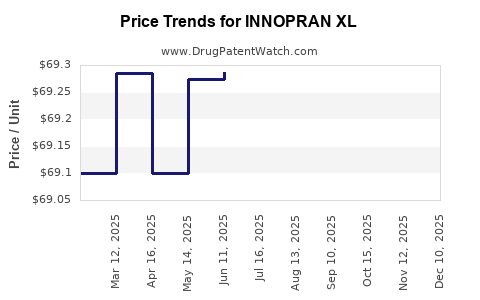
Pricing Strategy and Projections
| Region |
Current Price Range (per 500 mg tab) |
Projected Price (per tab, year 2023-2025) |
Market Entry Price |
Comments |
| North America |
$0.10 - $0.20 |
$0.15 - $0.25 |
$0.15 |
Premium due to extended release |
| Europe |
€0.12 - €0.25 |
€0.20 - €0.30 |
€0.20 |
Price varies by country |
| Asia-Pacific |
$0.05 - $0.12 |
$0.07 - $0.15 |
$0.07 |
Competitive pricing critical |
| Latin America |
$0.08 - $0.18 |
$0.10 - $0.20 |
$0.10 |
Market sensitive to cost |
Price Drivers:
- Product Differentiation: Extended-release offers a longer duration of pain relief, allowing a premium.
- Regulatory Charges: Approval costs and patent protections influence initial pricing.
- Reimbursement Policies: Insurance coverage and OTC classification affect consumer price points.
Market Penetration and Revenue Outlook
Initial launch in North America expected to generate revenues between $100 million and $200 million in year one, based on sales volume estimates and unit pricing. Market capture targets approximately 10% of the extended-release acetaminophen segment within three years.
Key Risks
- Patent expiration or litigation could lead to generic competition by 2030.
- Market preference for alternative analgesics, such as opioids or NSAIDs, could limit growth.
- Regulatory hurdles in emerging markets may delay launch timelines.
Summary
INNOPRAN XL has potential in the extended-release acetaminophen market, with high margins achievable through premium pricing in developed markets. The primary challenge remains market penetration against established brands, requiring aggressive marketing and favorable regulatory positioning.
Key Takeaways
- The global analgesic market is expected to grow at 4.2% CAGR, reaching ~$30 billion by 2028.
- INNOPRAN XL targets a niche offering longer-lasting pain relief, enabling premium pricing.
- Regional prices vary, influenced by market maturity, regulatory environment, and competitive dynamics.
- Revenue projections indicate potential sales of $100 million to $200 million in initial North American launch.
- Patent life until 2030 provides a window for market growth before generic competition emerges.
FAQs
1. How does INNOPRAN XL differentiate from existing acetaminophen products?
It offers an extended-release formulation that prolongs pain relief, reducing dosing frequency compared to standard tablets.
2. What are the primary risks to INNOPRAN XL’s market penetration?
Key risks include patent challenges, market acceptance, regulatory delays, and competition from generics.
3. How does patent protection influence pricing?
Patent exclusivity allows premium pricing by limiting generic competition; once expired, prices typically decline significantly.
4. Which markets are most attractive for INNOPRAN XL?
North America and Europe offer high margins due to established healthcare infrastructure and consumer willingness to pay a premium for extended-release drugs.
5. What is the outlook for long-term revenue from INNOPRAN XL?
If successfully launched, the product can sustain revenues until patent expiry, with potential for lifecycle extensions through formulations or indications.
References
[1] MarketWatch. "Global Analgesics Market Size, Outlook and Forecast." 2022.