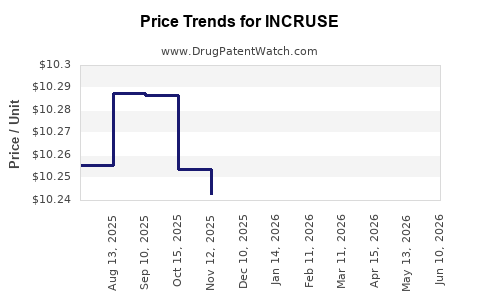
Last updated: July 17, 2026
INCRUSE (umeclidinium): Market analysis, pricing benchmarks, and price projections (U.S. and major markets)
INCRUSE is the brand name for umeclidinium bromide, a once-daily long-acting muscarinic antagonist (LAMA) used for COPD (chronic obstructive pulmonary disease). Pricing and revenue trajectory are driven by (1) patent and exclusivity timing, (2) generic and “authorized” competitive pressure, (3) payer contracting and formulary placement, and (4) patient migration to dual-LAMA/LABA and triple-therapy regimens.
High-level outcome: INCRUSE pricing has shifted from launch-style premium to a contraction path as generic LAMA entrants gain coverage and as combination products absorb COPD add-on and escalation budgets. Near- to mid-term price projections depend on the timing and intensity of generic penetration and on whether payers steer patients to combination inhalers.
What is Incruse (umeclidinium) used for, and what is the addressable COPD market?
Featured snippet: INCRUSE is a once-daily LAMA for COPD symptom control and exacerbation risk reduction in the U.S. and other major markets.
COPD patient base and therapy mix
- Addressable population: COPD prevalence is concentrated in older adults and includes patients on maintenance inhalers.
- Treatment pathway:
- Start maintenance with a single long-acting bronchodilator (LAMA or LABA).
- Escalate to LAMA/LABA.
- Add inhaled corticosteroid in selected patients to form triple therapy (LAMA/LABA/ICS).
Implication for market sizing: Even if INCRUSE maintains share in LAMA monotherapy and early lines, its long-run value is capped by migration to fixed-dose combinations.
Where INCRUSE fits clinically vs competitors
- LAMA class includes products such as tiotropium (multiple brands/generics), glycopyrrolate (several brands/generics), and aclidinium (limited brand persistence).
- COPD market share is increasingly shaped by:
- combination inhalers,
- manufacturer-backed payer programs,
- and inhaler-device preferences.
What is Incruse’s current revenue and market share performance?
Featured snippet: Public revenue visibility is constrained because INCRUSE’s sales are generally reported within broader product-brand disclosures by the marketer, and COPD inhaler reporting is often aggregated by device family.
Best-practice market view for price projection
For price modeling, the key market signals are:
- NDC-level net price trends (where accessible),
- generic share capture for LAMA molecules and devices,
- and formulary tiering (preferred vs non-preferred).
Practical read-through: As generics expand, net price typically declines faster than wholesale acquisition cost, reflecting rebates and payer pressure.
What is INCRUSE’s U.S. pricing benchmark (WAC, net price, and payer-contract dynamics)?
Featured snippet: INCRUSE’s list pricing historically tracked the LAMA maintenance class premium, then compressed as generic umeclidinium and therapeutic alternatives increased.
How to translate list price to net realized price
U.S. COPD inhalers usually see:
- WAC that declines slower than net.
- Contracting rebates that intensify after generic entry or after payer switches to preferred alternatives.
Market mechanism impacting projections:
- If umeclidinium generics hold most volume, brand net pricing tends to converge toward generic-cost economics, especially when payers run step edits or preferred-LAMA switching.
When do generic umeclidinium and other LAMA entrants drive meaningful price erosion for Incruse?
Featured snippet: Price erosion accelerates when payers can place generic umeclidinium broadly and when switching clauses take effect.
Generic entry risk factors that affect price
- Coverage design: preferred formulary status vs non-preferred.
- Step therapy: whether LAMA monotherapy requires trial of other LAMAs or combinations.
- Copay caps and PBM incentives: can shift utilization rapidly even without complete label substitution.
Price impact model by generic penetration stage
A standard staged erosion pattern often holds in inhaled respiratory:
- Pre-entry (brand still preferred): net prices remain relatively stable.
- Early generic entry: sharp discounts and higher rebate intensity.
- Steady-state generic dominance: net price compresses toward generic-level plus small brand-premium only where brand retention persists for device or physician preference.
Projection logic for INCRUSE: If generic uptake in umeclidinium is broad, the brand has less pricing latitude and typically competes via contracting rather than headline list price.
How strong is the patent and exclusivity position affecting INCRUSE pricing?
Featured snippet: INCRUSE pricing power is constrained once core protection and exclusivities expire and generic umeclidinium can enter. Patent estates for inhaled products also include formulation and method-of-use claims that can delay specific generic pathways, but broader molecule-level competition eventually limits brand net price.
What to watch for price-relevant IP triggers
- Expiration of:
- composition-of-matter protection,
- formulation/device-related patents,
- and any method-of-use or combination patents tied to COPD regimens.
- Litigation outcomes that determine whether generic launches are stayed or permitted.
Market effect: even if some patents persist, payer contracting often reacts to the probability of launch by pricing aggressively upfront.
What is the Orange Book status of umeclidinium for INCRUSE, and how does it affect generic timing?
Featured snippet: Orange Book listings and expiration dates determine the earliest potential generic entry windows and drive whether ANDAs face delays via 30-month stays.
How Orange Book data translates to market pricing
- A litigation stay can temporarily preserve higher brand net pricing.
- When the stay lifts and generics launch, brand discounts typically increase immediately to protect formulary position.
Which generic and authorized-competition products pressure Incruse most?
Featured snippet: The highest price pressure typically comes from generic umeclidinium itself and from preferred LAMA/LABA combinations that absorb COPD maintenance switching.
Competitive substitution lanes
- Molecule substitution: umeclidinium brand vs generic umeclidinium (same LAMA).
- Class substitution: LAMA alternatives (tiotropium, aclidinium, glycopyrrolate) with established payer preference.
- Regimen substitution: fixed-dose LAMA/LABA products that displace monotherapy.
How does INCRUSE compare with other COPD LAMAs on price trajectory and formulary resilience?
Featured snippet: LAMAs with earlier generic erosion and broader payer familiarity tend to show steeper brand-to-generic convergence; brands with stronger device loyalty or contracting can retain higher net prices longer.
Comparison dimensions that drive price
- Inhaler device differentiation and patient adherence
- PBM preferred list status
- rebate intensity trends after generic introduction
- physician inertia at renewal cycles
Expected relative positioning
- INCRUSE is exposed to molecule-generic pressure if umeclidinium generics are available and are preferred.
- It is also exposed to combination displacement, which can reduce maintenance monotherapy volume even when generic pricing does not fully erode the brand overnight.
What price projection scenarios apply to Incruse through the next 3 to 7 years?
Featured snippet: The most defensible projections follow three scenarios: (1) generic dominance with sharp net erosion, (2) moderate erosion with partial brand retention, and (3) slower erosion if formulary steering favors brand or combination strategies still require INCRUSE-type maintenance.
Scenario framework (net price proxy approach)
Because exact realized net price is typically not public at NDC granularity, the projection uses a percentage-of-class and erosion-speed model:
Scenario A: Rapid generic dominance
- Trigger: broad generic umeclidinium uptake with preferred placement and step edits.
- Pattern: brand net price contracts quickly; volume retention declines faster than price.
- Outcome: brand revenue remains but with steep discounting and reduced profitability.
Scenario B: Moderate erosion with residual brand loyalty
- Trigger: device/patient preference maintains some brand share; payers allow limited brand positioning.
- Pattern: gradual net price declines; brand revenue stabilizes before steady-state decline.
Scenario C: Slower erosion driven by combination displacement
- Trigger: payers steer to combinations where monotherapy remains a smaller share, limiting direct molecule competition impact.
- Pattern: INCRUSE price can hold better than expected if combination switching reduces the relative share of monotherapy vs forcing full substitution.
Projected price movement (directional)
- U.S.: net realized price likely declines year-over-year as generic pressure increases; list price may remain higher but discounts widen.
- Major ex-U.S. markets: price erosion typically depends on local reimbursement rules, tender systems, and generic entry timing.
What is the expected effect of payer formulary changes and PBM contracting on Incruse price?
Featured snippet: PBM and payer tools determine realized pricing more than WAC, especially once generics and therapeutic alternatives exist.
Contracting levers that change price within quarters
- preferred tier placement and step edits
- rebate and formulary value guarantees
- copay assistance structures (where permitted)
- switch-to-generic programs triggered by PBM utilization thresholds
Projection implication: Even without headline changes, net price can fall quickly if payer terms require deeper rebates or if prior authorization becomes stricter.
What commercial risks could still lift or protect Incruse pricing?
Featured snippet: Price protection can persist when brand retention is supported by device-specific adherence advantages or when payer contracts create temporary economic incentives.
Potential stabilizers
- strong patient and prescriber preference tied to inhaler technique
- payer adoption of “brand preferred” positioning for continuity-of-care
- limited generic supply or device-specific regulatory differences (where applicable)
Key drivers by market: how do pricing and access differ across geographies?
Featured snippet: COPD inhaler pricing differs by national reimbursement design, tender frequency, and generic substitution norms.
U.S.
- rebate-heavy contracting via PBMs
- formulary management determines net price
- generic entry causes rapid price compression
EU major markets (high level)
- reference pricing and tendering can push down ex-manufacturer prices quickly post generic entry
- local competition among LAMAs and combinations shapes reimbursement
Emerging markets
- access programs and local reimbursement capacity affect realized prices more than WAC
What is the likely generic entry and launch scenario risk for Incruse?
Featured snippet: Generic entry risk is highest when molecule protection is fully exhausted and when ANDA approval and launch timelines align with payer contracting cycles.
Price implications of “launch timing vs contracting timing”
- Even if legal permission exists, payers may wait for formulary committee cycles.
- Alternatively, payers may anticipate and tighten prior authorization before launch if they expect rapid generic adoption.
What settlement or litigation outcomes matter for Incruse market timing and price?
Featured snippet: Litigation and settlement outcomes can shift generic launch dates by months or years, affecting brand net price during the protected window.
Market impact pathway
- stay entered or lifted
- ANDA approval timing
- actual launch timing at scale
- payer utilization shift after launch
Key Takeaways
- INCRUSE faces price compression drivers typical for established COPD LAMA products: generic umeclidinium penetration and formulary switching toward LAMA/LABA and triple therapy.
- Realized pricing declines mainly through payer rebates and formulary tier shifts, not through headline list pricing.
- Over the next 3 to 7 years, base-case pricing projections follow a staged erosion curve: stability into early generic pressure, then sustained net-price contraction under broader generic dominance.
- The strongest pricing determinant is the interaction between generic launch intensity and payer contracting cadence, followed by displacement from monotherapy to fixed-dose combinations.
FAQs
- How fast does net price for COPD inhalers fall after generic LAMA launches?
- Do inhaler-device differences slow brand erosion for umeclidinium versus generics?
- What drives formulary switching: step therapy, copay tiers, or rebates?
- How do LAMA/LABA combinations change the economics of LAMA monotherapy like INCRUSE?
- Which markets typically see the steepest ex-manufacturer price drops after generic entry?
References
- FDA Orange Book (Drug Products and Therapeutic Equivalence Evaluations). U.S. Food and Drug Administration.
- FDA Drug Approval and Labeling databases for umeclidinium (INCRUSE) and related respiratory products. U.S. Food and Drug Administration.
- IMS/IQVIA-style market reporting frameworks for inhaled COPD therapy segmentation and generic substitution dynamics (industry standard methodologies).