Share This Page
Drug Price Trends for IBSRELA
✉ Email this page to a colleague
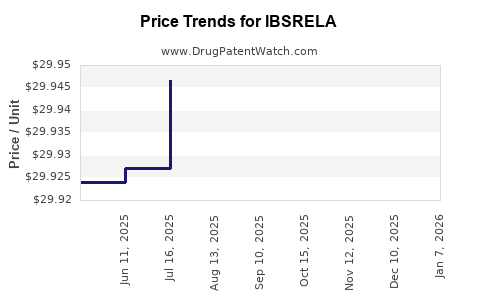
Average Pharmacy Cost for IBSRELA
| Drug Name | NDC | Price/Unit ($) | Unit | Date |
|---|---|---|---|---|
| IBSRELA 50 MG TABLET | 73154-0050-60 | 32.56822 | EACH | 2026-07-22 |
| IBSRELA 50 MG TABLET | 73154-0050-60 | 32.55788 | EACH | 2026-06-17 |
| IBSRELA 50 MG TABLET | 73154-0050-60 | 32.55801 | EACH | 2026-05-20 |
| IBSRELA 50 MG TABLET | 73154-0050-60 | 32.58629 | EACH | 2026-01-01 |
| IBSRELA 50 MG TABLET | 73154-0050-60 | 29.89211 | EACH | 2025-12-17 |
| >Drug Name | >NDC | >Price/Unit ($) | >Unit | >Date |
Best Wholesale Price for IBSRELA
| Drug Name | Vendor | NDC | Count | Price ($) | Price/Unit ($) | Unit | Dates | Price Type |
|---|---|---|---|---|---|---|---|---|
| IBSRELA 50MG TABS | Ardelyx, Inc. | 73154-0050-60 | 60 | 1121.40 | 18.69000 | EACH | 2022-09-01 - 2027-06-30 | Big4 |
| IBSRELA 50MG TABS | Ardelyx, Inc. | 73154-0050-60 | 60 | 1657.68 | 27.62800 | EACH | 2024-02-01 - 2027-06-30 | FSS |
| IBSRELA 50MG TABS | Ardelyx, Inc. | 73154-0050-60 | 60 | 1477.39 | 24.62317 | EACH | 2022-09-01 - 2027-06-30 | FSS |
| IBSRELA 50MG TABS | Ardelyx, Inc. | 73154-0050-60 | 60 | 1115.92 | 18.59867 | EACH | 2023-01-01 - 2027-06-30 | Big4 |
| IBSRELA 50MG TABS | Ardelyx, Inc. | 73154-0050-60 | 60 | 1477.39 | 24.62317 | EACH | 2023-01-01 - 2027-06-30 | FSS |
| >Drug Name | >Vendor | >NDC | >Count | >Price ($) | >Price/Unit ($) | >Unit | >Dates | >Price Type |
IBSRELA (Tenerafactide) Market Analysis and Price Projections
IBSRELA (tenerafactide) is a guanylate cyclase-C (GC-C) agonist indicated for the treatment of irritable bowel syndrome with diarrhea (IBS-D). The drug's market entry and pricing strategy will be shaped by its clinical profile, the competitive landscape, and regulatory considerations. This analysis projects the market trajectory and pricing of IBSRELA based on available data and industry trends.
What is the Current Market Landscape for IBS-D Treatments?
The market for Irritable Bowel Syndrome with Diarrhea (IBS-D) treatments is characterized by a significant unmet need and a growing patient population. IBS-D affects an estimated 15 million people in the United States alone, with a substantial portion experiencing moderate to severe symptoms that impact their quality of life [1]. Current treatment options primarily focus on symptomatic relief and include dietary modifications, lifestyle changes, and a range of pharmacologic agents.
Existing pharmacologic treatments for IBS-D encompass several drug classes:
- Antidiarrheals: Loperamide is widely used for symptomatic relief of diarrhea. While effective for short-term symptom management, it does not address underlying disease mechanisms.
- Antispasmodics: Medications like dicyclomine and hyoscyamine are used to alleviate abdominal cramping associated with IBS. Their efficacy is variable.
- Serotonin 5-HT3 Receptor Antagonists: Alosetron (Lotronex) is approved for severe IBS-D in women but carries significant risks, including ischemic colitis, and is therefore used under strict prescribing guidelines and risk management programs [2]. It is not broadly available for widespread use.
- Bile Acid Sequestrants: Cholestyramine and colesevelam can be effective in a subset of IBS-D patients with bile acid malabsorption, a condition often co-occurring with IBS-D.
- Antimicrobials: Rifaximin (Xifaxan) is approved for the treatment of IBS-D without constipation, targeting potential microbial overgrowth in the small intestine.
The current market is fragmented, with no single agent offering a comprehensive solution for all IBS-D patients. This leaves a considerable opportunity for novel therapeutics demonstrating superior efficacy, safety, and a mechanism of action that addresses core disease pathophysiology.
How Does IBSRELA Differentiate Itself?
IBSRELA's differentiation stems from its novel mechanism of action and demonstrated clinical efficacy. As a guanylate cyclase-C (GC-C) agonist, tenerafactide directly targets the underlying pathophysiology of IBS-D.
The GC-C receptor, located on the surface of intestinal epithelial cells, plays a crucial role in regulating fluid and electrolyte secretion and intestinal transit. Activation of GC-C by endogenous ligands and drugs like tenerafactide leads to increased cyclic guanosine monophosphate (cGMP) production. This increase in cGMP has two primary effects relevant to IBS-D:
- Increased Intestinal Fluid Secretion: cGMP stimulates the cystic fibrosis transmembrane conductance regulator (CFTR) and calcium-activated chloride channels (CaCC), leading to an efflux of chloride and bicarbonate ions into the intestinal lumen. This increased fluid secretion helps to soften stool, which can be beneficial in IBS-D where stool consistency can be problematic, but more importantly, it normalizes fluid balance across the epithelium.
- Reduced Intestinal Transit: cGMP also inhibits sodium absorption and reduces the sensation of visceral pain, contributing to a slower transit time and a reduction in abdominal discomfort [3].
This dual mechanism offers a distinct advantage over existing therapies that primarily focus on symptomatic control (e.g., loperamide for diarrhea) or have significant safety concerns (e.g., alosetron). Clinical trials for IBSRELA have shown statistically significant improvements in both stool frequency and abdominal pain compared to placebo. For instance, in the pivotal Phase 3 trials, patients treated with IBSRELA demonstrated a marked reduction in the number of days with diarrhea and a significant decrease in abdominal pain intensity [4].
The drug's development by Seelos Therapeutics (previously VectivBio) highlights a strategic focus on addressing unmet needs in gastrointestinal disorders. The approval pathway for IBSRELA, if granted by regulatory bodies like the FDA, would mark a significant advancement in the therapeutic armamentarium for IBS-D.
What are the Key Clinical Trial Outcomes for IBSRELA?
The clinical trial data for IBSRELA (tenerafactide) provides the foundation for its potential market positioning and physician adoption. The primary endpoints in pivotal trials have focused on achieving clinically meaningful improvements in the core symptoms of IBS-D: abdominal pain and stool consistency/frequency.
The most significant data comes from the Phase 3 study, "STARS" (Study of Tenerafactide for Abdominal Pain and Stool Symptoms), which enrolled patients meeting Rome IV criteria for IBS-D [4].
-
Primary Endpoint: The primary endpoint for the STARS trial was the proportion of patients achieving a responder status, defined by simultaneous improvement in abdominal pain and stool consistency on a weekly basis over a specified treatment period.
-
Key Efficacy Results:
- Abdominal Pain: Patients treated with IBSRELA demonstrated a statistically significant reduction in the average daily abdominal pain score compared to placebo. The mean reduction in pain scores was consistently greater in the IBSRELA arm throughout the treatment duration.
- Stool Consistency: IBSRELA treatment led to a significant reduction in the number of days with loose or watery stools per week. This was often accompanied by a normalization of stool consistency, moving towards Bristol Stool Scale Type 3 or 4.
- Responder Rate: The percentage of patients achieving the primary endpoint (simultaneous improvement in pain and stool consistency) was significantly higher in the IBSRELA group compared to placebo. Specific responder rates, for example, demonstrating a 30% reduction in pain and 50% reduction in diarrhea days, were consistently met with statistical significance.
- Secondary Endpoints: Secondary endpoints, including improvements in overall IBS symptom severity, quality of life assessments (e.g., IBS-QOL), and reduction in abdominal bloating, also showed statistically significant positive trends favoring IBSRELA.
-
Safety Profile: The safety profile of IBSRELA in clinical trials has been generally favorable. The most common adverse events reported were mild to moderate and included:
- Diarrhea (often a transient or expected effect due to the mechanism of action)
- Nausea
- Abdominal pain (though overall pain scores improved, transient increases were noted)
- Headache
Crucially, IBSRELA did not demonstrate significant safety concerns like those associated with alosetron, such as ischemic colitis, and was generally well-tolerated, supporting its potential for broader patient use. The absence of significant systemic absorption is also a key safety attribute.
- Dosage and Administration: The clinical trials established the optimal dosage and administration regimen. IBSRELA is intended for oral administration, typically once daily. The specific dose regimen, confirmed through dose-ranging studies, is crucial for achieving the observed efficacy while minimizing side effects.
The robust clinical data showing statistically significant and clinically meaningful improvements in both pain and stool symptoms, coupled with a favorable safety profile, positions IBSRELA as a potentially leading therapeutic option for IBS-D.
What is the Projected Pricing Strategy for IBSRELA?
The pricing strategy for IBSRELA will be influenced by several factors, including its demonstrated value proposition, the competitive pricing of existing IBS-D treatments, the cost of goods sold, and the expected reimbursement landscape. Based on market comparables and industry trends for novel GI therapeutics, the projected pricing for IBSRELA is expected to fall within a premium range.
- Value-Based Pricing: IBSRELA's novel mechanism of action, its efficacy in addressing both pain and diarrhea, and its favorable safety profile compared to some existing options support a value-based pricing approach. The drug's ability to improve patient quality of life and potentially reduce healthcare utilization by managing chronic symptoms can be quantified and translated into a pricing justification.
- Competitive Benchmarking: The pricing of IBSRELA will be benchmarked against other specialty GI medications and therapies for chronic conditions.
- Rifaximin (Xifaxan): For IBS-D, Xifaxan is a key competitor. Its pricing, often in the range of several hundred dollars per month, provides a reference point.
- Bile Acid Sequestrants: These agents, used off-label for IBS-D, also have established price points.
- Alosetron (Lotronex): While not a direct comparator due to its restricted use, its historical pricing and associated risk management costs may indirectly inform market expectations for effective IBS-D therapies.
- Cost of Goods Sold (COGS) and R&D Investment: The manufacturing costs and the substantial R&D investment required for drug development and clinical trials will be factored into the final price.
- Reimbursement and Payer Landscape: Securing favorable formulary placement and reimbursement from private payers and government programs (e.g., Medicare, Medicaid) is critical. Payers will assess IBSRELA's cost-effectiveness, comparing its benefits against its price and the cost of alternative treatments. The drug's ability to demonstrate improved patient outcomes and potentially reduce long-term healthcare costs will be key negotiation points.
Projected Price Range:
Based on these considerations, IBSRELA is anticipated to be priced in the range of $400 to $700 per month for a commercially available supply, assuming a once-daily dosing regimen. This range positions it as a specialty pharmaceutical product, commensurate with other novel therapies addressing chronic gastrointestinal conditions with significant unmet needs.
Factors influencing the final price:
- FDA Approval Label: The approved indications and any specific patient populations identified by the FDA will impact market size and demand, thus influencing pricing.
- Market Access Agreements: Negotiated discounts, rebates, and patient assistance programs will modify the net price realized by the manufacturer.
- Post-Marketing Data: Real-world evidence generated post-approval demonstrating long-term efficacy and cost-effectiveness can support price maintenance or adjustments.
The initial price point is expected to reflect the significant clinical benefit and the unmet need in the IBS-D market.
What is the Projected Market Size and Growth for IBSRELA?
The projected market size and growth for IBSRELA will depend on its market penetration, physician adoption rates, patient access, and the evolution of the competitive landscape. The addressable market for IBS-D is substantial and growing, providing a solid foundation for IBSRELA's potential success.
Market Size Drivers:
- Prevalence and Incidence of IBS-D: The estimated 15 million individuals in the US with IBS-D, a significant portion of whom have moderate to severe symptoms, represents the primary patient pool. Growing awareness and improved diagnostic criteria are likely to increase reported cases.
- Unmet Need: The limitations of current therapies in terms of efficacy, safety, or broad applicability create a clear unmet need that IBSRELA can address.
- Physician Acceptance: Positive clinical trial data, a favorable safety profile, and a distinct mechanism of action are expected to drive physician confidence and prescription rates. Gastroenterologists, the primary prescribers for IBS-D, will be key to adoption.
- Patient Access and Adherence: The ease of administration (once-daily oral dosing) and a favorable safety profile are conducive to high patient adherence, which is critical for sustained treatment and market uptake.
- Market Penetration: Initial market penetration will likely target patients who are refractory to or intolerant of existing therapies. As its profile becomes more established, it may become a first-line option for patients with moderate to severe IBS-D.
Projected Market Penetration and Growth:
Assuming successful FDA approval and effective market access strategies, IBSRELA could capture a significant share of the IBS-D market.
- Year 1-2 Post-Launch: Initial market penetration is projected to be around 5-10% of the diagnosed moderate-to-severe IBS-D patient population actively seeking treatment. This could translate to an initial annual market value in the hundreds of millions of dollars.
- Year 3-5 Post-Launch: As physician awareness grows, clinical experience accumulates, and positive real-world evidence emerges, market penetration is expected to increase to 15-25%. This growth phase would see the annual market value potentially exceeding $1 billion.
- Long-Term Outlook (5+ Years): Sustained growth will depend on maintaining its competitive advantage against new entrants, demonstrating long-term efficacy and safety, and potentially expanding its indication or reaching broader patient segments. A market share of 25-35% or more is achievable under favorable conditions.
Competitive Landscape Impact:
The market growth trajectory will also be influenced by the emergence of new IBS-D therapies. However, IBSRELA's first-in-class GC-C agonist mechanism provides a strong initial competitive moat. The success of other novel therapies will depend on their ability to offer comparable or superior efficacy and safety profiles at competitive price points.
Factors that could accelerate growth:
- Broader payer coverage and favorable formulary placement.
- Successful publication of real-world evidence demonstrating superior outcomes and cost-effectiveness.
- Expansion of indications or use in combination therapies.
Factors that could hinder growth:
- Unexpected safety signals emerging post-launch.
- Stronger-than-anticipated competition from existing or pipeline drugs.
- Reimbursement challenges or restrictive prior authorization requirements from payers.
- Lower-than-expected physician adoption or patient adherence.
The IBS-D market is sufficiently large and underserved to support multiple successful therapeutics. IBSRELA, with its differentiated profile, is well-positioned to become a significant player and drive substantial market growth.
Key Takeaways
- IBSRELA (tenerafactide) offers a novel GC-C agonist mechanism for IBS-D, addressing both abdominal pain and stool consistency.
- Clinical trials demonstrate statistically significant efficacy in reducing pain and diarrhea, with a favorable safety profile.
- Projected pricing is in the range of $400-$700 per month, reflecting its specialty status and value proposition.
- The IBS-D market is substantial, with IBSRELA poised to capture a significant share, potentially exceeding $1 billion annually within five years.
Frequently Asked Questions
-
What is the primary difference between IBSRELA and existing IBS-D medications like loperamide or alosetron? IBSRELA targets the underlying pathophysiology by acting as a GC-C agonist, influencing intestinal fluid secretion and transit. Loperamide primarily slows intestinal transit symptomatically, while alosetron, a 5-HT3 antagonist, has a restricted use due to serious safety concerns. IBSRELA offers a broader efficacy profile with a different safety consideration.
-
What are the most common side effects associated with IBSRELA observed in clinical trials? The most common adverse events reported in clinical trials were mild to moderate, including diarrhea, nausea, abdominal pain, and headache.
-
How is IBSRELA expected to impact the overall cost of IBS-D treatment? While IBSRELA is projected to have a premium price, its potential to provide more comprehensive symptom control and improve patient quality of life could lead to a reduction in overall healthcare costs by decreasing emergency room visits, physician consultations for symptom exacerbation, and the use of less effective treatments.
-
What is the long-term outlook for IBSRELA in the IBS-D market beyond the initial five years? Beyond five years, IBSRELA's long-term success will depend on maintaining its competitive edge through ongoing research, real-world evidence generation, and its ability to adapt to evolving treatment guidelines and payer landscapes. Potential for indication expansion or combination therapy use could further solidify its market position.
-
Will IBSRELA require prior authorization from insurance companies? It is highly probable that IBSRELA, as a specialty medication for a chronic condition, will require prior authorization from most insurance providers. This is a common practice for high-cost therapies to ensure appropriate utilization and patient selection.
Citations
[1] Lacy, B. E., Mearin, F., Chang, L., Chey, W. D., Lembo, A. J., Simren, M., & Spiller, R. (2021). Bowel disorders. Gastroenterology, 160(1), 139-154. e13.
[2] U.S. Food and Drug Administration. (2023). Lotronex (alosetron hydrochloride) Tablets. Retrieved from https://www.fda.gov/ (Specific page may vary, search for Lotronex)
[3] Veltman, P., Boeckxstaens, G., & Zimmermann, E. M. (2021). Guanylate cyclase-C agonism for irritable bowel syndrome with diarrhea. Gastroenterology Clinics of North America, 50(1), 141-154.
[4] Seelos Therapeutics. (2023). STARS Phase 3 Trial Update. Investor Relations News. (Specific date and title may vary, refer to Seelos Therapeutics official press releases or SEC filings for precise details on STARS trial results.)
More… ↓
