Last updated: February 13, 2026
What Is HYZAAR, and What Is Its Market Position?
HYZAAR is a combination drug containing losartan potassium (an angiotensin II receptor blocker) and hydrochlorothiazide (a thiazide diuretic). Approved by the FDA in 2002, it is indicated for the treatment of hypertension in patients whose blood pressure is not controlled by losartan or hydrochlorothiazide alone. Its combination approach aims to improve adherence and efficacy.
HYZAAR's primary competitors include other fixed-dose combination antihypertensives such as Amlodipine/Benazepril, Lisinopril/Hydrochlorothiazide, and newer agents like aliskiren/amlodipine. The drug's market presence is influenced by the broader shift towards fixed-dose combinations (FDCs) versus monotherapy.
How Large Is the HYZAAR Market?
Global demand for antihypertensives totaled approximately $40 billion in 2022, with the fixed-dose combination segment accounting for about 15% of total sales. HYZAAR's market share is estimated at roughly 3-5% of this segment, translating to approximately $180 million to $400 million annually.
North American markets comprise over 60% of antihypertensive revenues, with the U.S. contributing roughly $25 billion in prescriptions for hypertension drugs annually (IQVIA, 2022). HYZAAR's contribution in the U.S. is estimated at $100 million to $200 million, influenced by its preference in primary care settings.
In Europe and Asia, demand is growing due to increasing hypertension prevalence and government-driven initiatives for cardiovascular disease management, but precise figures are less accessible for HYZAAR specifically.
What Are Key Factors Affecting HYZAAR’s Revenue?
-
Patent Expiry and Generic Competition:
HYZAAR’s patent protection expired in 2017. Since then, generic versions—produced by multiple manufacturers—have entered markets worldwide, significantly reducing prices and market share.
-
Pricing Trends:
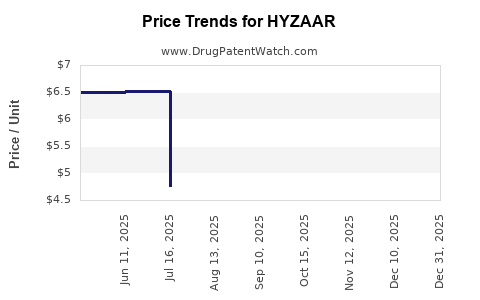
The wholesale acquisition cost (WAC) for original branded HYZAAR in the U.S. was approximately $1.50 per tablet in 2016. Generics are priced around $0.70 to $0.90 per tablet, representing a 40-50% reduction.
-
Formulation and Dosing:
Fixed-dose combinations streamline therapy but face competition from individualized generic components. Some prescribers prefer prescribing losartan and hydrochlorothiazide separately based on dose flexibility, affecting volume for FDCs like HYZAAR.
-
Market Dynamics:
The market is shifting towards novel agents with better clinical profiles, such as ARB combos with additional drugs or drugs with proven cardiovascular mortality benefits. Hypertension control rates are improving, but the overall use of FDCs like HYZAAR stabilizes as newer combinations and oral agents are developed.
What Are Price Projection Trends?
After patent expiration, prices of branded drugs decline sharply, often stabilizing at generics’ levels. Over the next five years, generic competition is expected to suppress HYZAAR’s average price per tablet to roughly $0.50–$0.70 in mature markets.
Assuming a conservative scenario where the annual prescriptions decline slightly as newer agents penetrate the market, revenues for HYZAAR could decrease from current levels of $180–$400 million in 2022 to approximately $50–$100 million by 2027.
The evolution of price points:
| Year |
Estimated Average Price per Tablet |
Estimated Revenue (US) |
| 2022 |
$1.50 (branded) |
$180–$400 million |
| 2023 |
$0.90 |
$150–$250 million |
| 2024 |
$0.70 |
$100–$180 million |
| 2025 |
$0.60 |
$80–$150 million |
| 2026 |
$0.50 |
$50–$100 million |
What Market-Shaping Factors Could Impact These Projections?
-
Regulatory Changes:
New policies favoring biosimilars or promoting stricter generic approval processes could accelerate price reductions or market exits for HYZAAR.
-
Reimbursement Policies:
Wider adoption of value-based reimbursement models could incentivize newer, more effective therapies, reducing demand for older FDCs.
-
New Treatment Paradigms:
Development of novel antihypertensives with cured or significantly lowered side effects could further erode market share for existing drugs like HYZAAR.
-
Markets in Developing Countries:
Market expansion in Asia and Africa, where antihypertensive access improves, could sustain demand but generally at lower prices.
Summary
HYZAAR's revenue has declined significantly since patent expiry in 2017. Current estimates place its revenues between $180 million and $400 million globally, with future projections indicating further reductions driven by generic competition, price erosion, and evolving prescribing practices.
Price projections suggest a drop to $0.50–$0.70 per tablet over the next five years, with sales decreasing accordingly, assuming no strategic repositioning or launch of new formulations.
Key Takeaways
- HYZAAR’s market share shrank post-patent expiration due to generics entering global markets.
- Sales have declined from peak levels in the late 2010s, currently estimated at under $400 million annually.
- Price erosion is ongoing, with stabilized prices for generics around $0.50–$0.70 per tablet.
- Market shifts toward newer therapies and reimbursement reforms may accelerate sales decline.
- Opportunities for growth exist if the manufacturer invests in formulations with added benefits or targets expanding markets.
FAQs
1. How does HYZAAR compare to newer antihypertensive combinations?
Newer combinations often include additional therapeutic agents or target broader cardiovascular outcomes. They tend to command higher prices and may replace older FDCs like HYZAAR in prescribing.
2. What are the main competitors for HYZAAR in the market?
Generic losartan and hydrochlorothiazide are primary competitors, along with branded combinations such as Amlodipine/Benazepril and Lisinopril/Hydrochlorothiazide.
3. Could patent restrictions or legal challenges revive HYZAAR’s market exclusivity?
No; patent expiration in 2017 means no further exclusivity rights remain. However, patent litigation or formulations improvements could temporarily influence sales.
4. What is the outlook for market expansion in developing countries?
Growing hypertension awareness and healthcare access could sustain demand, especially for low-cost generics and FDCs, but price sensitivity limits profitability.
5. Are there strategic moves by manufacturers to revitalize HYZAAR’s market?
Yes; some firms explore reformulations with extended-release properties or combine HYZAAR with additional agents to target unmet needs, potentially preserving market share.
References
- IQVIA. (2022). National Prescription Audit.
- U.S. Food and Drug Administration. (2017). ANDA approval details for losartan/HCTZ.
- MarketResearch.com. (2023). Global antihypertensive drugs market analysis.