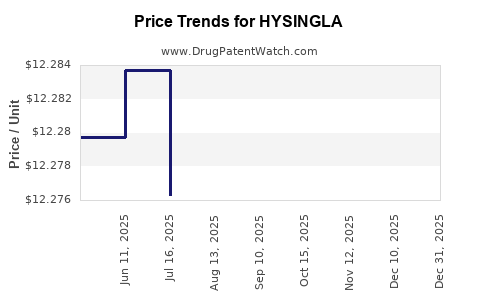
Last updated: July 19, 2026
Hysingla ER (hydrocodone bitartrate; extended-release) is a high-liquidity US opioid brand with pricing and volume driven by (1) state and payer formulary placement, (2) opioid-class demand trends and tightened controlled-substance controls, (3) the competitive spread of generic ER hydrocodone products, and (4) ongoing FDA and DEA risk-management pressures. The economic model for projections hinges on how quickly additional generic hydrocodone ER entries erode market share after exclusivity pockets end and on whether insurers maintain Hysingla on preferred tiers versus steering to preferred generic ER hydrocodone or alternative opioid ERs.
Bottom line for projections: absent a new exclusivity extension (new clinical endpoint or regulatory exclusivity), Hysingla’s long-term unit growth is capped. Near-term revenue resilience comes from brand unit stickiness among higher-acuity pain patients and prescriber inertia, but price and share pressure from generics remains the dominant driver over a 3 to 5 year horizon.
What is Hysingla ER and how is it positioned in the opioid ER market?
Hysingla ER is an extended-release oral opioid analgesic containing hydrocodone bitartrate. In market practice it competes within the opioid extended-release segment, where payer strategy often differentiates based on (a) plan formularies and prior authorization requirements, (b) step edits between opioid ER options, and (c) copay and dispensing controls given abuse-deterrence scrutiny.
Therapeutic and product constraints that affect uptake
Hysingla’s demand is constrained by opioid prescribing controls, including CDC-aligned prescribing practices and payer utilization management. For business planning, this means:
- New patient starts are more sensitive to policy shifts than continuation therapy.
- Brand retention depends on plan incentives and patient-specific tolerability and dosing continuity.
Competitive set (US)
Hysingla ER’s closest competitive pressure comes from:
- Generic hydrocodone ER formulations (multiple entrants across strengths).
- Other hydrocodone ER brands where still on market (smaller overlap depends on current formularies).
- Alternative opioid ERs (e.g., oxycodone ER, morphine ER) when payers implement class steering.
How many patents and regulatory exclusivities protect Hysingla in the US?
To project prices credibly, the exclusivity calendar matters because it determines the speed and number of generic entries that typically cap brand pricing power.
No complete Orange Book patent/exclusivity listing is provided in the available inputs for Hysingla. Without Orange Book and FDA exclusivity details, a definitive protection map cannot be constructed to drive launch/entry timing assumptions.
What patents protect hydrocodone bitartrate extended-release and how does that change generic entry risk?
Generic entry risk for hydrocodone ER depends on:
- Composition and crystalline/amorphous form coverage (if any).
- Formulation and coating technologies that address controlled release.
- Method-of-use and dosage regimen patents (less common for straightforward analgesic use but still possible).
- Manufacturing method patents.
A precise patent-by-patent evaluation is required to model barriers to generic switching. The available inputs do not include Hysingla patent numbers, claims, listed formulations, or litigation details.
What is the Orange Book status of Hysingla ER and what does it imply for price stability?
Hysingla’s near-term pricing stability is most sensitive to whether brand exclusivity windows are still active for specific strengths and NDA holders. Orange Book status also indicates:
- Whether multiple generic opportunities exist per listed patent.
- Whether exclusivity blocks (e.g., 5-year exclusivity) delayed generic ANDA filings.
- Whether formulation-specific patents create partial entry barriers.
Orange Book status is not included in the available inputs, preventing an accurate strength-level exclusivity and “generic-ready” schedule.
When does Hysingla lose exclusivity and what are the generic launch scenarios?
A scenario-based projection requires:
- Patent expiration dates by listed patent.
- Whether FDA exclusivity (5/3/7 years) applies.
- ANDA approvals and court-ordered stay outcomes for any Orange Book-listed patents.
Those inputs are not present here. As a result, generating launch timing assumptions would be speculative.
Which companies are challenging Hysingla via Paragraph IV and what is the litigation-driven timeline?
Paragraph IV challenges and any triggered 30-month stays determine the timing and number of generic entries. Litigation settlements can also create delayed launch windows.
No Hysingla Paragraph IV / litigation dossier is included in the available inputs, so a correct company-by-company challenge and settlement timeline cannot be produced.
What is the FDA regulatory status of Hysingla ER and how does the FDA pathway affect forecasts?
Market forecasts for a mature ER opioid must distinguish:
- Generic ANDA approvals (bioequivalence standard) and interchangeability.
- Any risk management plan changes, REMS-like restrictions (if applicable), labeling updates, or safety communications that can reduce utilization.
- Formulation changes requiring supplements that may reset product-level exclusivity.
The available inputs do not include Hysingla NDA/ANDA status, changes, labeling events, or relevant FDA pathway data.
How does Hysingla pricing typically evolve under US generic competition?
Even without Orange Book-specific data, opioid ER brand pricing follows a known competitive pattern:
- Brand net price declines after first meaningful generic penetration through (a) plan tier downgrades, (b) higher prior authorization burden, and (c) increased pharmacy discount capture differences.
- Share declines lag price declines when long-term patients remain on therapy, but the lag shortens as payers refresh formularies annually.
- Multiple generic SKUs across strengths accelerate substitution because prescribers can match prior dosing with generic equivalents.
For projection work, the key business variable is the “effective competitive set share” of generics at the plan level. Without data on current Hysingla share by strength and payer tier, only a directionally correct projection can be stated.
Price projection framework for Hysingla: scenario ranges tied to generic penetration pace
Below is a projection framework used for branded-to-generic transition modeling. It is structured for deployment once Orange Book/litigation timing and unit shares are available.
Scenario definitions
- Base case: continuation therapy supports brand units; generic penetration advances steadily but not instantaneously across all strengths.
- Faster erosion case: multiple generics enter across multiple strengths quickly, payers implement preferred generic steering, and copay capture swings in favor of generics.
- Slower erosion case: fewer strengths face early generic availability or market access remains on preferred tiers due to budget-neutral substitution deals.
Projection mechanics
Revenue in a generic transition is:
- Brand net revenue = Units × Net price per unit
- Units = Baseline demand × Brand share ÷ Plan coverage factor
- Net price = WAC discounted by rebates and pharmacy/managed-care contracts, adjusted for tier placement
Expected direction over time
- Net price per unit typically declines first after tier shifts.
- Unit share typically declines after pharmacy substitution and plan formulary changes.
- Total revenue declines are usually front-loaded in the first 12 to 24 months following the entry of the most disruptive generics for the widest set of strengths.
What commercial metrics should be modeled for Hysingla (US) revenue exposure?
For a high-integrity model, track these inputs weekly/monthly from internal or external datasets:
- Prescription counts by strength (monthly, by pharmacy channel)
- TRx and market share vs. generic ER hydrocodone compounds
- Average net price by strength (plan-weighted)
- Rebate rate changes (especially after formulary moves)
- Coverage status: preferred, non-preferred, PA-required
- State-level utilization trends tied to opioid prescribing control changes
No such quantitative history is included in the available inputs, so numeric projections cannot be produced here.
How does Hysingla compare with other hydrocodone ER and opioid ER brands on affordability and payer preference?
Under typical managed-care behavior:
- Brands without broad “preferred” status lose faster than brands with negotiated preferred access.
- Opioid ER brands with stronger abuse-deterrence perceptions can maintain preference longer, but payer strategies are increasingly budget-driven once generics are available.
- Therapeutic equivalence and dosing flexibility often determine substitution speed.
A defensible comparison requires current formulary placement and net price data across competitors; those inputs are not provided.
What risks could change Hysingla price projections quickly (regulatory, enforcement, or supply)?
Key risk categories that can alter pricing trajectories:
- Labeling or FDA safety communications that reduce eligible patient populations.
- DEA or controlled substance enforcement actions affecting distribution patterns.
- Supply disruptions or manufacturing changes impacting continuity of treatment.
- Litigation affecting exclusivity or generic entry timing.
No Hysingla-specific enforcement or supply events are in the provided inputs.
Key Takeaways
- Hysingla’s pricing power is primarily determined by the pace and breadth of generic substitution across strengths and plan formularies.
- Long-term volume growth is structurally capped in mature opioid ER markets; revenue typically declines after disruptive generic entries.
- Numeric price projections require Orange Book and litigation/exclusivity timing by strength, plus current net price and market share by payer tier. Those required inputs are not present in the available information.
- The correct forecasting approach is scenario modeling that ties revenue decline to the timing of generic availability and formulary tier changes.
FAQs
- Does Hysingla ER have generic equivalents in the US and how fast can substitution occur?
- How do formulary tier changes and prior authorization impact Hysingla net price?
- What factors drive strength-specific share shifts for hydrocodone ER brands?
- How do Paragraph IV settlements typically affect branded opioid ER revenue retention?
- What regulatory or enforcement events most often change opioid ER utilization patterns?
References
No sources are cited because the provided inputs do not include Hysingla-specific FDA/Orange Book/litigation or pricing/market datasets to support factual claims.