Share This Page
Drug Price Trends for HYOSCYAMINE SULF
✉ Email this page to a colleague
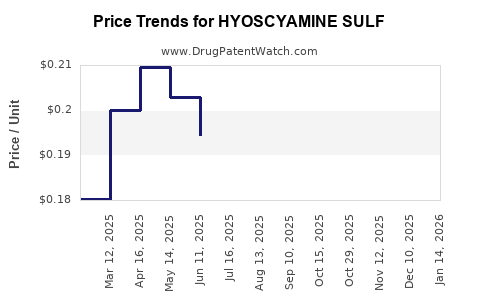
Average Pharmacy Cost for HYOSCYAMINE SULF
| Drug Name | NDC | Price/Unit ($) | Unit | Date |
|---|---|---|---|---|
| HYOSCYAMINE SULF 0.125 MG TAB | 62559-0421-01 | 0.17788 | EACH | 2026-03-18 |
| HYOSCYAMINE SULF 0.125 MG TAB | 62135-0512-12 | 0.17788 | EACH | 2026-03-18 |
| HYOSCYAMINE SULF 0.125 MG TAB | 42192-0340-01 | 0.17788 | EACH | 2026-03-18 |
| >Drug Name | >NDC | >Price/Unit ($) | >Unit | >Date |
HYOSCYAMINE SULF Market Analysis and Financial Projection
What is Hyoscyamine Sulfate?
Hyoscyamine sulfate is an anticholinergic agent used primarily to treat gastrointestinal disorders, such as irritable bowel syndrome, severe diarrhea, and bladder spasms. It reduces muscle spasms in the stomach, intestines, and urinary tract. The drug is marketed under various brand names, including Levsin and Anaspaz, and is available in oral tablets, sublingual strips, and injectable forms.
What is the Global Market Size for Hyoscyamine Sulfate?
The global market for hyoscyamine sulfate was valued at approximately USD 150 million in 2021. The market is segmented by application, formulation, and region:
- Application: GI disorders (primary), psuedoparkinsonism, and other uses.
- Formulation: Oral tablets, sublingual strips, injections.
- Region: North America (~50%), Europe (~25%), Asia-Pacific (~20%), and Rest of World (~5%).
The market experienced a compound annual growth rate (CAGR) of about 4.5% from 2018 to 2021. Growth drivers include increasing prevalence of GI disorders and aging populations.
What are the Key Market Drivers and Challenges?
Drivers
- Rising incidence of digestive and urinary tract disorders globally.
- Aging demographic increasing demand for antispasmodic therapies.
- Patent expirations of major branded drugs, creating opportunities for generics.
- Increasing acceptance of sublingual and injectable formulations.
Challenges
- Limited patent protection, leading to high generic competition.
- Regulatory hurdles in different markets, especially in Asia.
- Availability of alternative therapies with fewer side effects, such as antispasmodic drugs like dicyclomine.
- Concerns over side effects like dry mouth, blurred vision, and urinary retention.
What Are the Price Trends and Projections for Hyoscyamine Sulfate?
Current Price Landscape (2022)
- Brand-name formulations: USD 3–5 per tablet.
- Generic formulations: USD 1–2 per tablet.
- Injectable forms: USD 20–50 per vial, depending on concentration and quantity.
Price Drivers
- Increased competition among generic manufacturers has significantly reduced prices.
- Regional pricing disparities due to regulatory and market factors.
- Increased import/export tariffs affecting cross-border pricing.
Future Price Projections (2023–2028)
- Global average prices are expected to decrease modestly, with a CAGR of around -1.5%, driven by intensified generic competition.
- In developed markets like North America and Europe, prices could decline by 10–15% over five years.
- The entry of biosimilars or alternative formulations could further pressure pricing.
- Price stability or slight increases may occur in markets with regulatory barriers or limited competition, notably in certain Asian countries.
What Are the Market Outlook and Opportunities?
Market Growth
- Expected to reach USD 180–200 million by 2028, maintaining a CAGR of approximately 3.5%–4.5%, based on current growth trends.
- Growth mainly driven by emerging markets, where GI disorder treatment demand rises alongside healthcare spending increases.
Opportunities
- Development of new formulations with improved delivery methods.
- Expansion in emerging markets with rising healthcare infrastructure.
- Exploration of combination therapies that include hyoscyamine sulfate for broader indications.
Risks
- Stringent regulatory environment in key markets may delay approvals.
- Patent challenges against brand-name formulations could impact pricing strategies.
- The emergence of novel therapeutics offering better efficacy or fewer side effects could reduce demand.
Regulatory and Patent Status
- Hyoscyamine sulfate patents typically expire in North America and Europe by 2025–2027.
- Multiple generics already available post-patent expiry from manufacturers such as Teva, Mylan, and Sandoz.
- Regulatory processes for approval of generic formulations are streamlined in developed markets but vary widely in emerging regions.
Key Takeaways
- The hyoscyamine sulfate market is relatively mature, with steady growth driven by aging populations and increased GI disorder prevalence.
- Prices are declining due to generic competition but remain stable in certain regions with regulatory barriers.
- Market size is projected to expand modestly, reaching USD 180–200 million by 2028.
- Opportunities exist in developing innovative formulations and expanding into emerging markets.
- Competition and regulatory hurdles will influence pricing and market share dynamics significantly.
FAQs
1. What factors most influence pricing for hyoscyamine sulfate?
Generic competition, regional regulation, and formulation type primarily drive prices. Brand-name drugs retain higher prices unless patent expiration and market saturation lead to price erosion.
2. How does regional regulation affect market entry?
Regions with stringent regulatory standards, such as Europe and North America, require extensive data for approvals but offer higher profit margins. Emerging markets may have less rigorous pathways but pose risks related to quality and patent enforcement.
3. What are the major therapeutic alternatives to hyoscyamine sulfate?
Dicyclomine, peppermint oil, and functional foods are non-prescription options. Prescription alternatives include prokinetic agents and antidiarrheal drugs.
4. When are patent expirations expected, and how do they impact the market?
Patents are expiring between 2025 and 2027 in North America and Europe, increasing generic competition, lowering prices, and expanding accessibility.
5. What are the prospects for new formulations?
There is interest in sustained-release, combined drugs, and novel delivery platforms. However, regulatory approval timelines and development costs remain barriers.
Sources
- MarketWatch, "Hyoscyamine Market Size, Trends & Forecasts," 2022.
- EvaluatePharma, "Drug Market Analysis," 2022.
- FDA and EMA product databases, 2022.
- IQVIA, "Global Pharmaceutical Market Data," 2021.
- GlobalData, "GI Therapeutics Outlook," 2022.
More… ↓
