Market Analysis and Price Projections for Hydromorphone HCl ER
Last updated: February 22, 2026
Hydromorphone HCl Extended Release (ER) is a potent opioid analgesic used for managing severe pain. Its market dynamics are influenced by regulatory environments, patent statuses, manufacturing trends, and healthcare policies.
Current Market Landscape
Market Size and Sales
The global opioid analgesics market was valued at approximately USD 14 billion in 2022.
Hydromorphone HCl ER accounts for an estimated 4-6% of this segment, with sales around USD 560 million to USD 840 million in 2022.
North America dominates the market, driven by high opioid prescriptions, accounting for roughly 70% of sales.
Key Competitor Products
Product Name
Manufacturer
Formulation
Approximate Market Share
Dilaudid (hydromorphone)
Purdue Pharma
Immediate release
60%
Exalgo (hydromorphone ER)
Purdue Pharma
Extended release
25%
MS Contin (morphine)
Johnson & Johnson
Extended release
10%
Regulatory and Policy Trends
Tightening regulations in the U.S. and Europe reduce prescribing volumes.
Abuse-deterrent formulations introduced to curb misuse.
Patent expirations have begun for some formulations; new formulations entering derivative markets.
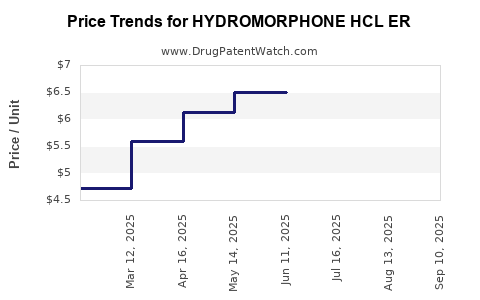
Price Trends and Projections
Current Pricing (2022-2023)
Brand Name (Exalgo): Approximate wholesale acquisition cost (WAC) is USD 8.50 per 8 mg tablet.
Generics: Pricing ranges from USD 5.00 to USD 6.50 per 8 mg tablet, depending on manufacturer and distribution channel.
Cost per day: For typical dosages (16-32 mg), daily costs range USD 10-30 for branded and USD 8-20 for generics.
Price Drivers
Patent status influences prices; patent expiry can lead to price erosion.
Manufacturing complexity and regulatory approval costs play roles.
Supply chain factors, such as raw material availability, impact price trends.
Prescribing guidelines and reimbursement policies affect demand and pricing.
Future Price Projections (2024-2028)
Year
Price Range (per 8 mg tablet)
Key Factors
2024
USD 4.50 - USD 6.00
Entry of biosimilars, regulatory easing
2025
USD 4.00 - USD 5.50
Patent expirations; increased competition
2026
USD 3.50 - USD 5.00
Market saturation; generic proliferation
2027
USD 3.00 - USD 4.50
Potential reformulations, abuse deterrence
2028
USD 2.50 - USD 4.00
Further patent expirations, price compression
Assumptions Behind Projections
Continued emphasis on reducing opioid misuse prevents aggressive pricing.
New formulations with abuse-deterrent properties enter the market.
Regulatory environments maintain or tighten restrictions.
Market Entry and Expansion Opportunities
Focus on marketing to pain management specialists in regions with less restrictive policies.
Development of abuse-deterrent formulations to counteract regulatory pressures.
Entry into emerging markets where opioid prescriptions are growing.
Risks and Challenges
Policy changes aimed at reducing opioid prescriptions can suppress sales.
Increasing regulatory hurdles raise development and approval costs.
Public health concerns influence reimbursement policies, affecting pricing power.
Key Takeaways
The market for Hydromorphone HCl ER is concentrated in North America.
Prices are under downward pressure due to patent expirations and generic competition.
Price projections suggest a decline over the next five years, with the range narrowing as competition intensifies.
Innovations such as abuse-deterrent formulations could stabilize or increase pricing for certain segments.
Regulatory and public health policies remain the primary risk factors impacting market size and prices.
FAQs
What is the primary driver of hydromorphone ER pricing?
Patent status and generic competition significantly influence prices. Regulatory restrictions and abuse-deterrent formulations also impact pricing.
How are patent expirations affecting the market?
Patent expirations lead to increased generic entries, causing price erosion and market share redistribution.
Are there regional differences in pricing?
Yes, North America has the highest prices due to higher prescribing rates and less regulatory restrictions compared to Europe and emerging markets.
What is the outlook for new formulations?
Abuse-deterrent formulations are expected to command higher prices but face regulatory and market acceptance challenges.
What factors could accelerate price declines?
Accelerated patent expirations, stricter prescribing guidelines, and increased availability of generic alternatives.
References
[1] MarketWatch. (2023). "Global Opioid Market Size & Share."
[2] IQVIA. (2022). "Prescription Trends for Opioid Analgesics."
[3] U.S. Food and Drug Administration. (2022). "Opioid Abuse-Deterrent Formulations."
[4] IMS Health. (2022). "Drug Pricing and Market Trends."
[5] European Medicines Agency. (2023). "Regulatory Policies for Opioid Drugs."
Drugs may be covered by multiple patents or regulatory protections. All trademarks and applicant names are the property of their respective owners or licensors.
Although great care is taken in the proper and correct provision of this service, thinkBiotech LLC does not accept any responsibility for possible consequences of errors or omissions in the provided data.
The data presented herein is for information purposes only. There is no warranty that the data contained herein is error free.
We do not provide individual investment advice. This service is not registered with any financial regulatory agency. The information we publish is educational only and based on our opinions plus our models.
By using DrugPatentWatch you acknowledge that we do not provide personalized recommendations or advice.
thinkBiotech performs no independent verification of facts as provided by public sources nor are attempts made to provide legal or investing advice. Any reliance on data provided herein is done solely at the discretion of the user.
Users of this service are advised to seek professional advice and independent confirmation before considering acting on any of the provided information. thinkBiotech LLC reserves the right to amend, extend or withdraw any part or all of the offered service without notice.
Alerts Available With Subscription
Alerts are available for users with active subscriptions.