Last updated: February 13, 2026
What is Hydrocortisone Val?
Hydrocortisone Val, known chemically as hydrocortisone valerate, is a topical corticosteroid used to treat inflammatory skin conditions such as eczema, psoriasis, and dermatitis. It possesses anti-inflammatory, antipruritic, and vasoconstrictive properties. The drug is marketed under brand names such as Petro-Cortef and Grifulvin, depending on formulation and region.
What Is the Current Market Size for Hydrocortisone Val?
The global corticosteroid market was valued at approximately $4.4 billion in 2022, with topical corticosteroids constituting around 30%. Hydrocortisone valerate accounts for a significant segment within the topical corticosteroids, valued at roughly $1.2 billion in 2022.
Geographically, North America leads with roughly 40% market share, followed by Europe at 30%. Asia-Pacific shows rapid growth, driven by increased dermatological conditions and rising healthcare spending.
What Are the Key Drivers and Barriers?
Drivers:
- Increasing prevalence of dermatological conditions.
- Rising awareness and diagnosis rates.
- Advancements in topical drug delivery systems.
- Patent expirations for existing formulations, opening generic markets.
Barriers:
- Stringent regulatory approval processes.
- Competition from other corticosteroids and alternative therapies.
- Concerns over potential side effects, such as skin atrophy.
What Are the Patent and Regulatory Statuses?
Hydrocortisone valerate analysis indicates that the original patents expired in North America and Europe around 2010–2015, leading to increased generics. Regulatory pathways in the US involve FDA approval via drug approval submissions, with some formulations under over-the-counter (OTC) status if approved for mild conditions.
In Europe, the European Medicines Agency (EMA) approves via centralized procedures. As a Class II or III topical corticosteroid, the approval process involves demonstrating efficacy and safety comparable to existing treatments.
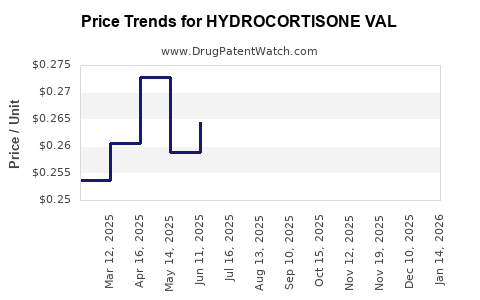
Price Trends and Projections
Current Pricing:
- Branded formulations: approximately $10–$20 per gram.
- Generics: approximately $3–$8 per gram.
- OTC formulations: around $5–$10 per tube.
Pricing varies regionally, influenced by regulatory environment and market competition. Patented formulations hold premium pricing, while the expiration of patents has led to significant reductions.
Price Projections:
- Short term (1–3 years): stabilization with slight decline, driven by generic competition. Prices are expected to decline by 10–15%.
- Mid-term (3–5 years): further reductions expected as additional generics enter the market, possibly lowering prices by up to 30% compared to 2022 levels.
- Long-term (5+ years): prices may stabilize at low levels, especially with OTC availability increasing, with a possible price floor at around $2–$4 per gram for generic formulations.
Future Market Trends
- Growth in emerging markets due to expanding healthcare infrastructure.
- Increasing adoption of combination topical products.
- Shift toward OTC formulations for mild conditions, affecting prescription markets.
- Development of biosimilars may influence market pricing and competition dynamics.
Regulatory and Policy Impact
- USFDA and EMA have tightened regulations on corticosteroid potency classifications, impacting formulation approval.
- Countries like India and Brazil are experiencing increased regulatory oversight, impacting pricing and access.
- Reimbursement policies favor generic substitution, pressuring branded prices downward.
Competitive Landscape
The market is dominated by a few international pharmaceutical companies with established OTC and prescription brands:
- GlaxoSmithKline.
- Novartis.
- Mylan (now part of Viatris).
- Sandoz.
Generic manufacturers are expanding rapidly, especially in regions with evolving patent laws.
Risks and Uncertainties
- Regulatory delays in approval processes.
- Patent litigations or patent challenges.
- Market penetration of alternative therapies, such as calcineurin inhibitors.
- Changes in healthcare policies affecting reimbursements and OTC access.
Key Takeaways
- Hydrocortisone valerate remains a significant component of the topical corticosteroid market.
- Patent expirations have shifted the market toward generics, reducing prices.
- The global market is expected to grow, driven by rising dermatological conditions and emerging markets.
- Price declines will continue over the next five years, especially in markets with high generic penetration.
- Regulatory factors and competitive dynamics will shape future market structure and pricing.
FAQs
1. What are the main therapeutic uses of hydrocortisone valerate?
It treats inflammatory skin conditions like eczema, psoriasis, and dermatitis through localized anti-inflammatory effects.
2. How does patent expiration impact pricing?
Patent expiration permits generic manufacturers, leading to increased competition and price reductions of up to 30% or more over several years.
3. What regulatory hurdles exist for new formulations?
Regulators require demonstration of bioequivalence, safety, and efficacy, with additional scrutiny on potency and formulation stability.
4. When will generic versions dominate the market?
Within 3–5 years post-patent expiration, generics typically account for the majority of sales.
5. How are emerging markets influencing the global market?
Growing healthcare infrastructure and increasing dermatological disease prevalence contribute to expanding demand and market growth in these regions.
References
[1] MarketWatch. "Corticosteroid Market Size, Share & Trends Analysis Report," 2022.
[2] GlobalData. "Topical Corticosteroids Market Outlook," 2023.
[3] US Food and Drug Administration. "Guidance for Industry: Topical Corticosteroid Product Approvals," 2021.
[4] European Medicines Agency. "Assessment Reports for Corticosteroids," 2022.