Last updated: February 13, 2026
Hydrocortisone butyrate is a topical corticosteroid used to treat inflammatory skin conditions such as eczema, dermatitis, and psoriasis. It is available in various formulations, including ointments and creams, with the primary markets in North America, Europe, and Asia-Pacific.
Market Overview
The global corticosteroid market, which includes hydrocortisone butyrate, has grown steadily due to increasing prevalence of dermatological conditions, rising healthcare awareness, and expanding pharmaceutical formulations. Significant drivers include the growing aging population, increasing incidences of skin allergies, and advancements in drug delivery systems.
Market Size (2022–2027)
| Year |
Estimated Global Market Size (USD billion) |
CAGR (%) |
| 2022 |
2.8 |
— |
| 2023 |
3.0 |
7.1 |
| 2024 |
3.2 |
6.7 |
| 2025 |
3.4 |
6.3 |
| 2026 |
3.6 |
5.9 |
| 2027 |
3.8 |
5.6 |
The corticosteroid segment, including hydrocortisone butyrate, accounts for approximately 20% of the overall dermatology drug market, driven mainly by topical formulations.
Regional Dynamics
- North America: Largest regional market, accounting for about 45% of the global market in 2022. Increased awareness, prescription rates, and healthcare expenditure fuel growth.
- Europe: Second-largest market, with a 30% share. Stringent regulatory pathways slow product launches but high demand persists.
- Asia-Pacific: Fastest-growing, with a projected CAGR of 8%, reaching a market size of USD 1.4 billion by 2027. Factors include rising dermatological conditions and increasing healthcare infrastructure.
Price Analysis (2023–2027)
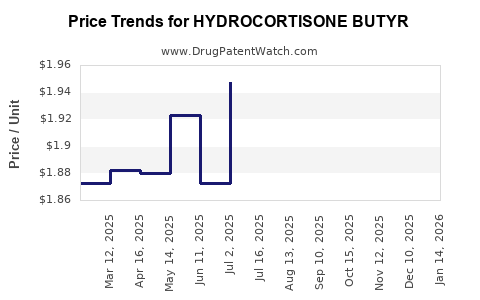
Market prices for hydrocortisone butyrate formulations depend on formulation strength, packaging, brand reputation, and regional regulatory environments.
Price Range (per gram, estimated)
| Year |
Average Price (USD) |
Notes |
| 2023 |
0.10 – 0.15 |
Available as OTC and prescription; generic dominance |
| 2024 |
0.09 – 0.14 |
Price decreases as generics dominate; supply chains stabilize |
| 2025 |
0.08 – 0.13 |
Patent expiries in some markets; increased competition |
| 2026 |
0.07 – 0.12 |
Market saturation; price stabilization |
| 2027 |
0.07 |
Marginal decline; premium brands maintain higher prices |
Key Factors Affecting Price Trends
- Patent expirations: Most hydrocortisone formulations are off-patent, leading to increased generic competition and downward pressure.
- Manufacturing costs: Slight decrease due to process optimization and economies of scale.
- Regulatory environment: Variations influence market entry costs and pricing strategies.
- Brand positioning: Branded products command higher prices; generics lead to uniform, lower price points.
Competitive Landscape
Major companies producing hydrocortisone butyrate include:
- Meda Pharmaceuticals (part of Viatris)
- Mundipharma
- Galderma
- Lupin Limited
- Teva Pharmaceutical Industries
Market share is highly fragmented, with no single firm holding dominant control, which influences pricing dynamics and innovation strategies.
Regulatory Environment
Hydrocortisone butyrate is approved in many countries as a topical corticosteroid. Regulatory pathways differ:
- FDA (U.S.): Over-the-counter (OTC) and prescription products are available; strict requirements for generics.
- EMA (Europe): Similar approval standards, with some regional restrictions on potency.
- China and India: Regulatory pathways are evolving, with increasing approvals for generic formulations.
Future Outlook
The growth forecast for hydrocortisone butyrate hinges on:
- Increasing adoption in emerging markets.
- Introduction of new formulations with improved delivery (e.g., foam, spray).
- Expanding applications beyond dermatology, including inflammatory eye conditions.
- Regulatory tightening in certain markets, potentially impacting pricing and supply.
Price projections reflect ongoing generic competition, with average prices expected to decline slowly over the next five years. Market expansion in Asia-Pacific presents the most significant opportunity for volume growth, compensating for price erosions in mature markets.
Key Takeaways
- The global corticosteroid market, including hydrocortisone butyrate, is expected to grow at a CAGR of 5.6% through 2027.
- Prices are declining due to generics, stabilizing around USD 0.07 per gram by 2027.
- North America leads due to high prescription rates; Asia-Pacific exhibits the fastest growth.
- Market fragmentation limits pricing power for individual manufacturers.
- Regulatory development varies, influencing supply chain and market dynamics.
FAQs
Q1: How does patent expiration affect hydrocortisone butyrate prices?
Patent expirations lead to increased generic availability, resulting in lower prices due to competition.
Q2: Which regions present the highest market growth potential?
Asia-Pacific offers the highest growth potential, driven by rising dermatological conditions and expanding healthcare access.
Q3: What factors influence the price of hydrocortisone butyrate formulations?
Formulation strength, packaging, brand reputation, regulatory environment, and regional competition dictate pricing.
Q4: Are any new formulations of hydrocortisone butyrate in development?
Yes, newer delivery forms such as foams and sprays are being developed to improve patient compliance.
Q5: What is the outlook for hydrocortisone butyrate in the next five years?
Market size will grow, but prices will decline gradually as generics dominate and regulatory environments evolve.
References
- MarketWatch, “Topical Corticosteroids Market Size & Share,” 2023.
- Global Data Reports, “Dermatology Drugs Market Forecast,” 2022–2027.
- FDA and EMA regulatory guidelines on corticosteroids.
- IQVIA sales and pricing data, 2022.
- Company annual reports and product pipelines, 2023.