Share This Page
Drug Price Trends for HM ISOPROPYL ALCOHOL
✉ Email this page to a colleague
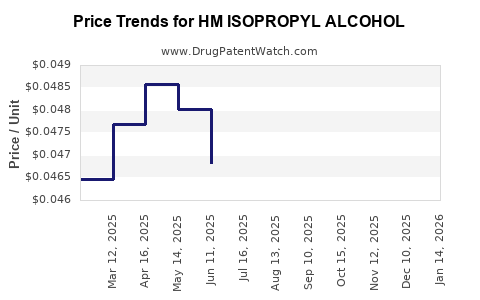
Average Pharmacy Cost for HM ISOPROPYL ALCOHOL
| Drug Name | NDC | Price/Unit ($) | Unit | Date |
|---|---|---|---|---|
| HM ISOPROPYL ALCOHOL 91% | 62011-0272-01 | 0.05547 | ML | 2026-07-22 |
| HM ISOPROPYL ALCOHOL 91% | 62011-0272-01 | 0.05548 | ML | 2026-06-17 |
| HM ISOPROPYL ALCOHOL 91% | 62011-0272-01 | 0.05532 | ML | 2026-05-20 |
| HM ISOPROPYL ALCOHOL 91% | 62011-0272-01 | 0.05501 | ML | 2026-04-22 |
| HM ISOPROPYL ALCOHOL 91% | 62011-0272-01 | 0.05486 | ML | 2026-03-18 |
| >Drug Name | >NDC | >Price/Unit ($) | >Unit | >Date |
What is the Market Size for HM Isopropyl Alcohol?
The global demand for isopropyl alcohol (IPA) was valued at approximately USD 4.3 billion in 2021 and is projected to reach USD 5.8 billion by 2028, growing at a compound annual growth rate (CAGR) of 4.3% (Fortune Business Insights). HM (highly purified or pharmaceutical-grade) isopropyl alcohol accounts for a specific segment used primarily in pharma, cosmetics, and electronics cleaning applications.
HM IPA production is concentrated in regions with advanced chemical manufacturing infrastructures, notably China, the United States, and Germany. The Asia-Pacific region dominates the market share, with approximately 40% of global consumption, driven by rising healthcare standards and growing industrial applications.
How Does Pricing for HM Isopropyl Alcohol Compare?
Prices for HM IPA fluctuate based on purity grade, volume, and regional supply chain factors. As of Q1 2023, the typical wholesale price ranges from USD 1.50 to USD 2.50 per liter. Major contract prices for large-volume purchasers tend to hover around USD 1.80 per liter—the lower bound being prevalent for volume orders exceeding 10,000 liters monthly.
Quality specifications for HM IPA generally include a purity level exceeding 99.8%, with specific pharmacopoeia requirements (e.g., USP, EP). These specifications influence manufacturing costs and, correspondingly, market pricing.
What Are the Key Market Drivers?
- Healthcare and Pharmaceutical Demand: Increase in sanitization needs and pharmaceutical manufacturing drives growth.
- Electronics Industry: Usage as a cleaning agent for electronic components sustains demand.
- Regulatory Standards: Stricter pharmaceutical-grade standards elevate the quality and price of HM IPA.
- COVID-19 Pandemic: Accelerated demand for disinfectants, boosting market volume.
What Are the Main Suppliers and Competitive Dynamics?
Leading suppliers include:
- BASF
- Dow Chemical
- Shell Chemicals
- LyondellBasell
- Mitsubishi Chemical
These companies control over 60% of market capacity, with price-setting tendencies influenced by raw material costs, such as propylene, and regional supply-demand shifts.
What Is the Outlook for Price Trends?
Projected price trajectories indicate a moderate increase over the next five years, driven by raw material cost fluctuations and regulatory demands for higher purity levels. The cost of propylene, the primary raw material, increased by roughly 15% in 2021, influencing IPA prices upwards.
Forecast data suggests that:
- 2023-2025: Prices may climb to USD 2.00–USD 2.20 per liter.
- 2026-2028: Prices might stabilize or marginally increase to USD 2.20–USD 2.50 per liter, contingent upon crude oil and propylene market trends.
How Does Regulatory Environment Affect Market and Pricing?
Stringent quality standards for pharmaceutical and cosmetic applications raise compliance costs. Certification and testing requirements contribute to higher prices, especially for suppliers targeting pharmaceutical-grade HM IPA.
Import tariffs and trade policies additionally influence regional price disparities. For example, tariffs on raw materials in certain regions can add 5–10% to production costs, impacting final pricing.
Summary of Key Data Points
| Aspect | Data |
|---|---|
| Market size (2021) | USD 4.3 billion |
| Projected market size (2028) | USD 5.8 billion |
| CAGR (2022-2028) | 4.3% |
| Volume price range (Q1 2023) | USD 1.50 – USD 2.50 per liter |
| Major producers | BASF, Dow, Shell, LyondellBasell, Mitsubishi Chemical |
| Raw material cost increase (2021) | 15% rise in propylene costs |
| Price forecast (2023-2028) | USD 2.00–USD 2.50 per liter |
Key Takeaways
- Demand growth driven by healthcare, electronics, and disinfectant markets.
- Price fluctuations linked to raw material costs, regulatory compliance, and regional trade policies.
- Market concentration exists among a handful of major producers.
- Prices are expected to increase gradually over the next five years, with some stabilization after 2026.
- Regional differences remain significant due to tariff policies and supply chain logistics.
FAQs
1. How does the purity level impact HM IPA pricing?
Higher purity levels (above 99.8%) require more advanced purification processes, increasing manufacturing costs and thus raising market prices.
2. What regions are the largest markets for HM IPA?
Asia-Pacific leads in volume, especially China and India. North America and Europe have significant pharmaceutical and electronics sectors influencing high-grade product demand.
3. What raw materials influence HM IPA prices?
Propylene is the key raw material, with its price directly affecting IPA manufacturing costs.
4. Are there environmental or regulatory risks that could affect future prices?
Yes. Stricter environmental standards may raise production costs due to increased compliance requirements, influencing overall market price.
5. When is significant price escalation expected?
If raw material prices continue rising or regulatory standards tighten, prices could escalate faster between 2024 and 2026, potentially reaching USD 2.30–USD 2.50 per liter.
Sources:
[1] Fortune Business Insights, "Isopropyl Alcohol Market Size, Share & Industry Analysis, 2022–2028"
[2] ICIS, "Global Propylene and IPA Market Reports"
[3] U.S. Pharmacopeia, "Pharmacopoeial Standards for Isopropyl Alcohol"
[4] MarketWatch, "Chemical Industry Price Trends 2023"
[5] CB Insights, "Major Chemical Manufacturers"
More… ↓
