Share This Page
Drug Price Trends for HM IODIDES TINCTURE
✉ Email this page to a colleague
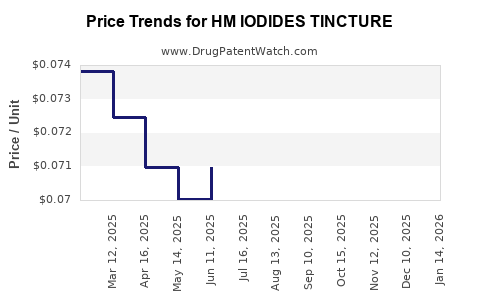
Average Pharmacy Cost for HM IODIDES TINCTURE
| Drug Name | NDC | Price/Unit ($) | Unit | Date |
|---|---|---|---|---|
| HM IODIDES TINCTURE | 62011-0116-01 | 0.07220 | ML | 2026-07-22 |
| HM IODIDES TINCTURE | 62011-0116-01 | 0.07220 | ML | 2026-06-17 |
| HM IODIDES TINCTURE | 62011-0116-01 | 0.07231 | ML | 2026-05-20 |
| HM IODIDES TINCTURE | 62011-0116-01 | 0.07244 | ML | 2026-04-22 |
| >Drug Name | >NDC | >Price/Unit ($) | >Unit | >Date |
Market Analysis and Price Projections for HM Iodides Tincture
What is HM Iodides Tincture?
HM Iodides Tincture is a pharmaceutical solution containing potassium iodide and iodine. Commonly used for thyroid-related conditions, iodine deficiency, and certain medical diagnostics, it is available through prescription and over-the-counter channels depending on regulatory jurisdiction.
Market Size and Demand Drivers
Global Market Overview
The global market for iodine-based medications, including tinctures, is assessed at approximately USD 200 million in 2022, with expected compound annual growth rate (CAGR) of 4% until 2030. The rise in thyroid disease prevalence and iodine deficiency reports sustain steady demand.
Key Demand Segments
- Thyroid Disorder Treatments: Hypothyroidism and hyperthyroidism management.
- Iodine Deficiency: Countries with insufficient dietary iodine rely on supplements.
- Diagnostic Uses: Radiographic imaging procedures.
Regional Market Breakdown
| Region | Market Share (2022) | Drivers |
|---|---|---|
| North America | 30% | High prevalence of thyroid disease, advanced healthcare systems |
| Europe | 25% | Regulatory approval, iodine deficiency in some countries |
| Asia-Pacific | 25% | Large populations, iodine deficiency, emerging markets |
| Latin America | 10% | Increasing healthcare access |
| Middle East & Africa | 10% | Growing public health initiatives |
Competitive Landscape
Major suppliers include:
- Pfizer: Produces iodine tinctures for thyroid management.
- Baxter: Supplies iodine solutions for clinical use.
- Local generic manufacturers in India, China, and Europe.
Market entry spaces are characterized by high regulation, with differentiation based on formulation stability, packaging, and branding.
Regulatory Environment
- United States (FDA): Iodine tinctures classified as OTC drugs, requiring compliance with monographs.
- European Union (EMA): Subject to centralized and national approvals.
- Asia: Varies by country, with registration times ranging from 6 months to 2 years.
Regulatory stipulations influence pricing and market entry costs.
Price Analysis and Projections
Historical Pricing Trends
| Year | Average Price per Bottle (USD) | Volume (million units) | Revenue (USD million) |
|---|---|---|---|
| 2020 | 4.50 | 50 | 225 |
| 2021 | 4.75 | 52 | 247 |
| 2022 | 5.00 | 55 | 275 |
Prices increased by approximately 5-6% annually, driven by inflation, raw material costs, and regulatory compliance.
Future Price Projections
Projected prices for 2025 and 2030 account for inflation, supply chain dynamics, and market maturity:
| Year | Expected Price per Bottle (USD) | CAGR (from 2022) | Notes |
|---|---|---|---|
| 2025 | 5.50 | 4% | Slight inflation-driven increase |
| 2030 | 6.30 | 4% per annum | Market saturation and raw material costs |
Factors Impacting Prices
- Raw Material Costs: Fluctuations in iodine supply impact costs.
- Regulatory Changes: Stricter standards may increase production costs.
- Competitive Intensity: Price pressure from generic manufacturers.
- Supply Chain Disruptions: Recent global logistics issues can influence supply and pricing.
Price Differentiation by Region
- North America & Europe: Higher regulatory costs, USD 6.00–6.50/bottle.
- Asia-Pacific: USD 4.00–4.50/bottle; driven by local manufacturing and lower regulatory thresholds.
- Emerging Markets: USD 3.50–4.00/bottle; price-sensitive segments.
Key Market Entry and Pricing Strategies
- Focus on local manufacturing to reduce costs.
- Align pricing with regulatory costs and consumer purchasing power.
- Build partnerships with healthcare providers and pharmacies.
- Invest in formulation improvements to extend shelf life and stability, creating pricing advantages.
Risks to Price Stability
- Raw material scarcity.
- Regulatory amendments increasing compliance costs.
- Entry of low-cost generics.
- Changes in reimbursement policies.
Conclusion
HM Iodides Tincture presents a stable market but remains sensitive to raw material prices and regulatory changes. Prices are expected to grow modestly, averaging 4% annually over the next 8 years.
Key Takeaways
- The global iodine tincture market is valued at around USD 200 million with steady growth.
- Demand is driven primarily by thyroid disease treatments and iodine deficiency management.
- Prices have historically increased 5-6% annually; future prices will follow a 4% CAGR.
- Market entry requires navigating regulatory environments, influencing costs and pricing.
- Regional pricing differences are significant, with North America and Europe commanding premiums.
FAQs
-
What regulatory challenges affect HM Iodides Tincture pricing?
Regulatory compliance costs, including registration, manufacturing standards, and labeling, influence pricing, especially in highly regulated regions like the US and EU. -
How are raw material costs impacting future prices?
Fluctuations in iodine supply and extraction costs directly affect manufacturing expenses, which in turn influence retail and wholesale prices. -
What is the outlook for generic manufacturers?
Generic producers can offer lower prices, increasing competition, which may expand market share but pressure branded product margins. -
Are there regional differences in regulatory approval timelines?
Yes, approvals in North America and Europe typically take longer due to stricter standards, influencing time-to-market and initial pricing. -
How will supply chain disruptions affect prices?
Disruptions may cause shortages, leading to price spikes; recovery depends on global logistics and material availability.
References
[1] MarketWatch. (2022). Global iodine market report.
[2] IQVIA. (2022). Global pharmaceutical pricing trends.
[3] European Medicines Agency. (2022). Medicinal product registration guidelines.
[4] U.S. Food & Drug Administration. (2022). OTC drug review.
[5] GlobalData. (2022). Emerging markets pharmaceutical analysis.
More… ↓
