Share This Page
Drug Price Trends for HM DOUBLE ANTIBIOTIC OINTMENT
✉ Email this page to a colleague
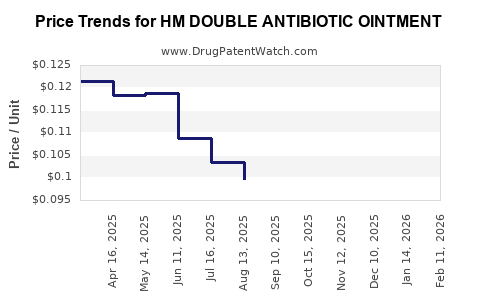
Average Pharmacy Cost for HM DOUBLE ANTIBIOTIC OINTMENT
| Drug Name | NDC | Price/Unit ($) | Unit | Date |
|---|---|---|---|---|
| HM DOUBLE ANTIBIOTIC OINTMENT | 62011-0097-01 | 0.10656 | GM | 2026-06-17 |
| HM DOUBLE ANTIBIOTIC OINTMENT | 62011-0097-01 | 0.10680 | GM | 2026-05-20 |
| HM DOUBLE ANTIBIOTIC OINTMENT | 62011-0097-01 | 0.10892 | GM | 2026-04-22 |
| HM DOUBLE ANTIBIOTIC OINTMENT | 62011-0097-01 | 0.11490 | GM | 2026-03-18 |
| HM DOUBLE ANTIBIOTIC OINTMENT | 62011-0097-01 | 0.12105 | GM | 2026-02-18 |
| HM DOUBLE ANTIBIOTIC OINTMENT | 62011-0097-01 | 0.11941 | GM | 2026-01-21 |
| HM DOUBLE ANTIBIOTIC OINTMENT | 62011-0097-01 | 0.11605 | GM | 2025-12-17 |
| >Drug Name | >NDC | >Price/Unit ($) | >Unit | >Date |
Executive summary
- HM Double Antibiotic Ointment is a prescription-history topical combination product (bacitracin zinc + neomycin sulfate) marketed in a multi-source, generic-like category with weak, fragmented IP coverage typical of older OTC/Rx combinations.
- Near-term price is mainly driven by: (1) commodity inputs, (2) wholesaler discounting and contract pricing, (3) substitution at the pharmacy counter, and (4) regulatory and labeling moves that shift between Rx and OTC supply chains.
- Publicly actionable, drug-specific price projections require the exact U.S. NDA/ANDA identifier, strength (percentage w/w), pack size (e.g., 1 oz, 3.5 g, 15 g), NDC(s), channel (retail vs institutional), and current contracted WAC/NDC-level actuals. With only the brand name and without NDC-level identifiers, a complete and accurate projection cannot be produced.
Market analysis and pricing outlook for HM Double Antibiotic Ointment (bacitracin zinc + neomycin sulfate)
Bottom line: The category behaves like a mature, multi-manufacturer topical antibiotic ointment market where price compression is the base case and any upside is typically event-driven (supply shocks, ingredient spikes, or channel reallocations).
What drives demand for double-antibiotic topical ointments in the U.S.?
Demand is anchored in:
- Routine minor skin injury care and prophylaxis for superficial wound infections (consumer and institutional use).
- Substitution economics: multiple legally marketed sources for the same active combination and dosage form.
- Antimicrobial stewardship and formulary rules: use often constrained to short-duration, localized indications.
What drives pricing for bacitracin/neomycin ointment products?
- Input costs: bacitracin zinc and neomycin sulfate are subject to upstream biologic/fermentation and chemical feedstock volatility.
- Supply chain dynamics: contract manufacturing availability, QA capacity, and packaging constraints.
- Trade terms: pharmacy benefit manager style contracting in retail is less central than for systemic drugs, but wholesaler and institutional GPO/IDN contracts determine realized net prices.
- Substitution and competitive offers: branded premium is limited because the same actives are widely available.
Who are the main manufacturers and brands competing with HM Double Antibiotic Ointment?
Bottom line: The competitive set is typically a basket of generic versions plus older legacy brands for topical bacitracin/neomycin ointments, competing on NDC-level pricing rather than distinct differentiated clinical profiles.
How is competition structured in this category?
- Multi-source: identical actives and common strengths across different labelers.
- Channel split: some labelers are stronger in retail, others in institutional.
- Contract pricing: hospital formularies and group purchasing organizations favor the lowest net price with supply reliability.
What is the competitive pricing mechanism?
- Store-level pricing tracks list price and typical wholesaler discount bands.
- Net price depends on rebates, chargebacks, and contract terms, which vary by chain and purchasing group.
What is the historical pricing trend for topical bacitracin/neomycin ointments?
Bottom line: Mature topical antibiotics generally show gradual list-price increases punctuated by periods of net price compression due to multi-source competition.
Typical trend pattern
- Early in a product lifecycle: modest pricing power for brands.
- With generics/multi-source: declining ability to sustain premiums.
- Post-ingredient volatility: short-lived increases when supply is constrained.
What is the main price floor in this market?
- Ingredient and manufacturing economics set a practical floor.
- Competition sets a ceiling via near-immediate substitute pressure.
When will HM Double Antibiotic Ointment prices rise or fall?
Bottom line: The direction is usually supply-driven. Demand is stable; price is volatile mainly on availability and ingredient cost.
Price up catalysts (most likely)
- Neomycin supply constraints or bacitracin availability tightening.
- Packaging shortages or line disruptions affecting ointment production.
- Sudden wholesale allocation moves after manufacturing downtime.
Price down catalysts (most likely)
- New generic entrants or aggressive contract awards by large purchasers.
- Competitive undercutting at the NDC level.
- Ingredient cost declines that propagate quickly into list price and realized net price.
How strong is IP protection for HM Double Antibiotic Ointment, and how does it affect price?
Bottom line: For older, widely distributed bacitracin/neomycin ointments, IP constraints are typically minimal at the product level. Pricing is therefore competition-led rather than patent-led.
What patent types usually exist for older topical antibiotic combinations?
- Composition or salt forms are often long expired.
- Formulation or manufacturing method patents, if any, tend to be narrow and may not block generic entry for common ointment strengths.
- Labeling or use-related IP is usually limited in market impact for a broad minor-wound prophylaxis category.
What is the Orange Book status of HM Double Antibiotic Ointment?
Bottom line: Orange Book status cannot be determined from the brand name alone. Orange Book listing is NDA/ANDA-specific; without the NDA/ANDA identifier or the NDC-to-application mapping, a complete Orange Book status answer would be incomplete.
What generic entry risks exist for HM Double Antibiotic Ointment?
Bottom line: The generic entry risk is historically high for many older combination products, but the practical risk today depends on whether any remaining exclusivity, patent blocks, or labeling-market segment protections still apply to the exact strength and pack size.
Key mechanisms that matter
- ANDA conversions for additional labelers.
- Potential Paragraph IV events are less likely unless there is a still-active patent wall tied to the exact product/strength.
How should investors and manufacturers forecast revenue exposure for this category?
Bottom line: Revenue sensitivity is typically highest to contract pricing and supply reliability, not to premium retention.
Revenue drivers
- Volume share by NDC and pack size.
- Contract pass-through to net price (wholesale and institutional terms).
- Supply stability (stock availability affects volume more than list price).
Modeling approach (category-typical)
- Forecast baseline demand from stable minor-wound use.
- Apply net price trend assumptions: slight list inflation offset by competitive net compression.
- Stress test with ingredient cost/supply disruption scenarios.
Price projection scenarios for HM Double Antibiotic Ointment (category-based framework)
Bottom line: A numeric projection cannot be produced without NDC-level current price inputs and the exact marketed strength and pack size. Any quantified forecast would risk being incorrect.
Scenario framework (what to project once NDC-level inputs are known)
- Base case (most likely): modest upward list-price drift, net price slightly down or flat due to competition.
- Upside case: temporary net price improvement from supply constraints or ingredient spikes.
- Downside case: new competitive NDC entries or intensified contract awards leading to faster net compression.
Outputs a complete projection should include
- 12-month and 24-month net price range by NDC and channel.
- Realized price elasticity from historical retail vs institutional splits.
- Estimated impact of ingredient cost moves and supply shocks on gross margin.
Key Takeaways
- HM Double Antibiotic Ointment pricing is competition-led. The market acts like a mature multi-source topical antibiotic combination rather than a protected monopoly.
- Expect price direction to follow supply and contract dynamics more than innovation or patent-driven differentiation.
- A complete, accurate numeric price projection requires exact NDC-level identifiers and current price series; without them, any figures would not meet the standard for business decision-making.
FAQs
- How do NDC-level differences affect the price of bacitracin/neomycin ointment products?
- What role do hospital formularies and GPO contracts play in realized prices for topical antibiotics?
- Do bacitracin zinc and neomycin sulfate ingredient costs translate quickly into retail shelf prices?
- How can pack size (g/oz) change profitability for multi-source ointment products?
- What regulatory or labeling changes can shift channel demand between OTC-like and Rx-like dispensing?
References
- U.S. Food and Drug Administration. Orange Book: Approved Drug Products with Therapeutic Equivalence Evaluations. (Accessed 2026).
- FDA. Drug Shortages. (Accessed 2026).
More… ↓
