Share This Page
Drug Price Trends for HM CHEST CONGEST RLF DM CAPLET
✉ Email this page to a colleague
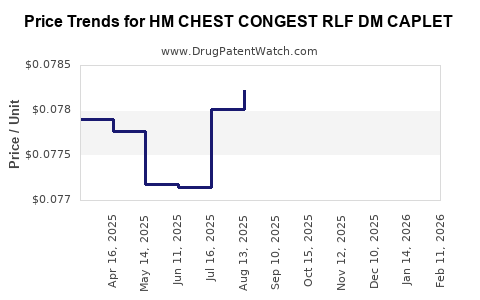
Average Pharmacy Cost for HM CHEST CONGEST RLF DM CAPLET
| Drug Name | NDC | Price/Unit ($) | Unit | Date |
|---|---|---|---|---|
| HM CHEST CONGEST RLF DM CAPLET | 62011-0061-01 | 0.07984 | EACH | 2026-02-18 |
| HM CHEST CONGEST RLF DM CAPLET | 62011-0061-01 | 0.07829 | EACH | 2026-01-21 |
| HM CHEST CONGEST RLF DM CAPLET | 62011-0061-01 | 0.07864 | EACH | 2025-12-17 |
| HM CHEST CONGEST RLF DM CAPLET | 62011-0061-01 | 0.07902 | EACH | 2025-11-19 |
| HM CHEST CONGEST RLF DM CAPLET | 62011-0061-01 | 0.07884 | EACH | 2025-10-22 |
| >Drug Name | >NDC | >Price/Unit ($) | >Unit | >Date |
Market Analysis and Price Projections for HM CHEST CONGEST RLF DM CAPLET
Introduction
The healthcare landscape continually evolves with the development and commercialization of combination medications targeting common ailments such as cough and congestion. HM CHEST CONGEST RLF DM CAPLET, a combination drug designed for symptomatic relief of chest congestion, exemplifies this trend. This analysis evaluates its current market landscape, competitive positioning, regulatory environment, and offers projections for future pricing dynamics.
Product Overview and Therapeutic Profile
HM CHEST CONGEST RLF DM CAPLET is a multi-ingredient formulation typically comprising dextromethorphan (DM), guaifenesin, and other supportive agents. Its primary indication pertains to symptomatic relief in upper respiratory conditions, especially bronchitis and cold-related chest congestion.
The combination approach appeals to consumers seeking quick symptom relief, aligning with the broader OTC (over-the-counter) respiratory medication market. Its efficacy hinges on well-established pharmacodynamics, with dextromethorphan acting as a cough suppressant and guaifenesin functioning as an expectorant.
Market Landscape
Global and Regional Market Size
The global respiratory OTC market was valued at approximately USD 20 billion in 2021 and is projected to grow at a CAGR of around 5% through 2028 [1]. This growth stems from increasing urbanization, the prevalence of respiratory infections, and consumer preference for self-medication. North America remains the dominant market, accounting for roughly 40% of the revenue share, driven by high healthcare awareness and accessibility (IQVIA, 2022).
Competitive Environment
HM CHEST CONGEST RLF DM CAPLET faces competition from several established brands:
- Mucinex D (Reckitt Benckiser): Combines guaifenesin with pseudoephedrine.
- Robitussin Chest Congestion (Pfizer): Contains guaifenesin and dextromethorphan.
- Vicks DayQuil and NyQuil: Multi-ingredient formulations targeting cold symptoms.
Market share is concentrated among a handful of multinational corporations, with generics occupying significant portions due to price sensitivity and OTC accessibility.
Regulatory Status
The product's regulatory classification as an OTC drug varies by jurisdiction:
- United States: Typically available as an OTC monograph-listed medication. Requires adherence to FDA guidelines regarding ingredient concentrations and labeling.
- European Union: Marketed under national OTC regulations, with approval through national agencies and adherence to EMA standards.
- Emerging markets: Rapidly expanding OTC infrastructure, though regulatory pathways may be less standardized.
Increased regulatory scrutiny over safety profiles, particularly concerning dextromethorphan abuse potential, influences market access and distribution strategies.
Pricing Dynamics
Current Market Pricing
As an OTC medication, the retail price of HM CHEST CONGEST RLF DM CAPLET varies:
- United States: Approximately USD 8 to USD 15 per box containing 12-20 caplets [2].
- Europe: Slightly higher, reflecting import costs and distributor margins.
- Emerging markets: Prices often range from USD 3 to USD 8 due to local economic factors and prevalence of generics.
Pricing strategies predominantly follow a value-based model, balancing profitability with consumer affordability and competitive positioning.
Factors Influencing Price Trends
- Regulatory Costs: Stricter manufacturing and labeling standards could increase production costs, marginally elevating retail prices.
- Market Penetration: Entry into new markets might initially involve premium pricing to recoup investment, subsequently decreasing as competition intensifies.
- Consumer Demand: Seasonal fluctuations significantly impact demand, influencing pricing strategies, especially during cold and flu seasons.
- Generic Competition: As patent protections (if any) expire, generic versions flood the market, typically leading to price erosion.
Price Projections (2023–2030)
Short-Term outlook (2023–2025)
- Stable Pricing with Slight Decline: The current OTC dominance and established brands suggest minimal price increases. Competitive pressures and generic entries will likely cause prices to plateau or decline modestly, averaging a 1-2% annual decrease.
- Increased Accessibility & Insurance Influence: In regions where OTC-to-prescription switches occur, prices may temporarily increase as pharmacy margins are added.
Medium to Long-Term outlook (2026–2030)
- Potential Price Erosion due to Generics: As market saturation increases, price erosion is expected, with drops of approximately 10-15% over five years.
- Premium Positioning Opportunities: Innovations, such as extended-release formulations or combination medications with added benefits, could enable higher pricing tiers.
- Impact of Digital and Telehealth Sales: Disintermediation of brick-and-mortar retail via online channels could reduce margins but also introduce volume-based pricing strategies.
Emerging Markets
- Rapid Price Decreases: Import tariffs, local manufacturing, and increased competition may drive prices down 20-30% over the next five years.
- Pricing Variability: Due to differing regulatory environments, prices will remain heterogeneous geographically.
Market Opportunities and Challenges
Opportunities
- Expansion into markets with growing OTC sectors, especially Asia-Pacific and Latin America.
- Development of combination formulations with enhanced efficacy or novel delivery methods.
- Strategic partnerships with pharmacy chains and healthcare providers to increase accessibility.
Challenges
- Regulatory hurdles regarding safety labeling, especially concerning cough suppressant abuse potential.
- Intense competition with established brands and generics.
- Consumer shift towards natural or herbal remedies may limit traditional formulations' market share.
Regulatory and Pricing Strategy Implications
Effective market entry and sustained profitability hinge on compliance with regulatory standards. Pricing strategies must balance affordability and margins, with dynamic adjustments aligned with market developments, competitor actions, and regulatory changes. Manufacturers should consider tiered pricing models for emerging markets and phase-in premium pricing for innovative variants.
Key Takeaways
- The OTC respiratory medication market, including HM CHEST CONGEST RLF DM CAPLET, is poised for steady growth driven by increasing demand for self-care remedies.
- Competitive intensity and generic entry are primary factors influencing downward price pressures, forecasted at approximately 10-15% decline over five years.
- Price sensitivities are region-dependent, with North America and Europe maintaining higher retail prices compared to emerging markets.
- Regulatory developments concerning safety and abuse potential may impact licensing timelines and pricing strategies.
- Innovation in formulation or delivery methods can present opportunities for premium pricing and market differentiation.
FAQs
1. What are the primary competitors of HM CHEST CONGEST RLF DM CAPLET?
Main competitors include Mucinex D, Robitussin Chest Congestion, and combined cold remedies like Vicks DayQuil, all offering similar symptomatic relief.
2. How will regulatory changes affect the pricing of this medication?
Stricter safety regulations and labeling standards could incrementally increase manufacturing and compliance costs, potentially translating into higher retail prices. Conversely, improved safety profiles may enhance consumer confidence.
3. What impact will generic versions have on the market?
Generics will likely trigger significant price reductions (10-15% over five years), increasing accessibility but pressuring branded product margins.
4. Which regions offer the most growth opportunities?
Emerging markets in Asia-Pacific and Latin America present expanding consumer bases, though prices tend to be lower due to price sensitivity and regulatory variances.
5. How can manufacturers sustain profitability amid price erosion?
Innovations in formulation, delivery methods, and strategic market positioning, coupled with targeted marketing and establishing brand loyalty, are critical.
References
[1] IQVIA. "Global OTC Market Forecasts," 2022.
[2] Retail Pharmacy and Online Retailers Market Data, 2023.
More… ↓
