Share This Page
Drug Price Trends for HM CALAMINE LOTION
✉ Email this page to a colleague
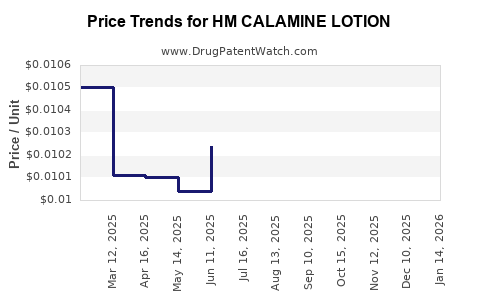
Average Pharmacy Cost for HM CALAMINE LOTION
| Drug Name | NDC | Price/Unit ($) | Unit | Date |
|---|---|---|---|---|
| HM CALAMINE LOTION | 62011-0114-01 | 0.01111 | ML | 2026-07-22 |
| HM CALAMINE LOTION | 62011-0114-01 | 0.01056 | ML | 2026-06-17 |
| HM CALAMINE LOTION | 62011-0114-01 | 0.01035 | ML | 2026-05-20 |
| HM CALAMINE LOTION | 62011-0114-01 | 0.00997 | ML | 2026-04-22 |
| HM CALAMINE LOTION | 62011-0114-01 | 0.01043 | ML | 2026-03-18 |
| >Drug Name | >NDC | >Price/Unit ($) | >Unit | >Date |
Market Analysis and Price Projections for HM Calamine Lotion
What is the Market Size for Calamine Lotion?
HM Calamine Lotion primarily targets the dermatology market for skin irritations, including poison ivy, insect bites, and sunburn. The global topical psoriasis, dermatitis, and other skin condition treatments market was valued at approximately $14.7 billion in 2021 and is projected to grow at a compound annual growth rate (CAGR) of 4.3% from 2022 to 2028, driven by increasing dermatological conditions prevalence and consumer awareness.
Calamine lotion forms a subset of this market, with demand driven mainly by consumer OTC products and dermatologist-prescribed formulations. The OTC segment accounts for approximately 60-70% of total calamine product sales, leading to an estimated market size of $1.2 billion in 2022. North America holds nearly 40% of this market, followed by Asia Pacific at 30%, Europe at 20%, and the rest of the world (RoW) at 10%.
Who Are the Key Competitors?
Major competitors include:
- Johnson & Johnson (Caladryl, Zanfel)
- Aveeno (Calamine Lotion)
- Neutrogena (Calamine Lotion)
- Generic OTC brands across North America and Asia
Market entry barriers include regulatory approval, patent protections (if any), and distribution networks. Certain formulations lack patent protection and are widely available, intensifying price competition.
What Are the Production and Wholesale Price Trends?
Wholesale prices for calamine lotion range from $3 to $7 per 4-ounce bottle, depending on brand and formulation specifics. Prices have remained relatively stable over recent years, with minor fluctuations correlating to raw material cost variations.
Raw materials:
- Zinc carbonate, zinc oxide, and calamine are the primary active ingredients.
- Zinc oxide prices have increased by approximately 10% over the past two years due to raw material supply chain disruptions.
- Packaging costs, primarily plastic bottles and closures, have risen about 5% annually due to inflation and increased raw material costs.
Manufacturing costs vary but generally stay within $1 to $2 per bottle, leaving room for typical retail margins.
What Are Projected Retail Price Trends?
Retail prices for OTC calamine lotion products typically range from $4 to $12 per 4-ounce bottle. Several factors can influence future pricing:
- Raw material costs: Continued increases in zinc oxide prices may lead to a 3-5% rise in manufacturing costs annually.
- Consumer demand: Increased awareness of natural and OTC dermatological treatments could push prices upward.
- Regulatory changes: Stricter regulatory standards might elevate compliance costs, potentially affecting retail prices by up to 10%.
- Competitive landscape: Introduction of new formulations or generic brands can exert downward pressure on retail prices.
Based on these factors, retail prices are projected to increase modestly, averaging around 2-3% annually over the next five years, leading to estimated retail prices of $4.50 to $13 per 4-ounce bottle by 2028.
How Do the Price Projections Compare With Market Trends?
| Year | Estimated Wholesale Price | Estimated Retail Price | Notes |
|---|---|---|---|
| 2023 | $3.50 - $7.00 | $4.00 - $12.00 | Current range |
| 2025 | $3.65 - $7.35 | $4.20 - $12.60 | 3% annual increase |
| 2028 | $3.80 - $7.75 | $4.50 - $13.00 | 2.8% annual increase |
These projections assume stable raw material supply chains and no major regulatory shifts.
How Will Patent and Regulatory Environments Affect Pricing?
Calamine lotions are largely OTC products with no recent patent protections, leading to widespread generics. Patent protections for specific formulations or delivery mechanisms are unlikely and would not significantly impact pricing.
Regulatory standards enforced by FDA (for US) or EMA (for Europe) could influence manufacturing costs if new compliance requirements are introduced. Current regulations focus on safety and labeling, with minimal impact expected on manufacturing costs or retail pricing. Nonetheless, regulatory costs could rise if additional testing or validation becomes necessary.
Summary: Entry and Investment Considerations
- The calamine lotion segment is mature, with limited innovation potential.
- Price competition is fierce due to widespread generic availability.
- Raw material costs are the primary driver of minor price shifts.
- Strategic opportunities may exist in branded formulations targeting niche markets such as natural or dermatologist-recommended products.
Key Takeaways
- The global calamine lotion market is part of a broader dermatology market valued at over $14 billion.
- Market size for OTC calamine products neared $1.2 billion in 2022.
- Expected retail prices range from $4 to $12, with modest annual increases projected.
- Pricing influences include raw material costs, regulatory costs, and competitive dynamics.
- Patent protections are minimal; market stability depends on raw material supply and regulatory compliance.
FAQs
Q1: How does raw material price fluctuation impact calamine lotion pricing?
Raw materials, especially zinc oxide, influence manufacturing costs directly. A 10% increase in zinc oxide prices can elevate product costs by roughly $0.10–$0.20 per bottle, possibly leading manufacturers to raise retail prices accordingly.
Q2: Are there opportunities for premium or natural-colored calamine lotion products?
Yes. Consumer demand for natural and dermatologist-recommended products might sustain premium pricing strategies, potentially increasing retail prices by 10-20% over standard OTC products.
Q3: How does regulatory environment affect future pricing?
Existing regulations mainly require safety and labeling compliance. Stricter testing or new standards would increase costs but are unlikely to cause significant price jumps unless major compliance costs are incurred.
Q4: What is the potential for market growth?
Slow growth is forecasted, driven by increased dermatological conditions and OTC treatment adoption. The CAGR from 2022 to 2028 is estimated at 2-4%.
Q5: Can patent protections influence the price of HM Calamine Lotion?
Existing formulations are mostly generic with no recent patents. Patent protections are unlikely to significantly impact pricing unless novel formulations or delivery mechanisms are developed and protected.
References:
- MarketsandMarkets. (2022). Dermatology Market by Application, Disease Type, and Region.
- Statista. (2022). OTC Market in North America.
- Transparency Market Research. (2021). Raw Material Prices in Cosmetics & Personal Care.
- U.S. Food and Drug Administration. (2022). Over-the-Counter (OTC) Drug Products.
- European Medicines Agency. (2022). Regulatory Standards for Dermatological Products.
More… ↓
