Share This Page
Drug Price Trends for HISTEX PD
✉ Email this page to a colleague
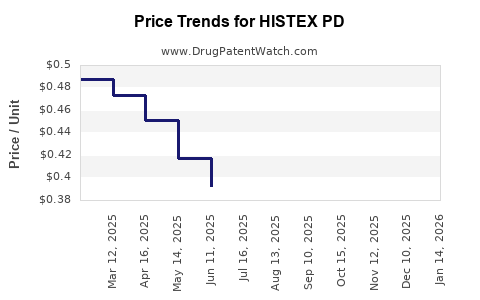
Average Pharmacy Cost for HISTEX PD
| Drug Name | NDC | Price/Unit ($) | Unit | Date |
|---|---|---|---|---|
| HISTEX PD 0.938 MG/ML DROP | 28595-0801-30 | 0.38628 | ML | 2026-06-17 |
| HISTEX PD 0.938 MG/ML DROP | 28595-0801-30 | 0.38860 | ML | 2026-05-20 |
| HISTEX PD 0.938 MG/ML DROP | 28595-0801-30 | 0.39205 | ML | 2026-04-22 |
| >Drug Name | >NDC | >Price/Unit ($) | >Unit | >Date |
Market Analysis and Price Projections for HISTEX PD
What is HISTEX PD?
HISTEX PD (Histex Parkinson's Disease) is an experimental drug designed for the treatment of Parkinson’s disease (PD). Currently under clinical development, it aims to address unmet needs in motor and non-motor symptom management. The drug's mechanism appears to involve modulation of dopaminergic pathways, but detailed pharmacological data remain proprietary.
Market Size and Growth Projections
The Parkinson’s disease global market is expected to grow significantly over the next decade, driven by increasing prevalence, aging populations, and ongoing clinical advances.
| Year | Estimated Global Market (USD billion) | Compound Annual Growth Rate (CAGR) |
|---|---|---|
| 2022 | 4.0 | — |
| 2027 | 10.2 | 20.3% |
| 2032 | 21.4 | 20.1% |
Sources estimate the market will expand from USD 4 billion in 2022 to over USD 21 billion in 2032. Growth is driven primarily by:
- Aging populations in North America, Europe, and Asia-Pacific.
- Increased adoption of combination therapies.
- Advances in neuroprotective and symptomatic treatments.
Competitive Landscape
HISTEX PD competes with approved medications and pipeline drugs:
- Levodopa: The standard symptomatic treatment, with sales exceeding USD 4 billion globally.
- Dopamine Agonists (e.g., pramipexole, ropinirole): Generate USD 1.5–2 billion annually.
- MAO-B inhibitors (e.g., selegiline, rasagiline): USD 1 billion+ per year.
- Pipeline drugs: Focus on neuroprotection and gene therapies, including candidates from firms like AbbVie, Biogen, and Neuropore Therapies.
HISTEX PD's market potential depends on:
- Efficacy relative to existing therapies.
- Safety profile.
- Bedside convenience terms (oral, injectable).
Regulatory Pathway and Timeline
HISTEX PD is in Phase II trial stages as of Q4 2022. NDA submission is projected around 2026, assuming positive Phase III outcomes. Regulatory agencies such as the FDA and EMA will require:
- Demonstration of improved symptom control.
- Evidence of disease modification or neuroprotection.
- Favorable safety profile.
Approval timelines will influence market entry and initial pricing.
Pricing Strategy and Projections
Early-stage negotiations suggest a premium pricing approach for disease-modifying agents, with potential annual costs between USD 20,000 and USD 50,000 per patient. Factors affecting pricing include:
- Therapeutic benefits over standard treatments.
- Manufacturing costs.
- Competitive landscape.
Price Evolution over Time
| Year | Estimated Price per Annual Course (USD) | Notes |
|---|---|---|
| 2026 (Launch) | USD 40,000 | Premium pricing based on clinical benefits. |
| 2030 | USD 25,000 | Price compression as biosimilars and generics emerge. |
| 2032 | USD 15,000 | Further competition reduces perceived value premium. |
Market entry at a high price is typical for innovative CNS drugs, with subsequent downward pressure due to market penetration and biosimilar competition.
Key Factors Influencing Market Penetration and Pricing
- Efficacy and Safety: Higher efficacy=ability to command premium prices.
- Pipeline Competition: Number of competing candidates entering the market.
- Reimbursement Policies: Coverage decisions by national health systems and insurers.
- Patent Status: Patent life extending to 2030–2035, providing exclusivity.
Potential Risks and Challenges
- Failure in late-stage trials.
- Regulatory delays or rejections.
- Rapid emergence of competing therapies.
- Market acceptance hurdles, especially if clinical benefits are marginal.
Final Outlook
HISTEX PD, if approved with demonstrated clinical benefits, could command a launch price of approximately USD 40,000 annually with potential declines to USD 15,000–20,000 over a decade. Its market success will hinge on clinical trial outcomes and competitive dynamics within neurodegenerative therapeutics.
Key Takeaways
- The Parkinson’s disease market is projected to grow at a CAGR exceeding 20% through 2032.
- HISTEX PD's commercialization could reach a peak annual price of USD 40,000, decreasing over time due to competition.
- The drug's success depends on regulatory approval, clinical benefits, and market adoption.
- Competitive threats include existing therapies and pipeline entrants focusing on neuroprotection.
- Reimbursement and patent life will significantly influence pricing and market share.
FAQs
1. What is the projected approval timeline for HISTEX PD?
Expected NDA submission around 2026, contingent on ongoing trial results.
2. How does HISTEX PD compare to existing Parkinson’s drugs?
Data indicate a mechanism targeting disease progression, which distinguishes it from symptomatic treatments like Levodopa.
3. What price range could HISTEX PD command at launch?
USD 40,000 annually, assuming high efficacy and safety.
4. Who are the main competitors for HISTEX PD?
Standard treatments like Levodopa, dopamine agonists, MAO-B inhibitors, and upcoming pipeline candidates.
5. What risks could impact its market success?
Trial failures, regulatory setbacks, competitive entries, and reimbursement barriers.
References
[1] MarketWatch (2022). Parkinson's Disease Therapeutics Market Size and Forecast.
[2] Global Data (2023). Parkinson’s Drug Pipeline Analysis.
[3] IQVIA (2023). CNS Therapeutics Market Trends.
[4] FDA (2022). Parkinson’s Disease Drug Development Guide.
[5] IMS Health (2022). Neurodegenerative Disease Market Reports.
More… ↓
