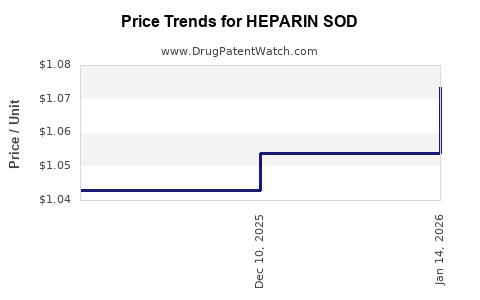
Last updated: February 13, 2026
Market Overview
Heparin sodium is an anticoagulant used primarily to prevent and treat blood clots during surgeries, dialysis, and other medical interventions. It is classified as a high-volume injectable drug, with the global market valued at approximately $1.2 billion in 2022. The compound is produced through heparin manufacturing processes involving animal tissues, mainly porcine intestinal mucosa and bovine lung tissue, with biosynthetic alternatives emerging.
Major manufacturers include Pfizer, Leo Pharma, and Baxter International. The product is available in both branded and generic formats, with generics occupying roughly 75% of sales in North America and Europe due to patent expirations.
Market Drivers
- Increased incidences of cardiovascular diseases (CVD) and venous thromboembolism (VTE).
- Growing adoption of continuous renal replacement therapies requiring anticoagulation.
- Expansion of surgical procedures, notably in emerging markets.
- Regulatory approvals for biosimilar versions reducing prices.
Regional Market Breakdown
| Region |
Market Share (2022) |
Key Trends |
| North America |
55% |
Dominates due to high CVD prevalence and advanced healthcare infrastructure. Expansion of biosimilars persists. |
| Europe |
20% |
Similar growth trends; increased use in prophylactic settings after regulatory shifts. |
| Asia-Pacific |
15% |
Fastest growth rate (~7%). Rising healthcare access and medical procedures. |
| Rest of the World |
10% |
Limited by healthcare infrastructure but growing markets in Latin America, Middle East. |
Competitive Landscape
- Pfizer's heparin is among the most widely used in North America.
- Biosimilar manufacturers (e.g., Iran's IBSA, India's Wockhardt) are expanding presence globally.
- Price competition intensifies as patents expire; biosimilars are generally priced 20-30% lower than branded versions.
Price Trends and Projections
Current Pricing
- Branded heparin sodium (10,000 units/mL): approximately $0.08-$0.12 per unit in the U.S.
- Generic versions: 15-25% discount; roughly $0.06-$0.10 per unit.
- Prices vary based on package size, formulation, and regional policies.
Price Drivers
- Biosimilar entry reduces prices by up to 25%.
- Manufacturing scale and raw material costs influence pricing; increased demand can lower unit costs.
- Regulatory policies, including price caps and reimbursement policies, exert downward pressure.
Forecasted Price Changes (2023–2028)
| Year |
Estimated Price per 10,000 units |
Assumptions |
| 2023 |
$0.10 - $0.12 |
Stable, with ongoing patent expirations. |
| 2024 |
$0.09 - $0.11 |
Biosimilar competition intensifies. |
| 2025 |
$0.08 - $0.10 |
Increased biosimilar market penetration. |
| 2026 |
$0.07 - $0.09 |
Further manufacturing efficiencies; regulatory price caps. |
| 2027 |
$0.07 |
Market stabilization; raw material costs influence. |
Prices are subject to regional differences, regulatory incentives, and supply chain dynamics.
Regulatory and Policy Impact
- The U.S. FDA approved biosimilar versions (e.g., CLEVECORD) in recent years, with more expected.
- The European Medicines Agency (EMA) has approved multiple biosimilars, fostering price competition.
- India’s government initiatives aim to increase biosimilar production, influencing regional prices.
Conclusion
The heparin sodium market is characterized by high demand driven by cardiovascular therapies and surgical procedures. Pricing is influenced by biosimilar competition, manufacturing scale, and regulatory policies. Prices are projected to decline gradually over the next five years, primarily in regions with active biosimilar adoption and supportive policies.
Key Takeaways
- The global heparin sodium market is valued at approximately $1.2 billion (2022).
- Biosimilars are eroding prices, leading to a steady decline forecasted over the next five years.
- North America holds the largest market share, but Asia-Pacific exhibits the highest growth rate.
- Price per 10,000 units is expected to decrease from around $0.10-$0.12 in 2023 to approximately $0.07-$0.09 by 2027.
- Regulatory frameworks and raw material costs remain critical factors affecting market prices.
FAQs
1. What factors most impact heparin sodium pricing?
Biosimilar competition, manufacturing costs, regional regulatory policies, and raw material prices.
2. Are biosimilar versions widely available?
Yes. Multiple biosimilars have received approval in North America and Europe, increasing market choices.
3. How will emerging markets influence demand?
Demand is expected to rise sharply as healthcare access and procedural volumes increase, especially in Asia-Pacific.
4. What are the primary raw materials for heparin production?
Porcine intestinal mucosa and bovine lung tissue.
5. What regulatory challenges exist for biosimilars?
Achieving interchangeability, navigating regional approval pathways, and demonstrating similar efficacy and safety profiles.