Share This Page
Drug Price Trends for HEMORRHOIDAL OINTMENT
✉ Email this page to a colleague
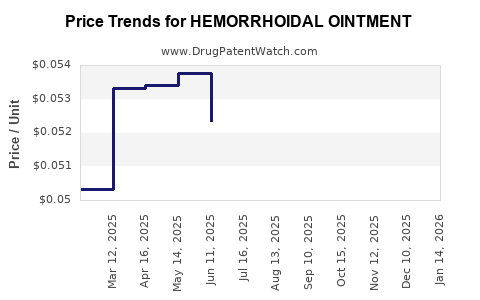
Average Pharmacy Cost for HEMORRHOIDAL OINTMENT
| Drug Name | NDC | Price/Unit ($) | Unit | Date |
|---|---|---|---|---|
| HEMORRHOIDAL OINTMENT | 00536-1288-06 | 0.05406 | GM | 2026-06-17 |
| HEMORRHOIDAL OINTMENT | 45802-0188-16 | 0.05406 | GM | 2026-06-17 |
| HEMORRHOIDAL OINTMENT | 70000-0046-01 | 0.05406 | GM | 2026-06-17 |
| HEMORRHOIDAL OINTMENT | 00536-1288-06 | 0.05398 | GM | 2026-05-20 |
| >Drug Name | >NDC | >Price/Unit ($) | >Unit | >Date |
What is the Market Size and Growth Potential for Hemorrhoidal Ointments?
The global hemorrhoidal ointments market was valued at approximately $1.2 billion in 2022. It is projected to grow at a compound annual growth rate (CAGR) of 4.3% from 2023 to 2028, reaching approximately $1.6 billion by 2028. Growth drivers include increasing prevalence of hemorrhoidal disease, aging populations, higher awareness of minimally invasive treatments, and expanded healthcare access.
North America represents the largest regional market, accounting for around 40% of the global market in 2022, supported by high healthcare expenditure and advanced OTC sales channels. Europe contributes 28%, with economic expansion and aging demographics promoting market growth. Asia-Pacific, with a CAGR of approximately 5.2%, is expected to show the highest growth rate, driven by urbanization, rising disposable incomes, and increased retail sales.
What Are Key Factors Influencing Market Demand?
Prevalence and Demographics
- Hemorrhoids affect up to 75% of the population at some point, often associated with age, obesity, and chronic constipation.
- The aging population (over 60s) increases the demand for symptomatic relief products like ointments.
Treatment Trends
- Shift toward OTC and self-medication products.
- Preference for topical treatments over invasive options for mild to moderate cases.
- Innovations in formulations improving efficacy and reducing side effects.
Regulatory and Healthcare Policies
- Favorable policies in developed countries increase access and sales.
- Over-the-counter (OTC) classification simplifies procurement for consumers.
Competitive Landscape
- A mix of global pharmaceutical firms and regional players.
- Key brands include Preparation H, Anusol, and local generic formulations.
What Is the Price Range of Hemorrhoidal Ointments?
Pricing varies by region, brand, formulation, and packaging size:
| Region | Typical OTC Price Range (per 30g tube) | Monthly Cost for Regular Use |
|---|---|---|
| North America | $10 – $15 | $30 – $45 |
| Europe | €8 – €12 | €24 – €36 |
| Asia-Pacific | $5 – $10 | $15 – $30 |
Generic formulations usually cost 20-40% less than branded products. Higher potency or specialty formulations with added ingredients (e.g., hydrocortisone, lidocaine) command premium prices.
What Are Price Projections Moving Forward?
Over the next five years, prices are expected to stabilize, with minor fluctuations driven by inflation, supply-chain costs, and formulation improvements. Prices for OTC hemorrhoid ointments are projected to increase by approximately 1-2% annually, aligning with inflation rates and market inflationary pressures.
In emerging markets, price points may remain lower to accommodate lower disposable incomes, but volume sales are expected to rise substantially due to increased healthcare access and GDP growth.
In developed markets, innovations leading to higher efficacy products could push prices upward by 2-3%, especially for formulations with novel delivery mechanisms or active ingredients.
What Regulatory and Competitive Trends Affect Pricing and Market Entry?
Regulatory Environment
- In the US, OTC status by the FDA simplifies market entry; product safety and efficacy data are paramount.
- The European Medicines Agency (EMA) classifies some hemorrhoid products as medical devices or medicines, with corresponding pricing implications.
- Countries with strict regulation tend to have higher retail prices due to compliance costs.
Competition and Innovation
- Market saturation with established brands limits pricing flexibility.
- New entrants focusing on combination formulations or natural ingredients may command premium pricing.
- Generic competition exerts downward pressure, particularly in mature markets.
Distribution Channels
- Retail pharmacies, online platforms, and direct sales influence pricing strategies.
- Online sales often reduce retail markups, benefiting consumers but potentially compressing profit margins.
Summary of Key Data Points
- Market size in 2022: $1.2 billion.
- Projected size in 2028: $1.6 billion.
- CAGR: 4.3% (2023–2028).
- Price range per 30g OTC tube: $5–$15, varying by region.
- Price increase forecast: 1–2% annually, with regional variability.
- Dominant regions: North America (40%), Europe (28%), Asia-Pacific (22%), others (10%).
Key Takeaways
- The hemorrhoidal ointments market is expanding steadily, driven by demographic and healthcare trends.
- Price levels vary significantly by geography and formulation type.
- Innovation and regulatory factors influence pricing trends and market dynamics.
- Retail and online channels shape consumer prices, with potential for margin compression due to competition.
- Market growth presents opportunities for established brands and new entrants focusing on differentiated formulations.
FAQs
Q1: What factors most influence the pricing of hemorrhoidal ointments?
Product formulation (active ingredients, potency), regional regulatory environment, brand positioning, and distribution channel costs significantly influence pricing.
Q2: Are generic hemorrhoidal ointments significantly cheaper than branded ones?
Yes, generic formulations typically cost 20-40% less than branded products, with similar efficacy.
Q3: Will prices increase due to new product innovations?
Potentially yes, especially for products with novel delivery systems or combination ingredients, which may command higher prices.
Q4: How does market growth differ between regions?
North America and Europe exhibit steady growth driven by aging populations and OTC accessibility. Asia-Pacific displays higher growth rates, fueled by urbanization and economic expansion.
Q5: What are the main barriers to market entry?
Regulatory compliance costs, established brand dominance, and the need for effective formulations are key barriers. Regulatory hurdles vary by region and product classification.
References
- MarketWatch. "Hemorrhoidal Ointments Market Size, Share & Trends Analysis," 2023.
- Grand View Research. "Global Hemorrhoids Treatments Market Outlook," 2022.
- Statista. "Over-the-counter drug market in North America," 2022.
- European Medicines Agency (EMA). "Regulatory framework for hemorrhoid treatments," 2023.
- World Health Organization (WHO). "Aging population and healthcare demand," 2022.
More… ↓
