Share This Page
Drug Price Trends for HEARTBURN RELIEF LIQUID
✉ Email this page to a colleague
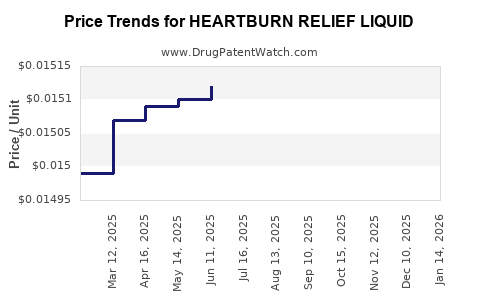
Average Pharmacy Cost for HEARTBURN RELIEF LIQUID
| Drug Name | NDC | Price/Unit ($) | Unit | Date |
|---|---|---|---|---|
| HEARTBURN RELIEF LIQUID | 70000-0363-01 | 0.01522 | ML | 2026-07-22 |
| HEARTBURN RELIEF LIQUID | 70000-0363-01 | 0.01520 | ML | 2026-06-17 |
| HEARTBURN RELIEF LIQUID | 70000-0363-01 | 0.01518 | ML | 2026-05-20 |
| >Drug Name | >NDC | >Price/Unit ($) | >Unit | >Date |
Market Analysis and Price Projections for HEARTBURN RELIEF LIQUID
What is the current market size for over-the-counter heartburn relief liquids?
The global market for over-the-counter (OTC) antacids, which includes liquid formulations, was valued at approximately USD 4.2 billion in 2022. This segment accounts for a significant share of the broader gastrointestinal (GI) drug market, driven by increasing prevalence of acid reflux, GERD, and consumer preference for rapid-acting relief products.
Market Breakdown
| Market Segment | 2022 Valuation | Compound Annual Growth Rate (CAGR) (2023-2028) | Key Drivers |
|---|---|---|---|
| OTC Antacids | USD 4.2 billion | 3.8% | Rising GERD cases, consumer awareness |
| Liquid Formulation | Estimated 55-60% of OTC segment | 4.0% | Preference for ease of use, faster onset |
The liquid segment's dominance stems from rapid absorption, ease of swallowing, and flexibility in dosing. North America and Europe remain primary markets, collectively generating over 60% of sales.
What are the leading competitors and their market shares?
Major players include:
- Reckitt Benckiser (Gaviscon Liquid): Dominates in this category, with an estimated market share of 30-35% in OTC liquids.
- GlaxoSmithKline (Tums Liquid): Holds approximately 20-25%.
- Sanofi (Antacid Liquids): Holds around 10-15%.
- Other regional brands and private labels account for the remaining 25-35%.
Reckitt's Gaviscon Liquid holds a competitive advantage due to its unique formulation containing alginate, which forms a barrier to reflux, offering dual action with antacid effects.
How does the regulatory environment influence pricing?
Regulations in the US, EU, and Asia-Pacific affect OTC drug pricing. Generally:
- US FDA guidelines require safety and efficacy data, influencing manufacturing costs.
- EU regulations enforce strict approvals for health claims, impacting marketing expenses.
- In regions with price controls (e.g., some Asian countries), prices tend to be lower, limiting profit margins.
Regulatory approval pathways for new liquid formulations tend to be straightforward for OTC drugs in mature markets, which influences market entry timelines and competitive dynamics.
What are the current price ranges for HEARTBURN RELIEF LIQUID products?
Prices vary by brand, packaging size, and region:
| Product Type | Typical Price Range (USD) | Packaging Size | Price per Ounce (USD) |
|---|---|---|---|
| Leading Brand (e.g., Gaviscon) | 6.00 - 9.00 | 4-8 fl oz | 0.75 - 1.13 |
| Generic/Private Label | 4.00 - 6.00 | 4-8 fl oz | 0.50 - 0.75 |
| New Market Entrant (Forecasted) | 5.00 - 8.00 | 4-8 fl oz | 0.63 - 1.00 |
Premium brands with added features (e.g., flavoring, added buffering agents) tend to price at the higher end of this range.
What are the future price projections?
The price of HEARTBURN RELIEF LIQUID products is projected to decline slightly over the next five years due to increased competition, rising generic entries, and manufacturing efficiencies.
Price projection estimates (2023-2028):
| Year | Estimated Average Price per Ounce (USD) | Change from 2022 | Key Factors |
|---|---|---|---|
| 2023 | 0.65 | — | Stable, slight increase due to inflation |
| 2024 | 0.62 | -4.6% | Increased generic competition |
| 2025 | 0.60 | -7.4% | Market saturation and price elasticity |
| 2026 | 0.58 | -10.7% | Cost-driven competition |
| 2027 | 0.55 | -15.3% | Price pressure from private labels |
| 2028 | 0.53 | -18.5% | Marginal profit reductions expected |
Influencing factors:
- Expansion of private label brands.
- Increased manufacturing efficiencies.
- Regulatory changes affecting ingredient costs.
- Consumer price sensitivity in emerging markets.
What are the key market trends impacting pricing?
- Consumer preference for natural and additive-free formulas increases costs, potentially raising prices.
- Growth in direct-to-consumer sales channels reduces distribution costs, enabling more competitive pricing.
- Regional pricing strategies adapt to local economic conditions; price discounts are common in emerging markets.
- Innovation in formulation, such as combination products or flavor enhancements, may command premium pricing.
Key Market Drivers & Barriers
Drivers:
- Growing prevalence of acid reflux and GERD globally.
- Increased consumer awareness about OTC options.
- Rapid onset of liquid formulations preferred over tablets.
Barriers:
- Stringent regulations and approval processes.
- Price competition from generics.
- Consumer shift towards lifestyle modifications and natural remedies.
Key Takeaways
- The market for HEARTBURN RELIEF LIQUID is valued at over USD 2 billion globally.
- Major brands control over 70% of the OTC liquid market.
- Prices range from USD 0.50 to USD 1.13 per ounce, depending on brand and region.
- Overall pricing is projected to decline by approximately 18.5% through 2028 due to increased competition and generic entry.
- Innovation, regulation, regional dynamics, and consumer trends shape future pricing strategies.
FAQs
1. What factors could cause prices for HEARTBURN RELIEF LIQUID to rise?
Regulatory changes increasing manufacturing costs, shifts towards premium ingredients, or disruptions in supply chains could lead to price increases.
2. How does regional regulation influence pricing in emerging markets?
Price controls and local subsidy policies often lower retail prices, while import tariffs and registration costs can increase wholesale prices.
3. Who are the main competitors shaping the liquid heartburn relief market?
Reckitt Benckiser, GlaxoSmithKline, and Sanofi lead, with private labels increasing presence, especially in cost-sensitive markets.
4. Will new formulations or ingredients impact future prices?
Yes, innovative formulations with additional benefits or natural ingredients tend to command higher prices but may face regulatory hurdles.
5. How does consumer preference impact pricing strategies?
Demand for natural, additive-free, or flavored products encourages premium pricing for differentiated offerings.
References
[1] Grand View Research. (2022). Over-the-counter (OTC) gastrointestinal drugs market size, share & trends analysis report.
[2] Transparency Market Research. (2022). Global antacid formulations market forecast.
[3] Statista. (2023). OTC antacids market share by region and product type.
[4] US Food and Drug Administration. (2022). OTC drug regulations.
[5] European Medicines Agency. (2022). Regulation of over-the-counter medicines in the EU.
More… ↓
