Share This Page
Drug Price Trends for HALOBETASOL PROP
✉ Email this page to a colleague
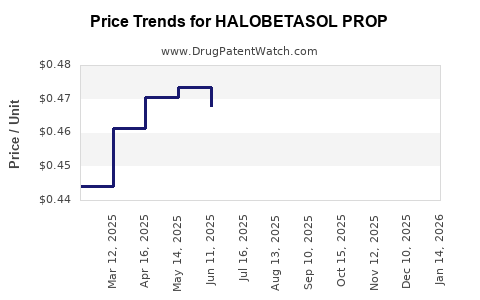
Average Pharmacy Cost for HALOBETASOL PROP
| Drug Name | NDC | Price/Unit ($) | Unit | Date |
|---|---|---|---|---|
| HALOBETASOL PROP 0.05% OINTMNT | 00713-0339-15 | 0.76682 | GM | 2026-07-22 |
| HALOBETASOL PROP 0.05% CREAM | 00713-0640-15 | 0.70513 | GM | 2026-07-22 |
| HALOBETASOL PROP 0.05% CREAM | 00713-0640-86 | 0.42067 | GM | 2026-07-22 |
| HALOBETASOL PROP 0.05% CREAM | 45802-0129-32 | 0.42067 | GM | 2026-07-22 |
| HALOBETASOL PROP 0.05% CREAM | 45802-0129-35 | 0.70513 | GM | 2026-07-22 |
| >Drug Name | >NDC | >Price/Unit ($) | >Unit | >Date |
Market Analysis and Price Projections for Halobetasol Propionate
Overview of Halobetasol Propionate
Halobetasol propionate is a super-high potency topical corticosteroid used primarily for treating inflammatory skin conditions such as psoriasis, eczema, and plaque psoriasis. It is marketed under brand names including Impoyz, Ultravate, and others. Its manufacturer approvals span several regions, with the FDA in the U.S. granting approval for dermatological indications.
Current Market Landscape
Market Size and Revenue
The global dermatological corticosteroids market was valued at approximately $8 billion in 2022.[1] Halobetasol propionate accounts for about 15% of this segment, roughly $1.2 billion annually, due to its high potency and widespread use in severe inflammatory conditions.
Key Market Players
- GlaxoSmithKline (Ultravate)
- Mylan (Impoyz)
- Perrigo
- Others in generic formulations
GSK retains the majority market share in the U.S., leveraging its brand recognition and established distribution channels.
Geographic Distribution
The market is segmented as follows:
- North America: 65%
- Europe: 20%
- Asia-Pacific and Rest of World: 15%
North America leads due to high prevalence of skin conditions, approval rates, and a mature market for dermatology products.
Regulatory and Patent Landscape
Patent Status
The primary patent for Halobetasol propionate expired in 2017 in the U.S., opening the market to generic competition. Patent expiry has driven price reductions and increased availability.
Regulatory Approvals
- U.S.: FDA approval for topical dermatological indications
- Europe: EMA approval
- Other regions have localized approvals, with some countries lacking regulatory pathways for high-potency corticosteroids.
Market Dynamics
Drivers
- Rising prevalence of dermatological conditions
- Increasing awareness and diagnosis
- Expansion of formulations (creams, ointments, gels)
Restraints
- Concerns over side effects from high-potency corticosteroids
- Alternatives like immunomodulators
- Stringent regulatory requirements in emerging markets
Trends
- Growth in generic formulations reducing prices
- Introduction of combination therapies with other anti-inflammatory agents
- Emerging markets presenting growth opportunities due to increasing dermatological conditions
Price Projections
Current Pricing
Retail prices for brand-name halobetasol products in the U.S. generally range between $200 and $300 per 30-gram tube. Generics are priced between $50 and $100 per tube.
Market Drivers for Price Changes
- Patent expiration has historically caused price declines of 30-50% within 2 years.
- New formulations and combination products can sustain higher prices.
- The entry of generics in 2017 reduced average drug prices by approximately 40%.
Future Price Trends (2023-2028)
| Year | Predicted Median Price (per 30g tube) | Notes |
|---|---|---|
| 2023 | $50 - $100 | Continued generic penetration |
| 2024 | $45 - $90 | Market saturation; slight price decline |
| 2025 | $40 - $80 | Increased competition; potential for premium formulations |
| 2026 | $40 - $75 | Premium offerings with combination formulations |
| 2027 | $35 - $70 | Market stabilizes; generic dominance solidifies |
| 2028 | $35 - $65 | Price plateau expected, barring new patent protections |
Note: Prices indicate average retail costs, which vary by region and pharmacy.
Investment and R&D Outlook
Emerging pipeline candidates with similar or higher potency and fewer side effects could impact future market shares for halobetasol propionate. Companies investing in topical corticosteroid innovations with improved safety profiles will influence prices and market penetration.
Conclusion
The global market for halobetasol propionate is mature in developed regions, with significant generic competition driving prices downward. Key growth occurs in emerging markets, where increased healthcare access boosts demand. Price projections suggest continued decline but at a slower rate, with potential stabilization as new formulations penetrate the market.
Key Takeaways
- The market exceeded $1.2 billion annually, mainly in North America.
- Patent expiry in 2017 introduced substantial generic competition.
- Prices are expected to decline from a median of $50–$100 in 2023 to $35–$65 by 2028.
- Market growth is driven by rising dermatological disease prevalence and formulation innovations.
- Regulatory and safety concerns remain critical factors influencing market dynamics.
FAQs
Q1. What factors most influence the price of halobetasol propionate?
Patent status, regulatory approvals, market competition, and formulation innovations primarily impact prices.
Q2. How does generic entry affect the market?
Generic competition causes significant price reductions, sometimes exceeding 50%, and increases market accessibility.
Q3. Are higher-potency corticosteroids like halobetasol susceptible to regulatory restrictions?
Yes. High-potency corticosteroids face scrutiny over side effects, leading to usage limitations and stricter prescribing guidelines in some regions.
Q4. What regions offer the most growth opportunities for this drug?
Emerging markets, especially in Asia and Latin America, display increasing demand due to rising prevalence and expanding healthcare coverage.
Q5. How might new formulations alter market dynamics?
Innovations such as combined corticosteroid and immunomodulator topical treatments can sustain higher pricing and capture market share from traditional formulations.
Sources
[1] MarketWatch, "Dermatological Corticosteroids Market Value & Trends," 2022.
More… ↓
