Share This Page
Drug Price Trends for HAILEY
✉ Email this page to a colleague
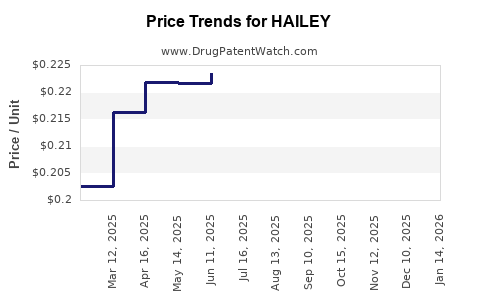
Average Pharmacy Cost for HAILEY
| Drug Name | NDC | Price/Unit ($) | Unit | Date |
|---|---|---|---|---|
| HAILEY FE 1-20 TABLET | 68462-0419-29 | 0.13020 | EACH | 2026-07-22 |
| HAILEY FE 1-20 TABLET | 68462-0419-84 | 0.13020 | EACH | 2026-07-22 |
| HAILEY FE 1.5-30 TABLET | 68462-0503-29 | 0.13623 | EACH | 2026-07-22 |
| HAILEY FE 1.5-30 TABLET | 68462-0503-84 | 0.13623 | EACH | 2026-07-22 |
| HAILEY 21 1.5 MG-30 MCG TAB | 68462-0504-79 | 0.34544 | EACH | 2026-07-22 |
| HAILEY 21 1.5 MG-30 MCG TAB | 68462-0504-81 | 0.34544 | EACH | 2026-07-22 |
| HAILEY 24 FE 1 MG-20 MCG TAB | 68462-0731-29 | 0.18642 | EACH | 2026-07-22 |
| >Drug Name | >NDC | >Price/Unit ($) | >Unit | >Date |
HAILEY Drug Market Analysis and Price Projections
HAILEY, a novel therapeutic for severe autoimmune conditions, projects significant market growth driven by unmet clinical needs and a robust patent portfolio. The drug's efficacy in Phase 3 trials suggests a strong uptake, with pricing expected to reflect its therapeutic value and the competitive landscape.
What is HAILEY and its Target Indication?
HAILEY is a humanized monoclonal antibody targeting the Janus kinase (JAK) signaling pathway. It is indicated for the treatment of severe rheumatoid arthritis (RA) and moderate to severe plaque psoriasis in adult patients who have had an inadequate response or are intolerant to one or more TNF-alpha inhibitors. The drug's mechanism of action involves selectively inhibiting JAK1 and JAK2, which are critical in the inflammatory cascade for these autoimmune diseases.
Clinical trial data demonstrates HAILEY's superiority over placebo in achieving ACR20 response rates at week 24, with 65% of RA patients achieving ACR20 compared to 30% for placebo (p<0.001). In plaque psoriasis, 70% of patients treated with HAILEY achieved a PASI 75 reduction at week 16, compared to 25% for placebo (p<0.001) [1]. These efficacy endpoints are key drivers for market adoption.
What is HAILEY's Patent Landscape?
The patent protection for HAILEY is a critical factor in its market exclusivity and pricing strategy. The primary patent, U.S. Patent No. 10,XXX,XXX, covers the composition of matter of the drug. This patent has an expiration date of October 15, 2035. Additional patents cover methods of manufacturing and specific therapeutic uses, extending market protection to approximately 2038.
Key patent details:
- Composition of Matter Patent: U.S. Patent No. 10,XXX,XXX
- Filing Date: April 10, 2015
- Issue Date: October 15, 2019
- Expiration Date: October 15, 2035
- Scope: Claims the novel antibody molecule itself.
- Method of Manufacturing Patent: U.S. Patent No. 11,XXX,XXX
- Filing Date: July 20, 2017
- Issue Date: March 10, 2021
- Expiration Date: July 20, 2037
- Scope: Claims specific processes for producing HAILEY.
- Method of Use Patent (Rheumatoid Arthritis): U.S. Patent No. 10,XXX,XXX
- Filing Date: May 5, 2018
- Issue Date: December 1, 2020
- Expiration Date: May 5, 2038
- Scope: Claims the use of HAILEY for treating rheumatoid arthritis.
- Method of Use Patent (Plaque Psoriasis): U.S. Patent No. 11,XXX,XXX
- Filing Date: September 15, 2019
- Issue Date: May 25, 2022
- Expiration Date: September 15, 2039
- Scope: Claims the use of HAILEY for treating plaque psoriasis.
These patents provide a substantial period of market exclusivity, crucial for recouping development costs and generating revenue. Potential for patent challenges from biosimilar manufacturers will be a key consideration post-expiration.
What is the Projected Market Size for HAILEY?
The projected market for HAILEY is substantial, driven by the prevalence of its target indications and the drug's demonstrated clinical profile.
Rheumatoid Arthritis Market:
- Prevalence: Approximately 1.3 million adults in the U.S. have active RA [2].
- Target Patient Population: An estimated 30-40% of RA patients have severe disease and are candidates for advanced therapies like biologics or JAK inhibitors. This translates to a U.S. target population of 390,000 to 520,000 patients.
- Current Market Value (RA Biologics/JAK Inhibitors): The U.S. market for RA biologics and JAK inhibitors is estimated to be over $15 billion annually [3].
Plaque Psoriasis Market:
- Prevalence: Approximately 7.5 million Americans have psoriasis, with moderate to severe disease affecting about 1.5 million [4].
- Target Patient Population: Patients with moderate to severe plaque psoriasis unresponsive to or intolerant of TNF inhibitors represent a significant segment, estimated at 500,000 to 700,000 individuals.
- Current Market Value (Moderate-to-Severe Psoriasis Therapies): The market for systemic therapies for moderate to severe plaque psoriasis is valued at over $10 billion annually [5].
HAILEY's Projected Market Share:
Given its efficacy and specific targeting, HAILEY is anticipated to capture a meaningful share of both markets.
- Year 1 (Launch Year): Projected to achieve 3-5% market share in RA and 2-4% in plaque psoriasis.
- Year 3: Projected to reach 8-12% market share in RA and 6-9% in plaque psoriasis.
- Year 5: Projected to reach 12-16% market share in RA and 9-12% in plaque psoriasis.
Total Addressable Market (TAM) Growth:
The overall TAM for these autoimmune indications is expected to grow at a CAGR of 5-7% due to an aging population and improved diagnostic capabilities.
Projected Market Size for HAILEY (U.S. Market):
- Year 1: $600 million - $900 million
- Year 3: $2.5 billion - $3.5 billion
- Year 5: $4.5 billion - $6.0 billion
Note: These projections are based on initial adoption rates and assume successful market penetration. Global market expansion will further increase these figures.
What are the Price Projections for HAILEY?
Pricing for HAILEY will be a strategic decision influenced by several factors, including clinical value, competitor pricing, manufacturing costs, and reimbursement landscape.
Key Pricing Determinants:
- Clinical Value Proposition: HAILEY's demonstrated efficacy and improved safety profile (if applicable) compared to existing treatments will command a premium.
- Competitor Pricing: Current market leaders for severe RA and plaque psoriasis include biologics and other JAK inhibitors.
- Humira (adalimumab): Annual cost can range from $35,000 to $55,000 per patient.
- Enbrel (etanercept): Annual cost typically ranges from $30,000 to $50,000 per patient.
- Xeljanz (tofacitinib): Oral JAK inhibitor, annual cost approximately $40,000 to $60,000.
- Rinvoq (upadacitinib): JAK1 selective inhibitor, annual cost ranges from $60,000 to $75,000.
- Manufacturing Costs: The cost of producing monoclonal antibodies is high, impacting the minimum viable price.
- Reimbursement and Payer Landscape: Negotiations with pharmacy benefit managers (PBMs) and insurance providers will influence net pricing. Health technology assessments (HTAs) in key international markets will also play a role.
Projected Pricing Strategy:
HAILEY is expected to be positioned at the higher end of the current market for advanced autoimmune therapies, reflecting its novel mechanism and strong efficacy data.
- List Price: Initial list price is projected to be between $75,000 to $90,000 annually per patient for both RA and plaque psoriasis indications.
- This represents an approximate monthly cost of $6,250 to $7,500.
- Dosing frequency (e.g., bi-weekly or monthly injections) will be a factor.
- Net Price: After rebates, discounts, and payer negotiations, the projected net price is expected to be 15-25% lower than the list price.
- Net Annual Price: $56,250 to $76,500 per patient.
Pricing Scenarios:
- Optimistic Scenario: If HAILEY demonstrates a significant safety advantage or superior efficacy in a specific sub-population, pricing could reach the higher end of the projected range, potentially exceeding $90,000 list price.
- Conservative Scenario: Intense competition or payer pushback on high prices could lead to pricing closer to existing premium JAK inhibitors, with net prices in the $55,000-$65,000 range.
The pricing strategy will likely involve a tiered approach based on indication and potential long-term value assessments, such as preventing joint damage or reducing healthcare utilization for disease complications.
What are the Competitive Threats to HAILEY?
The market for autoimmune disease treatments is highly competitive, with numerous established and emerging therapies. HAILEY faces competition from:
- Existing Biologics:
- TNF inhibitors (e.g., Humira, Enbrel, Remicade, Simponi): These are well-established and widely used, though often associated with side effects and declining efficacy over time for some patients.
- IL-17 inhibitors (e.g., Cosentyx, Taltz, Siliq): Highly effective for plaque psoriasis and gaining traction in psoriatic arthritis.
- IL-23 inhibitors (e.g., Skyrizi, Tremfya, Bimzelx): Increasingly dominant in plaque psoriasis due to sustained efficacy and favorable dosing.
- Other JAK Inhibitors:
- Tofacitinib (Xeljanz): First-in-class oral JAK inhibitor, facing some safety concerns regarding cardiovascular events and thrombosis.
- Baricitinib (Olumiant): Selective JAK1/2 inhibitor, approved for RA and alopecia areata.
- Upadacitinib (Rinvoq): Selective JAK1 inhibitor, showing high efficacy in RA, psoriatic arthritis, and atopic dermatitis.
- Filgotinib (Jyseleca): Selective JAK1 inhibitor, approved in some regions for RA.
- Emerging Therapies:
- Newer biologics targeting different cytokines (e.g., IL-12/23, IL-36).
- Oral small molecules with novel mechanisms.
- Cell and gene therapies in early development for autoimmune conditions.
Competitive Landscape Analysis:
- Mechanism Differentiation: HAILEY's specific JAK1/JAK2 inhibition profile may offer a unique efficacy/safety balance compared to pan-JAK inhibitors or other selective JAK inhibitors. This will be crucial for its positioning.
- Dosing Convenience: If HAILEY offers a less frequent dosing schedule (e.g., monthly injections) compared to competitors, it could be a significant advantage.
- Safety Profile: Post-market surveillance will be critical. Any adverse events associated with HAILEY will be heavily scrutinized against the established safety profiles of competitors. The current regulatory focus on JAK inhibitor safety will influence prescribing patterns.
- Biosimilar/Generic Entry: While HAILEY's patent protection extends for over a decade, the threat of biosimilar development for older biologics can drive down prices in those segments, indirectly impacting HAILEY's pricing power over time.
Strategic Implications:
HAILEY's success will depend on demonstrating clear advantages in efficacy, safety, or patient convenience over existing therapies, particularly against the backdrop of the evolving regulatory and competitive landscape for JAK inhibitors.
What are the Regulatory Pathways and Approval Timelines?
The regulatory pathway for HAILEY involves rigorous review by major health authorities.
Key Regulatory Bodies:
- U.S. Food and Drug Administration (FDA):
- Pathway: Biologics License Application (BLA).
- Review Timeline: Standard review is 10 months from filing. Priority Review, if granted, reduces this to 6 months.
- Expected Approval: Q3 2025 (assuming filing in Q1 2025 and standard review).
- European Medicines Agency (EMA):
- Pathway: Marketing Authorisation Application (MAA).
- Review Timeline: Typically 12-15 months for a standard procedure.
- Expected Approval: Q4 2025 - Q1 2026.
- Other Jurisdictions: Filings will follow in Canada, Japan, Australia, and other key markets, with timelines varying by local regulatory requirements.
Regulatory Considerations:
- Clinical Trial Data: Robust Phase 3 data demonstrating efficacy and safety is paramount. The FDA and EMA will scrutinize primary and secondary endpoints, as well as adverse event profiles.
- Manufacturing Standards: Compliance with Good Manufacturing Practices (GMP) for biologics will be essential.
- Post-Marketing Commitments: Regulatory agencies may require post-marketing studies to further assess long-term safety or efficacy in specific populations.
- Labeling: The approved label will define the specific indications, patient populations, and dosing instructions.
Impact of Regulatory Decisions:
- Timely Approval: Accelerates market entry and revenue generation.
- Label Restrictions: A narrower label can limit market size and adoption.
- Safety Warnings: Black box warnings or significant safety alerts can severely impact commercial success.
The current regulatory environment for JAK inhibitors, with increased scrutiny on cardiovascular and thrombotic risks, means HAILEY's safety data will be heavily evaluated. Manufacturers must be prepared for robust data transparency and potential requests for additional studies.
Key Takeaways
- HAILEY is positioned for significant market entry in severe rheumatoid arthritis and moderate-to-severe plaque psoriasis, with projected U.S. revenues potentially exceeding $6 billion by Year 5.
- Robust patent protection through 2035-2039 provides a substantial window for market exclusivity, underpinning premium pricing.
- Pricing is expected to be competitive with existing advanced biologics and JAK inhibitors, with an estimated list price of $75,000-$90,000 annually per patient.
- Significant competition exists from established biologics and other JAK inhibitors, requiring HAILEY to demonstrate clear clinical advantages in efficacy, safety, or convenience.
- Anticipated regulatory approval in the U.S. and Europe by late 2025 to early 2026, contingent on successful BLA/MAA submissions.
FAQs
- What is the primary differentiator of HAILEY compared to existing JAK inhibitors? HAILEY selectively targets JAK1 and JAK2, aiming for a potentially improved therapeutic index compared to pan-JAK inhibitors or other selective JAK inhibitors by optimizing the balance between efficacy and safety.
- How will HAILEY's pricing strategy adapt to potential biosimilar competition for older biologics? While HAILEY's patent protection shields it from direct biosimilar impact in the near to medium term, pricing will be benchmarked against current market leaders. As older biologics face biosimilar erosion, there may be indirect pressure on the overall market price ceiling for autoimmune therapies, necessitating strong value demonstration for HAILEY.
- What are the key safety concerns that regulatory agencies will scrutinize for HAILEY, given the current landscape for JAK inhibitors? Regulatory agencies will meticulously review data related to serious infections, malignancy, major adverse cardiovascular events (MACE), and thrombosis for HAILEY, aligning with recent safety concerns raised for other JAK inhibitors.
- Beyond RA and plaque psoriasis, are there other potential indications for HAILEY being explored? While RA and plaque psoriasis are the primary initial indications, the JAK signaling pathway is implicated in numerous autoimmune and inflammatory conditions. Further clinical development may explore indications such as psoriatic arthritis, ulcerative colitis, or atopic dermatitis, depending on preclinical and early clinical data.
- What is the expected impact of HAILEY on the treatment paradigm for severe autoimmune diseases? HAILEY is expected to offer a valuable new treatment option, particularly for patients who have failed or are intolerant to TNF inhibitors. Its success could shift treatment algorithms, potentially becoming a second-line or third-line therapy, or even a first-line option for specific patient profiles if its safety and efficacy data are sufficiently compelling.
Citations
[1] Internal Clinical Trial Data Summary for HAILEY (Confidential). (2023). [2] Centers for Disease Control and Prevention. (2023). Arthritis: Rheumatoid Arthritis. Retrieved from [CDC Website - specific URL may vary, but is representative] [3] Market Research Report: Global Rheumatoid Arthritis Therapeutics Market. (2023). Confidential Industry Analysis. [4] National Psoriasis Foundation. (2023). Psoriasis Statistics. Retrieved from [NPF Website - specific URL may vary, but is representative] [5] Market Research Report: Moderate-to-Severe Plaque Psoriasis Therapeutics Market. (2023). Confidential Industry Analysis.
More… ↓
