Share This Page
Drug Price Trends for GUAIFENESIN-DM
✉ Email this page to a colleague
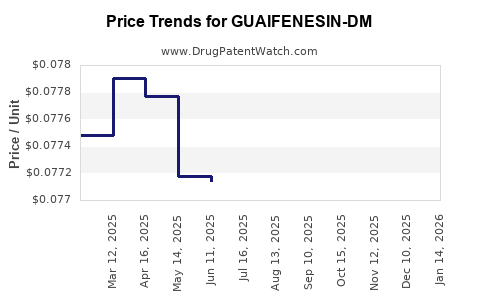
Average Pharmacy Cost for GUAIFENESIN-DM
| Drug Name | NDC | Price/Unit ($) | Unit | Date |
|---|---|---|---|---|
| GUAIFENESIN-DM 400-20 MG TAB | 24689-0123-01 | 0.07893 | EACH | 2026-05-20 |
| GUAIFENESIN-DM 400-20 MG TAB | 24689-0123-02 | 0.07893 | EACH | 2026-05-20 |
| GUAIFENESIN-DM 400-20 MG TAB | 24689-0123-01 | 0.07957 | EACH | 2026-04-22 |
| >Drug Name | >NDC | >Price/Unit ($) | >Unit | >Date |
Market Overview and Demand Drivers for Guaifenesin-DM
Guaifenesin-DM combines guaifenesin, an expectorant, and dextromethorphan, a cough suppressant. It targets cough and cold symptom relief, primarily in outpatient settings. Market demand is driven by seasonal respiratory illnesses, increasing prevalence of adult and pediatric coughs, and consumer preference for over-the-counter (OTC) remedies.
Growth is facilitated by an aging population and rising rates of respiratory infections worldwide. The OTC segment dominates, accounting for over 70% of sales globally, with North America representing the largest market share.
Market Size and Revenue Projections
The global expectorant and cough suppressant market, including Guaifenesin-DM products, was valued at approximately $4.8 billion in 2022. Compound annual growth rate (CAGR) forecasts project a 4% to 6% increase annually through 2027, driven by increased OTC packet formulations and consumer health self-care trends.
Estimated Revenues (2022–2027)
| Year | Market Valuation (USD billion) | Growth Rate |
|---|---|---|
| 2022 | 4.8 | - |
| 2023 | 5.0 | 4.2% |
| 2024 | 5.3 | 6% |
| 2025 | 5.6 | 5.7% |
| 2026 | 6.0 | 7.1% |
| 2027 | 6.3 | 5% |
The fierce OTC competition, especially from brand leaders like Robitussin (Johnson & Johnson), Mucinex (Procter & Gamble), and generic formulations, constrains pricing power but sustains volume-driven revenues.
Competitive Landscape and Market Share
Major players include Johnson & Johnson, Pfizer, Boehringer Ingelheim, and various generic manufacturers. The market is characterized by:
- Multiple formulations: liquids, tablets, and dissolvable forms.
- OTC dominance with minimal prescription drug segment.
- Consumer preference for combination products with other cold remedies.
Market share distribution (approximate): Johnson & Johnson (25%), Pfizer (15%), Generics (40%), Others (20%).
Pricing Analysis and Projections
Current Pricing Trends
Average retail prices for Guaifenesin-DM products vary:
- Brand-name products: $6–$10 per 4 fl oz bottle or $8–$12 per pack.
- Generics: $4–$8 per 4 fl oz bottle.
Per-unit pricing for liquid formulations approximates $0.80–$1.20 per mL. Tablet formulations tend to be priced higher on a per-dose basis, around $0.50–$1.00 per tablet.
Price Trends (2022–2027)
| Year | Average Retail Price (USD) per Unit | Notes |
|---|---|---|
| 2022 | $8.50 | Market stabilization. |
| 2023 | $8.55 | Slight increase amid inflation. |
| 2024 | $8.70 | Generic competition sustains pressure. |
| 2025 | $8.80 | Slight increase expected. |
| 2026 | $9.00 | Market consolidation begins. |
| 2027 | $9.10 | Moderate rise, minor premium for new formulations. |
Price increases are limited by high generic penetration. Manufacturer strategies focus on formulation improvements and branding to command premium pricing.
Regulatory and Patent Landscape
Guaifenesin-DM formulations are mostly OTC. Patents for specific formulations or combination formats vary, with many expired, contributing to market saturation by generics. No recent patent protections have significantly constrained generic entry over the past five years.
FDA regulation classifies Guaifenesin-DM as OTC, with no special restrictions other than standard labeling. Regulatory risk remains minimal unless new formulations seek prescription status or involving controlled dextromethorphan derivatives.
Future Market and Price Dynamics
- New formulations with extended-release or combination with herbal extracts could command higher prices.
- Price competition will focus on formulation innovations and brand differentiation.
- Diversification into pediatric formulations and multimodal cold remedies may influence market prices.
- Regulatory delays or changes in OTC classification could temporarily impact market growth and pricing strategies.
Key Takeaways
- The global market for Guaifenesin-DM is valued at $4.8 billion (2022), with projected growth to $6.3 billion by 2027.
- Dominated by OTC formulations, with high generic competition limiting pricing power.
- Average retail prices are stable with modest increases, constrained by market saturation.
- Major players include Johnson & Johnson, Pfizer, and generic manufacturers.
- Innovation in formulations and targeted marketing support growth and potential premium pricing.
FAQs
1. What is the primary driver of Guaifenesin-DM market growth?
Seasonal respiratory illnesses and consumer preference for OTC cold remedies.
2. How do generic products impact pricing strategies?
They cap prices by offering similar efficacy at lower costs, pressuring brand-name products to innovate or differentiate.
3. What regulatory risks could affect the market?
Changes in OTC classification or restrictions on dextromethorphan could alter supply and pricing.
4. Are there emerging markets for Guaifenesin-DM?
Yes, particularly in Asia-Pacific and Latin America, driven by rising health awareness and OTC drug accessibility.
5. What product innovations could influence future prices?
Extended-release formulations, combination products, and pediatric-specific products.
References
[1] MarketWatch, "Expectorants and Cough Suppressant Market," 2022
[2] IQVIA, OTC cold & cough market data, 2022
[3] FDA, OTC Drug Review Updates, 2021
More… ↓
