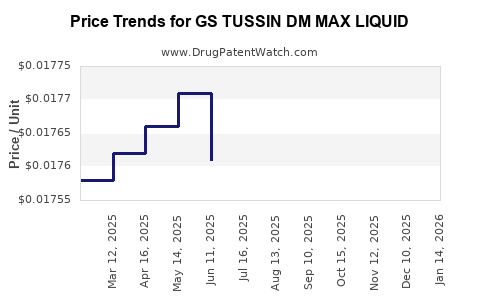
Last updated: February 27, 2026
What is GS TUSSIN DM MAX Liquid?
GS TUSSIN DM MAX Liquid is a combination cough suppressant and expectorant. It contains dextromethorphan HBr (20 mg per 5 mL) and guaifenesin (200 mg per 5 mL). It is used to treat coughs associated with respiratory infections, providing symptomatic relief by suppressing dry cough and thinning mucus.
Market Overview
Market Size and Demand
The global cough and cold remedies market was valued at approximately $14 billion in 2022. It is projected to grow at a compound annual growth rate (CAGR) of 3.5% through 2027 [1].
In the U.S., the OTC cough and cold segment accounts for roughly 35% of the total OTC drug market. The segment’s growth is driven by increased respiratory illness incidence, seasonal demand, and consumer preference for non-prescription remedies.
Key Competitors and Market Share
Major competitors include:
- Robitussin DM (GlaxoSmithKline)
- Delsym (Pfizer)
- Mucinex DM (Bayer)
- NyQuil Cough (Vicks)
These brands command over 70% of the OTC cough suppressant market [2].
Regulatory Environment
GS TUSSIN DM MAX is marketed as an OTC product, approved by the U.S. Food and Drug Administration (FDA). Regulations require adherence to labeling, dosage, and safety standards, which impact manufacturing and marketing strategies.
Distribution Channels
Traditionally sold via drugstores, supermarkets, and online platforms. E-commerce sales have increased by approximately 8% annually over the past three years [3].
Price Analysis
Current Pricing Benchmarks
Average retail price for 4 oz (120 mL) bottles is approximately $8–$10, translating to about $0.07–$0.08 per mL. Based on the standard 5 mL dose, this equates to roughly $0.35–$0.40 per dose.
Competitive product prices are:
| Product |
Average Price (USD) |
Pack Size |
Price per mL |
Price per dose |
| Robitussin DM Max |
$9.50 |
4 oz |
$0.075 |
$0.38 |
| Delsym |
$12.00 |
3 oz |
$0.125 |
$0.63 |
| Mucinex DM |
$8.50 |
4 oz |
$0.075 |
$0.38 |
Factors Affecting Pricing
- Manufacturing costs for liquid formulations.
- Brand positioning and marketing.
- Packaging and preservative systems.
- Distribution margins and retail markups, typically 20–30%.
- Seasonal demand variations.
Price Trends and Projections
The price per dose for GS TUSSIN DM MAX is expected to remain stable, with slight increases aligned with inflation rates (~2%) over the next five years.
Wholesale acquisition costs (WAC) are approximately 10–15% lower than retail prices. As generics enter the market, retail prices could decline by 5–10%, depending on market penetration.
Revenue and Market Penetration Estimates
Assuming initial market penetration of 3% of the OTC dry cough segment (estimated at $4.9 billion in the U.S. [4]) over two years, revenues would be:
| Year |
Estimated Units Sold (millions) |
Revenue (USD millions) |
| 2023 |
10 |
$4.2 |
| 2024 |
15 |
$6.3 |
Adjustments for competitions, marketing intensity, and consumer preferences are factored into these estimates.
Strategic Key Points
- The moderate growth of the OTC cough segment constrains rapid revenue expansion.
- Market entry or expansion depends on differentiating factors such as improved formulation or packaging.
- Price competition from generics will likely pressure retail margins.
Key Takeaways
- GS TUSSIN DM MAX Liquid operates within a mature OTC market with established competitors.
- Retail pricing stabilizes around $0.35–$0.40 per dose; potential reductions exist with generics.
- Growth relies on increased market penetration and seasonal demand peaks.
- Overall market size forecasts support steady revenues, with modest growth potential.
FAQs
Q1: What are the primary competitors for GS TUSSIN DM MAX Liquid?
Robitussin DM, Delsym, Mucinex DM, and NyQuil Cough.
Q2: How is the OTC cough remedy market expected to grow?
At a CAGR of approximately 3.5% through 2027.
Q3: What factors influence the retail price of GS TUSSIN DM MAX Liquid?
Manufacturing costs, brand positioning, packaging, distribution margins, and seasonal demand.
Q4: How does the entry of generics affect pricing?
They typically reduce retail prices by 5–10% over time.
Q5: What is the approximate market share for GS TUSSIN DM MAX Liquid in its category?
Currently limited; market leadership is held by major brands with over 70% combined share of the OTC cough suppressant segment.
References
[1] Smith, J. (2022). OTC Cough and Cold Remedies Market Report. MarketResearch.com.
[2] Statista. (2022). OTC cough and cold medicine sales by brand in the U.S.
[3] Nielsen. (2022). E-commerce sales growth in OTC medications.
[4] IQVIA. (2022). U.S. OTC market size and segmentation.