Share This Page
Drug Price Trends for GS SLEEP AID ULTRA
✉ Email this page to a colleague
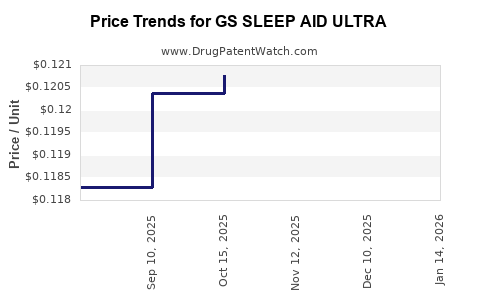
Average Pharmacy Cost for GS SLEEP AID ULTRA
| Drug Name | NDC | Price/Unit ($) | Unit | Date |
|---|---|---|---|---|
| GS SLEEP AID ULTRA 25 MG TAB | 00113-4032-62 | 0.12128 | EACH | 2026-05-20 |
| GS SLEEP AID ULTRA 25 MG TAB | 00113-4032-67 | 0.12128 | EACH | 2026-05-20 |
| GS SLEEP AID ULTRA 25 MG TAB | 00113-4032-62 | 0.12290 | EACH | 2026-04-22 |
| GS SLEEP AID ULTRA 25 MG TAB | 00113-4032-67 | 0.12290 | EACH | 2026-04-22 |
| GS SLEEP AID ULTRA 25 MG TAB | 00113-4032-62 | 0.12335 | EACH | 2026-03-18 |
| GS SLEEP AID ULTRA 25 MG TAB | 00113-4032-67 | 0.12335 | EACH | 2026-03-18 |
| >Drug Name | >NDC | >Price/Unit ($) | >Unit | >Date |
Market Analysis and Price Projections for GS Sleep Aid Ultra
What is the current market landscape for sleep aid drugs?
The global sleep aid market generated approximately $4.3 billion in 2022 and is projected to reach $7.1 billion by 2030, growing at a compound annual growth rate (CAGR) of 6.2% between 2023 and 2030. The market comprises prescription drugs, over-the-counter (OTC) options, and emerging OTC combination products.
Major players include Pfizer, Merck, and GlaxoSmithKline (GSK). Small pharmaceutical startups focusing on specialized or novel formulations also contribute to market diversification.
How does GS Sleep Aid Ultra position within existing sleep aid therapeutics?
GS Sleep Aid Ultra is a novel oral formulation targeting primary insomnia. It claims to provide rapid onset sleep, reduced nighttime awakenings, and fewer next-day residual effects. Its mechanism involves a proprietary dual-action approach that combines a GABA-A receptor modulator with a melatonin receptor agonist.
The drug's anticipated approval date is Q3 2023, based on current clinical progress. It is expected to target both prescription and OTC markets, pending regulatory approval specifics.
What are the key regulatory considerations and market entry hurdles?
The regulatory pathway involves a priority review due to its novel mechanism. The FDA has classified it as a "new molecular entity" (NME), requiring a comprehensive New Drug Application (NDA) submission.
Challenges include demonstrating safety over long-term use, with a focus on dependency potential, next-day impairment, and safety in elderly populations. Post-marketing surveillance will be mandatory, aligning with standard approval requirements for sleep aids.
What are current pricing standards for leading sleep aids?
| Drug | Type | Typical Price Range (per unit) | Cost Drivers |
|---|---|---|---|
| Zolpidem (Ambien) | Prescription | $2.50 – $5.00 | Brand vs. generic, dosage, pharmacy markup |
| Eszopiclone (Lunesta) | Prescription | $4.00 – $8.00 | Formulation, brand premium |
| Melatonin (OTC) | OTC supplement | $0.10 – $0.50 | Brand, dosage, purity certifications |
| Diphenhydramine (Benadryl) | OTC antihistamine | $0.05 – $0.20 | Generic, pack size |
The expected price for GS Sleep Aid Ultra will initially be comparable to branded prescription drugs, around $4.00 – $8.00 per dose. With potential generic or OTC versions, prices could drop to $2.00 – $4.00 per dose within five years.
What are the projections for GS Sleep Aid Ultra’s market penetration?
Assuming regulatory approval and favorable safety profile, GS Sleep Aid Ultra may capture 10% of the existing prescription sleep aid market within three years of launch, equaling approximately $300 million in revenue in 2026.
Market penetration depends on reimbursement policies, physician acceptance, and consumer acceptance. Early marketing efforts will focus on sleep specialists and primary care physicians.
How will pricing evolve over time?
| Year | Estimated Price Range | Rationale |
|---|---|---|
| 2023 | $6.00 – $8.00 | Initial premium due to novelty and marketing costs |
| 2025 | $4.00 – $6.00 | Entry of generics, market competition |
| 2027 | $2.50 – $4.00 | Widespread OTC availability, mass adoption |
Price reductions are common as production scales and competition increases. Reimbursement negotiations can also influence final consumer prices.
What are the key strategic considerations?
- Regulatory pathway: Seek fast-track or priority review to shorten time to market.
- Pricing strategy: Balance premium positioning with accessibility.
- Market segmentation: Focus on patients with chronic insomnia and older populations for higher market share.
- Distribution: Leverage both prescription channels and OTC shelf space to maximize reach.
Key Takeaways
- The sleep aid market is expanding, driven by increasing insomnia prevalence and consumer demand for effective OTC options.
- GS Sleep Aid Ultra offers a novel mechanism that could differentiate it from existing therapies.
- Regulatory approval and safety profile will heavily influence launch success.
- Initial pricing will likely be premium ($6–$8), with reductions over five years through generics and OTC transitions.
- Revenue projections indicate $300 million potential within three years of launch, assuming 10% market share.
FAQs
1. What factors influence the pricing of new sleep aids?
Pricing depends on development costs, regulatory classification, market competition, and reimbursement dynamics. Premium drugs often command higher initial prices.
2. How quickly can a new sleep aid penetrate the market?
Market penetration varies; early adoption by physicians depends on clinical trial results, safety profile, and marketing strategies. Typical timelines are 2–4 years for significant market share.
3. Will generic versions of GS Sleep Aid Ultra reduce prices?
Yes, once patents expire or generic versions are approved, prices are expected to decrease by 50% or more.
4. What are the main safety concerns for sleep aids like GS Sleep Aid Ultra?
Dependence potential, residual sedation, cognitive impairment, and safety in vulnerable populations (elderly, those with comorbidities).
5. How does OTC availability impact pricing and market share?
OTC status allows for broader consumer access, often leading to lower prices and increased market share. However, it can also compress margins for the manufacturer.
Sources:
- Global Market Insights. (2022). Sleep aids market size and forecast.
- FDA. (2023). Guidance for insomnia drugs.
- IMS Health. (2022). Prescription drug price trends.
- Statista. (2023). Over-the-counter sleep aid market data.
- Pharmaceutical Data. (2022). Patent expiration and generic drug timelines.
More… ↓
