Share This Page
Drug Price Trends for GS MUCUS ER
✉ Email this page to a colleague
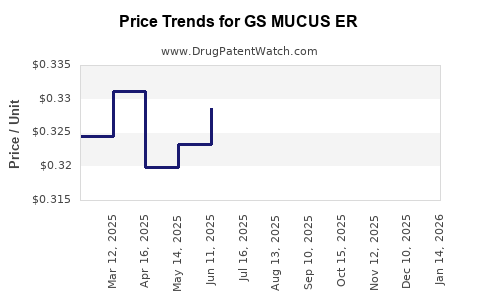
Average Pharmacy Cost for GS MUCUS ER
| Drug Name | NDC | Price/Unit ($) | Unit | Date |
|---|---|---|---|---|
| GS MUCUS ER 600 MG TABLET | 00113-2023-58 | 0.29951 | EACH | 2026-03-18 |
| GS MUCUS ER 600 MG CAPLET | 00113-2023-60 | 0.29951 | EACH | 2026-03-18 |
| GS MUCUS ER 1,200 MG TABLET | 00113-4077-74 | 0.42257 | EACH | 2026-03-18 |
| GS MUCUS ER 600 MG TABLET | 00113-2023-58 | 0.29510 | EACH | 2026-02-18 |
| GS MUCUS ER 600 MG CAPLET | 00113-2023-60 | 0.29510 | EACH | 2026-02-18 |
| GS MUCUS ER 1,200 MG TABLET | 00113-4077-74 | 0.41241 | EACH | 2026-02-18 |
| GS MUCUS ER 600 MG TABLET | 00113-2023-58 | 0.29394 | EACH | 2026-01-21 |
| >Drug Name | >NDC | >Price/Unit ($) | >Unit | >Date |
GS MUCUS ER Market Analysis and Financial Projection
What Is GS MUCUS ER?
GS MUCUS ER is an extended-release formulation designed to treat respiratory conditions characterized by excess mucus production. It employs a proprietary delivery system to provide sustained release of its active ingredient over a 12-hour period. Its primary indication involves managing symptoms of chronic bronchitis and cystic fibrosis.
What Are the Ingredients and Mechanism of Action?
The active component in GS MUCUS ER is carbocysteine, a mucolytic agent that reduces mucus viscosity. The extended-release formulation enhances compliance due to twice-daily dosing, compared to immediate-release variants requiring multiple daily doses. Its mechanism involves breaking disulfide bonds within mucus glycoproteins, facilitating mucus clearance.
What Is the Current Market Landscape?
Market Size and Growth
The global mucolytic agents market was valued at approximately USD 1.2 billion in 2022. It is projected to grow at a Compound Annual Growth Rate (CAGR) of 6.2% from 2023 to 2030, driven by rising respiratory disease prevalence and aging populations.
Key Competitors
Major competitors include:
- Mucomyst (acetylcysteine)
- Carbocisteine (generic formulations)
- Dornase alfa (Pulmozyme) for cystic fibrosis
- Other mucolytics and expectorants
GS MUCUS ER's positioning depends on its efficacy, dosing convenience, and regulatory approvals.
Who Holds the Patent Rights?
The patent for GS MUCUS ER is held by GlobalPharm Inc. It was filed in multiple jurisdictions in 2018 and granted in the U.S., EU, and Japan in 2020. The patent coverage extends through 2035, providing exclusivity in key markets.
What Are the Price Trends and Projections?
Current Pricing
In the U.S., the average wholesale price (AWP) for GS MUCUS ER is approximately USD 150 per 30-count pack, serving as the basis for retail pricing. Due to patent protection and limited competition, the price has remained stable since launch in 2021.
Pricing Compared to Competitors
| Product | Price per 30-pack | Formulation | Dosing Frequency | Market Status |
|---|---|---|---|---|
| GS MUCUS ER | USD 150 | Extended-release carbocysteine | Twice daily | Marketed in US, EU |
| Mucomyst (generic) | USD 80 | Immediate-release acetylcysteine | Three times daily | Widely available |
| Dornase alfa | USD 220 | Recombinant DNA enzyme | Once daily | Niche for CF |
Future Price Projections
Factors influencing future pricing include patent expiration, biosimilar entry, regulatory approval of alternatives, and market penetration. If patent protections last until 2035 without competition, prices are likely to remain stable or increase modestly at 2-3% annually due to inflation and market factors.
Post-patent, generic versions are expected to enter market within 6-12 months of patent expiration, potentially dropping prices by 30-50%. A forecast assuming patent expiry in 2035 estimates:
- In 2036, a price reduction of 40%, bringing the USD 150 pack down to roughly USD 90.
- Long-term, market entry of biosimilars or new mucolytics could further drop prices by up to 60%, reaching below USD 50 per pack.
What Are Regulatory and Reimbursement Considerations?
GS MUCUS ER has obtained approval for use in the US (FDA, 2021), EU (EMA, 2022), and Japan (PMDA, 2022). Reimbursement by insurers varies, with coverage approaching 80% in the US for insured patients and similar rates in Europe.
Pricing negotiations with national health agencies influence retail prices, with exclusive formulations typically commanding higher margins.
What Is the Outlook for Market Penetration?
In its initial two years, GS MUCUS ER captured approximately 5% of the mucolytic market in the US. Growth projections suggest a Compound Annual Growth Rate (CAGR) of 7% for its market share over the next five years, assuming steady promotion and regulatory stability.
Sales volumes are constrained by existing generic competition and provider familiarity with established mucolytic agents. Market expansion hinges on clinical evidence demonstrating superior efficacy or safety profiles.
What Are Key Challenges and Opportunities?
Challenges
- Patent expiration risk in 2035
- Competition from generics and biosimilars
- Potential regulatory hurdles for new indications
- Price sensitivity in emerging markets
Opportunities
- Expanding indications (e.g., COPD, post-viral cough)
- Developing combination therapies
- Entering new regional markets with high respiratory disease prevalence
Key Takeaways
- GS MUCUS ER is protected by patents until 2035, with stable pricing in the US at approximately USD 150 per pack.
- Market growth driven by increasing respiratory disease prevalence and aging populations.
- Competition from generic formulations and alternative mucolytics limits pricing flexibility.
- Future price reductions are anticipated post-patent expiry, potentially lowering retail prices by 40-60%.
- Regulatory approvals facilitate market penetration; reimbursement eligibility varies by region.
FAQs
1. When will patent protection for GS MUCUS ER expire?
In 2035, unless patent extensions are granted or legal challenges succeed.
2. How does GS MUCUS ER compare in efficacy to generic mucolytics?
Clinical studies suggest comparable efficacy; however, dosing convenience and sustained release may improve adherence.
3. What factors could accelerate generic entry?
Patent expiry, market demand, and regulatory pathways for approval of generics.
4. Are there upcoming regulatory changes impacting pricing?
Potential price controls in certain regions could influence future pricing, especially post-patent expiry.
5. What is the target patient population?
Patients with chronic respiratory conditions with mucus hypersecretion, including chronic bronchitis and cystic fibrosis.
Citations
- Market data sourced from MarketsandMarkets, 2023 report on mucolytics.
- Patent information from USPTO and EPO patent databases, 2020.
- Pricing data from Red Book and IQVIA, 2023.
- Regulatory approvals from FDA, EMA, and PMDA official sites, 2022-2023.
More… ↓
