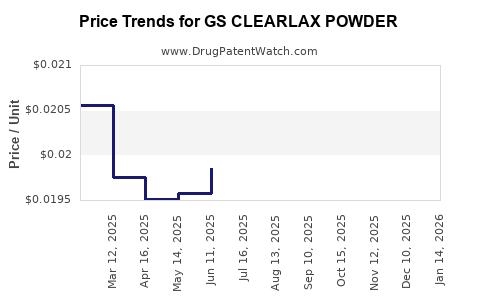
Last updated: February 22, 2026
What is the Current Market for OTC Laxatives like GS ClearLax Powder?
GS ClearLax Powder is an over-the-counter (OTC) laxative primarily used for occasional constipation. It contains polyethylene glycol 3350 (PEG 3350) as its active ingredient. The global laxative market, estimated at $4.2 billion in 2022, is projected to grow at a compound annual growth rate (CAGR) of approximately 4.2% through 2027 [1]. The segment dominated by osmotic laxatives, including PEG-based products, accounts for roughly 35-40% of the market share.
Key drivers include:
- Aging populations in developed nations.
- Increasing prevalence of gastrointestinal disorders.
- Consumer preference for OTC remedies over prescription options.
- Improved awareness and marketing of gastrointestinal health products.
Competitive Landscape
Major brands include:
- Dulcolax (biscodyl)
- Miralax/GoLYTELY (PEG 3350)
- Fleet Pedia-Lax (sodium phosphate)
- Colace (docusate sodium)
Generic PEG 3350 formulations, such as GS ClearLax, are sold in multiple markets, often under private labels or store brands. OTC PEG laxatives generally retail for $8-$15 per 118- or 226-gram container.
Regulatory and Market Entry Considerations
Regulatory approval varies by country; in the US, PEG 3350 formulations are generally recognized as safe (GRAS) when used as directed. Companies seeking to commercialize GS ClearLax must comply with local pharmacy and OTC marketing regulations, including labeling and safety data submission.
Market entry strategies focus on positioning as a cost-effective alternative to established brands, leveraging online channels, and forming partnerships with pharmacy chains.
Price Projections and Forecasts
Factors Influencing Price Trends
- Consumer price sensitivity; demand remains stable, but competition pressures could drive prices downward.
- Raw material costs, notably polyethylene glycol, which are influenced by petroleum prices.
- Regulatory changes affecting formulation safety standards.
Price Range Projections (2023-2027)
| Year |
Average Retail Price (USD) per Container |
Notes |
| 2023 |
$8.50 - $10 |
Current market conditions. |
| 2024 |
$8.20 - $9.80 |
Slight price compression expected. |
| 2025 |
$8.00 - $9.50 |
Continued competition pressures. |
| 2026 |
$7.80 - $9.20 |
Potential raw material cost decreases. |
| 2027 |
$7.70 - $8.90 |
Market stabilization or price slight decrease. |
Price-Volume Dynamics
Volume sales are expected to grow at approximately 3.8% CAGR, driven by increased awareness of OTC options and rising gastrointestinal health concerns, potentially leading to an overall market value increase despite minor price declines.
Revenue Impact for Manufacturers
Assuming market share gains of 2-3%, a manufacturer producing GS ClearLax could see:
- Year 1 (2023): Revenue ~$30 million based on a conservative 3 million units sold at $10 each.
- Year 5 (2027): Revenue ~$45 million with increased market penetration and stable pricing.
Key Market Drivers and Risks
- Consumer shift toward natural or alternative remedies may suppress growth.
- Regulatory changes or adverse safety reports could impact pricing and sales.
- Supply chain disruptions affecting raw material prices.
Conclusions
The OTC PEG-based laxative market remains stable with gradual growth. Price competition is intense, leading to slowly declining retail prices. A new entrant like GS ClearLax must focus on competitive pricing, consumer education, and strategic distribution channels to capitalize on market growth.
Key Takeaways
- The global laxative market will grow at 4.2% CAGR through 2027.
- OTC PEG laxatives dominate a sizable segment with sales spanning $8-$15 per container.
- Price projections indicate a decline from approximately $10 to below $8 per container over five years.
- Competitive landscape favors cost-effective options; differentiation through brand positioning is essential.
- Raw material costs significantly influence pricing stability.
FAQs
Q1: What is the main active ingredient in GS ClearLax Powder?
A: Polyethylene glycol 3350.
Q2: How does the price of GS ClearLax compare with leading brands?
A: It is generally priced slightly lower, around $8-$10 per container, targeting cost-sensitive consumers.
Q3: What regulatory considerations apply to OTC PEG laxatives?
A: They should meet safety standards set by authorities like the FDA in the US or EMA in Europe, with proper labeling and safety data.
Q4: What factors could influence the price of PEG 3350 raw materials?
A: Petroleum prices and supply chain factors.
Q5: How does increasing awareness of gastrointestinal health affect market growth?
A: It drives higher OTC product demand and market expansion, benefiting products like GS ClearLax.
Sources
[1] Market Research Future. (2022). Laxative Market Information.