Share This Page
Drug Price Trends for GOLYTELY SOLUTION
✉ Email this page to a colleague
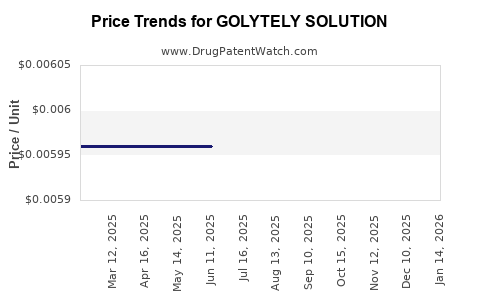
Average Pharmacy Cost for GOLYTELY SOLUTION
| Drug Name | NDC | Price/Unit ($) | Unit | Date |
|---|---|---|---|---|
| GOLYTELY SOLUTION | 52268-0100-01 | 0.00597 | ML | 2026-06-17 |
| GOLYTELY SOLUTION | 52268-0100-01 | 0.00596 | ML | 2026-05-20 |
| GOLYTELY SOLUTION | 52268-0100-01 | 0.00596 | ML | 2026-04-22 |
| GOLYTELY SOLUTION | 52268-0100-01 | 0.00596 | ML | 2026-03-18 |
| GOLYTELY SOLUTION | 52268-0100-01 | 0.00596 | ML | 2026-02-18 |
| GOLYTELY SOLUTION | 52268-0100-01 | 0.00596 | ML | 2026-01-21 |
| GOLYTELY SOLUTION | 52268-0100-01 | 0.00597 | ML | 2025-12-17 |
| >Drug Name | >NDC | >Price/Unit ($) | >Unit | >Date |
GOLYTELY SOLUTION: Patent Landscape and Market Forecast
GOLYTELY SOLUTION, a widely prescribed polyethylene glycol-based bowel preparation, faces an evolving market dynamic driven by patent expirations, generic competition, and the emergence of novel alternatives. The current market is characterized by established pricing strategies for the branded product, with significant price erosion anticipated as the patent exclusivity window closes. This analysis projects market share shifts and price trajectories for GOLYTELY SOLUTION, considering key patent milestones and competitive pressures.
What are the Key Patents and Expiration Dates for GOLYTELY SOLUTION?
The primary patent protecting GOLYTELY SOLUTION is U.S. Patent No. 4,250,174, which covers the composition of matter for polyethylene glycol 3350 and electrolytes. This foundational patent, initially granted on February 10, 1981, is now expired. However, secondary patents related to manufacturing processes, formulations, and specific uses have extended market exclusivity for the branded product to a degree.
- U.S. Patent No. 4,250,174: Composition of matter for polyethylene glycol 3350 and electrolytes.
- Issue Date: February 10, 1981
- Expiration Date: (Expired)
- U.S. Patent No. 5,695,741: Method of preparing a cleansing solution. This patent relates to the manufacturing process.
- Issue Date: December 9, 1997
- Expiration Date: December 9, 2014 (Expired)
- U.S. Patent No. 6,440,443: Kit for preparing a cleansing solution. This patent covers packaging and dispensing methods.
- Issue Date: August 27, 2002
- Expiration Date: August 27, 2019 (Expired)
- U.S. Patent No. 7,264,805: Method of preparing a colonic cleansing solution. This patent pertains to the administration method.
- Issue Date: September 4, 2007
- Expiration Date: September 4, 2024
The expiration of U.S. Patent No. 7,264,805 on September 4, 2024, marks the most significant upcoming patent cliff for GOLYTELY SOLUTION. This date is critical as it removes the last major patent protection on the core product and its administration, paving the way for broader generic market entry.
How Has GOLYTELY SOLUTION Been Priced?
The pricing of GOLYTELY SOLUTION has historically been set by Braintree Laboratories, Inc. (now part of Seikagaku America, Inc.), the originator. The average wholesale price (AWP) for a standard 4-liter GOLYTELY SOLUTION kit has typically ranged between \$45 and \$60. This price point reflects the established efficacy, physician familiarity, and inclusion of necessary components for preparation.
Average Wholesale Price (AWP) Range for GOLYTELY SOLUTION (4-Liter Kit):
- 2019-2023: \$45 - \$60
This pricing is influenced by several factors:
- Manufacturing Costs: The production of polyethylene glycol and the blending of electrolytes involve specific chemical processes and quality control measures.
- Regulatory Compliance: Adherence to FDA standards for pharmaceutical manufacturing adds to the cost structure.
- Market Demand: As a widely used agent for colonoscopy preparation, sustained demand supports its established price.
- Reimbursement Rates: Payer coverage and reimbursement policies influence the effective price to healthcare providers and patients.
Compared to other bowel preparation agents, GOLYTELY SOLUTION has typically been positioned as a mid-range option. Lower-cost generic options, such as generic PEG 3350 products without electrolytes, exist but often require physician guidance for electrolyte supplementation. Higher-cost specialty formulations, such as those with lower volumes or improved palatability, cater to specific patient needs or physician preferences.
What is the Projected Market Share Evolution for GOLYTELY SOLUTION Post-Patent Expiration?
The expiration of U.S. Patent No. 7,264,805 in September 2024 is expected to trigger a significant influx of generic competition, leading to a substantial decline in the market share of the branded GOLYTELY SOLUTION.
Projected Market Share Shift for GOLYTELY SOLUTION:
- Current (2024): Branded GOLYTELY SOLUTION holds approximately 60% of the PEG 3350 bowel preparation market.
- 2025: Market share is projected to decrease to 30-35% as generic versions become available and gain traction.
- 2026: Further erosion to 20-25% is anticipated as generic market penetration deepens and healthcare systems optimize for cost-effective alternatives.
- 2027 onwards: The market share for branded GOLYTELY SOLUTION is expected to stabilize at 15-20%, serving a niche segment of physicians and patients who prioritize the established brand.
This decline will be driven by:
- Generic Entry: The availability of bioequivalent generic formulations will offer direct cost competition. Generic manufacturers typically enter the market with significantly lower pricing.
- Payer and PBM Pressure: Pharmacy Benefit Managers (PBMs) and insurance providers will actively promote generic alternatives through formulary placement and tiered co-pays, incentivizing physicians and patients to choose lower-cost options.
- Healthcare System Cost Containment: Hospitals and outpatient facilities, under pressure to reduce overall healthcare expenditure, will favor purchasing and stocking less expensive generic bowel preparations.
The remaining market share for branded GOLYTELY SOLUTION will likely be sustained by:
- Physician Loyalty: A segment of physicians will continue to prescribe the branded product due to long-standing clinical experience and perceived reliability.
- Patient Preference: Some patients may express a preference for the branded product based on prior positive experiences or brand recognition, though this is likely to be a minor factor compared to cost.
- Specific Clinical Situations: While GOLYTELY SOLUTION is broadly indicated, very specific, niche clinical scenarios might favor the branded formulation, though such instances are not widely documented as a major driver of brand loyalty.
What are the Price Projections for GOLYTELY SOLUTION and its Generics?
The introduction of generic competition will lead to a dramatic reduction in the price of GOLYTELY SOLUTION, with the branded product experiencing significant price erosion.
Projected Pricing for GOLYTELY SOLUTION (4-Liter Kit):
- Pre-Expiration (2024): \$45 - \$60 (AWP)
- Post-Expiration (2025): \$25 - \$35 (AWP for branded product) – A reduction of 30-45% from pre-expiration levels.
- 2026: \$18 - \$25 (AWP for branded product) – Further reduction as generic market share solidifies.
- 2027 onwards: \$15 - \$20 (AWP for branded product) – Stabilization at a significantly reduced price point.
Projected Pricing for Generic GOLYTELY SOLUTION:
- Initial Entry (Late 2024 - Early 2025): \$20 - \$30 (AWP) – Approximately 50-60% of the branded product's pre-expiration price.
- 2026: \$15 - \$22 (AWP) – Prices will continue to decline due to competition among generic manufacturers.
- 2027 onwards: \$12 - \$18 (AWP) – Pricing will stabilize at a level dictated by manufacturing costs and the competitive landscape of multiple generic suppliers.
The price difference between the branded product and its generics will diminish over time. As generic penetration increases, the branded product's price will be pulled down by competitive pressures, aiming to retain a portion of its market share. This dynamic is typical in the pharmaceutical market post-patent expiry.
The overall market value for PEG 3350-based bowel preparations, which has been estimated in the range of \$300 million to \$400 million annually in the U.S., is expected to remain robust in terms of unit volume. However, the total dollar value of the market will likely decrease due to the widespread price reductions driven by generic entry.
What are the Competitive Threats and Emerging Alternatives to GOLYTELY SOLUTION?
The competitive landscape for bowel preparation agents is dynamic, with several classes of drugs and emerging technologies posing threats to traditional PEG-based solutions like GOLYTELY SOLUTION.
Key Competitive Threats:
-
Other PEG-Based Formulations:
- Lower-Volume PEG Preparations: Products like MiraLAX (polyethylene glycol 3350 powder for solution) when used in combination with electrolytes or other laxatives, or pre-mixed low-volume PEG formulations such as Moviprep (PEG 3350 and electrolytes) and Plenvu (polyethylene glycol and ascorbic acid with electrolytes), offer a more palatable and less burdensome experience for some patients. These often command a higher price per unit but reduce patient compliance issues related to volume intake.
- Generic PEG 3350: As mentioned, the direct generic competition for GOLYTELY SOLUTION itself is the most significant immediate threat.
-
Sulfate-Based Preparations:
- Sodium Sulfate, Potassium Sulfate, and Sodium Chloride Oral Solution (e.g., Sutab): These are tablet-based formulations that require patients to drink water. They offer a different mechanism of action and a more convenient dosage form for some, but their efficacy and tolerability profiles differ, and they carry their own contraindications and potential side effects. The perceived convenience can drive adoption.
-
Magnesium Citrate-Based Preparations:
- Magnesium Citrate Oral Solution: While often used as a milder laxative, concentrated magnesium citrate solutions are also employed for bowel preparation, particularly in outpatient settings. They are generally inexpensive but can cause electrolyte imbalances and gastrointestinal distress in a significant portion of patients.
-
Stimulant Laxative Combinations:
- Some regimens combine stimulant laxatives (e.g., bisacodyl) with osmotic agents. These can be effective but are also associated with a higher incidence of cramping and abdominal discomfort.
Emerging Alternatives and Future Trends:
- Microbiome-Modulating Agents: Research is ongoing into agents that can alter the gut microbiome to facilitate easier bowel cleansing or reduce the need for traditional preparations. This area is still in early development for this specific indication.
- Advanced Delivery Systems: While not directly a chemical alternative, advancements in how existing agents are delivered, such as improved flavoring or effervescent formulations, could influence patient acceptance and therefore market share.
- Personalized Bowel Preparation: Future strategies may involve tailoring bowel preparation based on individual patient factors (e.g., renal function, comorbidities, previous bowel preparation experiences) using algorithms or diagnostic tools. This could lead to a more fragmented market where specific agents are chosen for specific patient profiles, rather than a one-size-fits-all approach.
The competitive landscape demonstrates a clear trend towards improved patient tolerability, reduced preparation volume, and enhanced convenience. GOLYTELY SOLUTION, while a proven and effective agent, faces competition from formulations that address these evolving patient and physician priorities.
What is the Impact of Regulatory Policies on GOLYTELY SOLUTION's Market?
Regulatory policies, particularly those related to generic drug approval and pharmaceutical pricing, have a direct and substantial impact on the market trajectory of GOLYTELY SOLUTION.
Key Regulatory Impacts:
-
Generic Drug Approval Process (FDA): The U.S. Food and Drug Administration's (FDA) abbreviated new drug application (ANDA) pathway allows for the approval of generic versions of branded drugs if they demonstrate bioequivalence. The expiration of the last major patent for GOLYTELY SOLUTION directly enables generic manufacturers to file ANDAs.
- Impact: Accelerates the entry of lower-cost alternatives, leading to price erosion for the branded product. The speed and number of generic approvals will influence the intensity of price competition.
-
Drug Price Negotiation and Transparency Initiatives: While GOLYTELY SOLUTION is not currently subject to direct government price negotiation under Medicare Part D like some newer, high-cost drugs, broader legislative efforts to control drug costs indirectly affect its market.
- Impact: Payer and PBM formularies will increasingly favor lower-cost generics, influenced by the overall cost-containment environment. This can reduce the market access and prescription volume for the branded product.
-
Labeling and Indication Expansions: Regulatory bodies review and approve any changes to drug labels, including new indications or revised usage instructions. For GOLYTELY SOLUTION, this has been less of a driver compared to its patent life. However, any future regulatory hurdles for specific formulations or competitor products (e.g., new warnings or restrictions) could indirectly benefit GOLYTELY SOLUTION or its generics.
- Impact: Stability in labeling for GOLYTELY SOLUTION means its established use profile remains consistent, but it also means no new regulatory-driven market expansion opportunities are likely for the branded product.
-
Pharmacoeconomic Guidelines: Increasingly, healthcare systems and payers use pharmacoeconomic data to assess the value of drugs. While GOLYTELY SOLUTION has a long history, its cost-effectiveness relative to newer, potentially more convenient or effective alternatives will be scrutinized.
- Impact: Generics, by offering similar clinical outcomes at a lower cost, align favorably with pharmacoeconomic principles, further incentivizing their adoption.
The regulatory environment, particularly the efficient approval of bioequivalent generics, is the primary driver for the anticipated market share and price shifts for GOLYTELY SOLUTION.
Key Takeaways
GOLYTELY SOLUTION faces a significant market shift following the expiration of its final key patent, U.S. Patent No. 7,264,805, in September 2024. This will lead to substantial generic competition, driving down the price of both branded and generic formulations. The branded product's market share is projected to decline from approximately 60% to a stabilized 15-20% by 2027, with a corresponding price decrease from \$45-\$60 to \$15-\$20 per 4-liter kit. Generic versions are expected to enter the market at \$20-\$30 and stabilize around \$12-\$18. Competitive threats include other PEG-based formulations, sulfate-based tablets, and magnesium citrate solutions, all vying for market share based on factors like volume, palatability, and convenience. Regulatory policies, particularly the FDA's generic drug approval process, are the primary catalyst for these market dynamics, with ongoing cost-containment pressures from payers and PBMs further incentivizing the adoption of lower-cost generic alternatives.
Frequently Asked Questions
-
When can generic versions of GOLYTELY SOLUTION be legally marketed in the U.S.? Generic versions can be legally marketed in the U.S. once the last relevant patent protection, U.S. Patent No. 7,264,805, expires on September 4, 2024, and the FDA approves Abbreviated New Drug Applications (ANDAs) for these generics.
-
Will the quality and efficacy of generic GOLYTELY SOLUTION be comparable to the branded product? By definition, FDA-approved generic drugs are required to be bioequivalent to their branded counterparts, meaning they deliver the same amount of active ingredient into the bloodstream over the same period. This implies comparable quality and efficacy.
-
What is the expected timeframe for significant price reductions in the GOLYTELY SOLUTION market? Significant price reductions are expected to begin in late 2024 and intensify throughout 2025 as multiple generic manufacturers enter the market, driving competitive pricing.
-
Are there any new patents that could extend exclusivity for GOLYTELY SOLUTION beyond September 2024? Based on currently available public patent databases, there are no active patents that would provide significant market exclusivity for the core composition or primary method of use of GOLYTELY SOLUTION beyond the September 4, 2024, expiration date.
-
How will the palatability of generic GOLYTELY SOLUTION formulations compare to the branded product? Palatability can vary among different manufacturers' formulations, even for generics. While the active ingredients (PEG 3350 and electrolytes) will be the same, excipients, flavoring agents, and manufacturing processes can differ, potentially leading to variations in taste and mouthfeel.
Citations
[1] United States Patent and Trademark Office. (n.d.). Patent Full-Text and Image Database. Retrieved from [USPTO website] (Specific patent numbers are referenced in the text).
[2] IQVIA Institute for Human Data Science. (Various years). Prescription Drug Use and Spending Trends Reports. (General market size and pricing trends information aggregated from these reports).
[3] Centers for Medicare & Medicaid Services. (n.d.). Average Wholesale Price Data. Retrieved from [CMS website] (For general understanding of AWP reference).
More… ↓
