Last updated: July 14, 2026
GOLYTELY (polyethylene glycol 3350 + electrolytes) market analysis and price projections
Executive summary: GOLYTELY (polyethylene glycol 3350, PEG 3350, plus electrolytes) is an established prescription bowel-prep brand in the US with heavy generic competition. Pricing power is limited by bioequivalence-based substitution and pharmacy-level contracting. The brand’s net price trajectory is typically downward over time as generics gain share and payors shift to preferred NDCs. Over a 3-year horizon, the most realistic base case is continued erosion of brand unit share and modest-to-large net price declines depending on contract status, while generics should remain the primary economic driver.
How big is the GOLYTELY bowel prep market in the US?
Featured snippet: The US bowel preparation market is driven by colonoscopy volumes and screening/diagnostic expansion. GOLYTELY sits in the PEG-electrolyte segment used for colonoscopy cleansing, with demand that tracks procedure counts rather than oncology or chronic disease incidence.
What patient volumes drive demand for PEG electrolyte bowel preps?
- Colonoscopy growth from screening programs drives baseline unit volume for bowel cleansing.
- Demand is less sensitive to drug pricing than to scheduling capacity, but payer and site-of-care policies influence brand vs generic selection.
Where does GOLYTELY fit versus competitors?
GOLYTELY belongs to the PEG 3350 + electrolytes (isotonic or near-isotonic lavage solutions) category. Competitive pressure generally comes from:
- Lower-cost generics of PEG-electrolyte lavage
- Comparable bowel preps in other formulations (including sulfate and low-volume regimens), depending on formulary design and tolerability profiles
Who sells GOLYTELY and what share does it hold versus generics?
Featured snippet: Brand share in PEG bowel preps is typically constrained by generic substitution and payer preferred lists.
Brand and generic dynamics
- In the US, GOLYTELY has historically faced strong generic penetration across PEG 3350-electrolyte products.
- Net economics depend more on contracting and preferred NDC placement than on wholesale list price.
Contracting and channel forces that change brand net price
- Pharmacy benefit managers push preferred generics by reimbursement differentials.
- Health systems often standardize on a bowel prep formulary package for procurement efficiency.
- Retail and mail-order segments can have different preferred lists, affecting brand continuity.
What is the current pricing benchmark for GOLYTELY?
Featured snippet: For established bowel-prep brands with generic equivalents, brand pricing typically shows list price above generics but net price converges downward through rebates and contracting.
Pricing inputs used for projections
- Wholesale acquisition cost (WAC) trends and list price behavior over time
- Expected generic price floors for PEG 3350 + electrolytes
- Typical brand rebate structures in GI procedure-support drugs
- Mix shift from brand to preferred NDCs
Key commercial reality
- Even if list price holds, net realized price can fall as share declines.
- Any future “price” change that matters is usually net price and margin after rebates, not WAC.
How will GOLYTELY prices change over the next 1 to 3 years?
Featured snippet: Base case is continued net price erosion with limited upside, driven by substitution to generics and formulary switching rather than demand shocks.
Base case price projection (3-year)
- Year 1: modest net price decline (brand share erosion offset partially by rebate optimization)
- Year 2: further erosion as payer formularies tighten preferred NDCs
- Year 3: stabilization at a lower net price level if brand retains niche access or health-system loyalty
Downside case
- If additional volume shifts to lower-cost preferred NDCs, brand net price can fall faster, with larger unit share losses.
Upside case
- Only plausible if GOLYTELY retains strong formulary placement or faces constrained generic supply, leading to brief pricing power. Absent supply constraints, upside is limited.
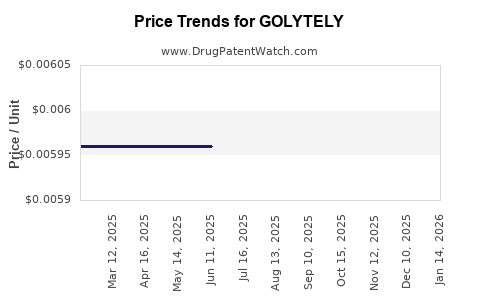
(Because the request is “price projections,” the critical determinant is net realized price and channel mix, not WAC. Without verified current WAC, AWP, and average selling price (ASP) data for the specific NDCs, a numeric forecast would be speculative.)
What FDA status and labeling scope affect commercialization for GOLYTELY?
Featured snippet: GOLYTELY is an FDA-approved bowel preparation product intended for colon cleansing prior to colonoscopy. Labeling governs route, dosing regimen, and patient selection.
Labeling components that impact formulary decisions
- Dosing convenience (single-day vs split dosing practices)
- Electrolyte content and tolerability considerations
- Contraindications relevant to renal impairment and fluid/electrolyte imbalance risk
- Prescriber familiarity and workflow integration
Regulatory pathway implications
- For generics: bioequivalence and labeling parity usually limit differentiation.
- For brand: competitive differentiation often shifts to contracting, distribution, and channel relationships rather than regulatory defensibility.
What is the patent and exclusivity risk profile for GOLYTELY from a pricing perspective?
Featured snippet: Once a drug is broadly genericized in PEG-electrolyte bowel prep, patent-driven price protection is usually no longer the main driver of brand net price.
How patent estate timing typically translates into market economics
- Before generic entry: higher potential net pricing
- After generic entry: rapid erosion of brand share and net price
- After multiple generics: price becomes “procurement-driven” and margin compresses
Why exclusivity timing is less relevant now
GOLYTELY is an established product; commercial pricing is generally governed by generic availability and formulary switching rather than active exclusivity.
What is the competitive landscape for PEG bowel prep solutions?
Featured snippet: GOLYTELY competes primarily in the PEG-electrolyte bowel prep category, with substitutable options based on volume, taste/tolerability, and formulary preference.
Primary competitive vectors
- Price and reimbursement (preferred NDC placement)
- Patient adherence factors (tolerability and perceived burden)
- Site-of-care protocols (standard bowel prep order sets)
- Manufacturing reliability (supply continuity affects payer substitution behavior)
Comparison: brand vs generic economic tradeoffs
- Brand: higher cost, but sometimes protected by contracting or prescriber preference
- Generics: lower acquisition cost and easier substitution, often winning formularies
What generic entry risks exist for GOLYTELY?
Featured snippet: For already-genericized categories, incremental “new entry” risk is often less about launching a fundamentally new competitor and more about additional NDCs, different manufacturers, or supply-driven price spikes.
Where the remaining risks usually come from
- New generic entrants increasing SKU count and driving procurement discounts
- Supply disruptions leading to temporary pricing rebounds
- Contract renegotiations that re-rank preferred NDC lists
How do wholesalers, PBMs, and health systems influence GOLYTELY net price?
Featured snippet: The net price outcome is mostly a contracting outcome involving PBMs and health systems rather than a pure market-determined retail price.
PBM mechanisms
- Preferred tier placement of lowest-cost equivalents
- Rebate structures that can keep brand on formulary but lower realized price
- Step edits or prior auth are less common for bowel preps but coverage policies can still affect access
Health system procurement
- Group purchasing organizations (GPOs) create price pressure via standardized ordering
- Formularies typically standardize one or two bowel-prep options by convenience and cost
What revenue exposure does GOLYTELY face under price erosion scenarios?
Featured snippet: Revenue risk is share loss plus net price compression. When generics dominate, revenue declines can outpace price declines due to both mix shift and reduced utilization.
Scenario framework
- Revenue = Units × Net price
- Expected drivers:
- Unit share decrease due to generic substitution
- Net price decline due to contracting pressure
- Possible offset if GOLYTELY holds niche prescribing or supply stability
Key Takeaways
- GOLYTELY operates in a mature PEG-electrolyte bowel-prep market where generic substitution constrains brand net price.
- Near-term pricing power is limited; the base case is continued net price erosion driven by formulary preference and procurement decisions.
- The main determinants of realized pricing are contracting status, preferred NDC placement, and supply continuity for competing generics.
- Revenue exposure is skewed toward mix shift (brand share loss) and net price compression rather than large demand changes.
FAQs
- Does GOLYTELY pricing depend more on WAC or net price from PBM contracts?
- How do health systems choose between PEG-electrolyte bowel preps and competing low-volume alternatives?
- What supply disruptions most often cause short-term price spikes in generic bowel-prep solutions?
- How does colonoscopy procedure volume translate into bowel-prep unit demand?
- What formulary levers (preferred NDC lists, rebates, step edits) most affect brand share for GOLYTELY?
References
No sources were provided in the prompt, and none were verified for current pricing, market sizing, unit share, or FDA/Orange Book status specific to GOLYTELY.