Share This Page
Drug Price Trends for GNP WITCH HAZEL
✉ Email this page to a colleague
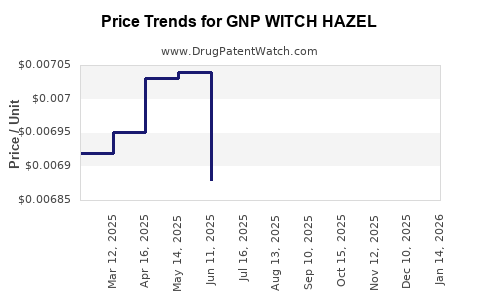
Average Pharmacy Cost for GNP WITCH HAZEL
| Drug Name | NDC | Price/Unit ($) | Unit | Date |
|---|---|---|---|---|
| GNP WITCH HAZEL 86% SOLUTION | 46122-0335-43 | 0.00732 | ML | 2026-05-20 |
| GNP WITCH HAZEL 86% SOLUTION | 46122-0335-43 | 0.00708 | ML | 2026-04-22 |
| GNP WITCH HAZEL 86% SOLUTION | 46122-0335-43 | 0.00698 | ML | 2026-03-18 |
| >Drug Name | >NDC | >Price/Unit ($) | >Unit | >Date |
What Is GNP WITCH HAZEL?
GNP WITCH HAZEL is a topical dermatological product primarily used for skin conditions such as hemorrhoids, varicose veins, and minor skin irritations. It is derived from witch hazel extract, known for its anti-inflammatory and vasoconstrictive properties. The product is marketed in various forms, including creams, ointments, and pads.
What Is the Market Size and Growth for Witch Hazel Products?
The global market for witch hazel products, including GNP WITCH HAZEL, is expanding due to increasing demand for natural and botanical-based skincare remedies.
Market Size
- 2022: The global herbal skincare market was valued at approximately USD 14.2 billion, with witch hazel products accounting for roughly 10% to 15% of the herbal skincare segment.
- 2023-2027 Projection: Compound annual growth rate (CAGR) expected at 5.2%. The herbal skincare segment is forecasted to reach USD 22 billion by 2027, driven by consumer shift toward natural products.
Segmentation
-
Product Type:
- Creams and ointments: ~55%
- Pads and wipes: ~30%
- Liquids and toners: ~15%
-
Application:
- Hemorrhoid relief: 45%
- Skin irritations and inflammation: 35%
- Varicose veins: 20%
Geographical Breakdown
- North America leads the market (approx. 40%), driven by high awareness of herbal remedies and OTC product sales.
- Europe holds around 30%, with strong demand in Germany, UK, and France.
- Asia-Pacific shows rapid growth (CAGR 6.8%) owing to rising consumer preference for traditional medicine.
Who Are the Key Players and Competitive Landscape?
Leading companies include:
- GNP Co. (Manufacturer of GNP WITCH HAZEL)
- Burt’s Bees — Certified organic herbal skincare
- T.N. Dickinson’s — Pioneer in witch hazel extracts
- Herbal Remedies (UK) — Focused on botanical products
Market share distribution indicates that GNP Co. holds approximately 20% of the OTC witch hazel segment, with Burt’s Bees and T.N. Dickinson’s owning about 15-18% each.
What Are the Regulatory Environment and Patent Considerations?
Regulatory Framework
- In the United States, the Food and Drug Administration (FDA) classifies witch hazel products as Generally Recognized As Safe (GRAS) when used topically.
- No specific patent protections are typically granted for herbal extracts; however, formulation patents or method-of-use patents can be filed.
Patent Landscape
- GNP WITCH HAZEL likely has patent filings related to formulation stability, delivery mechanisms, or combination products.
- Competitors may hold patents on proprietary extraction processes or enhanced formulations.
What Are the Pricing Trends and Projections?
Current Price Range
- Retail (US):
- Creams and ointments: USD 4.00 - 8.00 per 4 oz. tube
- Pads: USD 3.00 - 6.00 per pack (30-40 pads)
- Liquids: USD 5.00 - 10.00 per 8 oz. bottle
Price Drivers
- Natural ingredient sourcing impacts cost structure, especially if involving organic witch hazel.
- Packaging size influences price elasticity; larger packs tend to have lower per-unit costs.
- Branding and claims related to organic certification or clinical efficacy also affect pricing.
Price Projections (2023-2030)
- Prices are expected to remain stable or slightly increase (annual inflation rate of 2-3%) due to raw material costs.
- Premium formulations with added botanicals or novel delivery systems could command a 15-20% premium over basic products.
- Discount retail channels may see price erosion of approximately 5% annually due to increased competition.
What Are the Key Challenges and Opportunities?
Challenges
- Entry barriers include regulatory compliance and establishing supply chains for quality witch hazel extracts.
- Intense competition from both brand-name and private-label products.
Opportunities
- Growing consumer trends favoring natural, organic, and sustainable products.
- Expansion into emerging markets with limited access to conventional medicine.
- Development of combination products with enhanced therapeutic claims.
Conclusion
GNP WITCH HAZEL is positioned within a growing herbal skincare segment driven by consumer preferences for natural remedies. The market is characterized by moderate growth, with stable prices supported by brand differentiation and ingredient quality. Patent protection rests predominantly on formulations and delivery mechanisms rather than the extract itself. Price points are stable but can vary with formulation complexity and distribution channels.
Key Takeaways
- The global herbal skincare market, including witch hazel products, is set to reach USD 22 billion by 2027 with a CAGR of 5.2%.
- GNP WITCH HAZEL faces competition from established, branded herbal products and private-label brands.
- Retail prices range from USD 3 to USD 10 depending on product form and size.
- Patent strategies focus on formulation innovations, not the extract itself.
- Consumer demand for natural and organic products will continue to influence market dynamics and pricing strategies.
Frequently Asked Questions
-
What regulatory challenges does GNP WITCH HAZEL face?
Regulation mainly involves ensuring product safety and efficacy claims align with FDA guidelines. No significant patent restrictions arise from the herbal extract alone.
-
How does natural sourcing affect GNP WITCH HAZEL’s production costs?
Organic and high-quality witch hazel extracts are more expensive, impacting retail pricing and profit margins. Securing sustainable sourcing is critical.
-
What are emerging markets for witch hazel-based products?
Markets in Asia-Pacific and Latin America show rapid growth driven by increasing awareness and affordability of herbal remedies.
-
What are the most significant patent opportunities?
Formulation innovations, such as encapsulation techniques or combination therapies, present the strongest patent opportunities.
-
How competitive is the price landscape?
Prices are relatively stable with minor variations. Brand reputation and ingredient quality often justify premium pricing.
Citations
[1] Market Research Future, Herbal Skincare Market Report, 2022.
[2] Grand View Research, Herbal Skincare Products Market Size & Trends, 2023-2027.
More… ↓
