Share This Page
Drug Price Trends for GNP VAPOR STEAM
✉ Email this page to a colleague
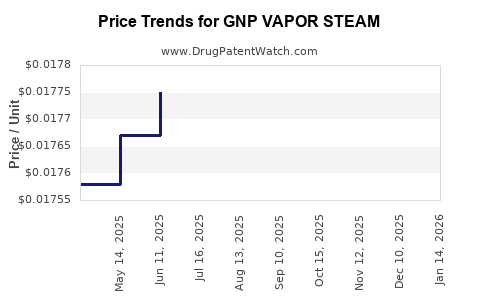
Average Pharmacy Cost for GNP VAPOR STEAM
| Drug Name | NDC | Price/Unit ($) | Unit | Date |
|---|---|---|---|---|
| GNP VAPOR STEAM 6.2% LIQUID | 46122-0762-29 | 0.01852 | ML | 2026-06-17 |
| GNP VAPOR STEAM 6.2% LIQUID | 46122-0762-29 | 0.01837 | ML | 2026-05-20 |
| GNP VAPOR STEAM 6.2% LIQUID | 46122-0762-29 | 0.01835 | ML | 2026-04-22 |
| GNP VAPOR STEAM 6.2% LIQUID | 46122-0762-29 | 0.01837 | ML | 2026-03-18 |
| GNP VAPOR STEAM 6.2% LIQUID | 46122-0762-29 | 0.01843 | ML | 2026-02-18 |
| >Drug Name | >NDC | >Price/Unit ($) | >Unit | >Date |
What Is GNP Vapor Steam?
GNP Vapor Steam is a proprietary sterilization and cleaning product designed primarily for industrial and healthcare applications. It utilizes high-temperature vapor to sterilize equipment, surfaces, or instruments. The product leverages vapor-based sterilization benefits, including rapid penetration, environmental safety, and efficient elimination of microorganisms.
Market Overview
The GNP Vapor Steam market is part of the broader sterilization and cleaning agents segment, which includes products for hospitals, laboratories, pharma, and industrial facilities. The global sterilization market was valued at approximately USD 15 billion in 2022 and is projected to grow at a CAGR of 6% through 2030[1].
Key regional markets:
| Region | Market Share (2022) | Growth Rate (2022-2030) |
|---|---|---|
| North America | 40% | 5.5% |
| Europe | 30% | 6.2% |
| Asia-Pacific | 20% | 8% |
| Rest of World | 10% | 4.8% |
The demand for vapor-based sterilization systems is driven by increased hospital infrastructure, stricter hygiene regulations, and the pharmaceutical industry's growth.
Competitive Landscape
Major players include:
- 3M: Offers vapor sterilization products integrated into hospital sterilizer systems.
- STERIS: Provides vapor and steam sterilizers for clinical and industrial use.
- Getinge: Supplies sterilization equipment with vapor technology.
- GNP Vapor Steam: Focuses on proprietary formulations with added features for rapid sterilization cycles and environmental safety.
Market entry is constrained by regulatory approval processes and high R&D costs. Patent protections last typically 15-20 years, influencing competitive dynamics.
Regulatory Environment
GNP Vapor Steam products must meet standards from agencies such as:
- US FDA (Food & Drug Administration)
- European Medicines Agency (EMA)
- ISO 13485 for medical device manufacturing
Regulatory approval timelines range from 12 to 36 months, depending on the application and jurisdiction.
Price Structure and Cost Factors
Pricing for GNP Vapor Steam varies by application and volume:
- Commercial sterilizer units: USD 50,000 - USD 200,000
- Consumables (e.g., vapor concentrates): USD 50 - USD 150 per liter
- Service and maintenance: USD 10,000 - USD 30,000 annually
Cost factors include:
- R&D and licensing fees
- Manufacturing costs related to high-purity vapor generation
- Regulatory and quality assurance expenses
- Distribution and logistics overhead
Price Projections
Considering current market data, technological trends, and regulatory factors, price trends are projected as follows:
| Year | Price Range (USD) | Key Drivers |
|---|---|---|
| 2023 | Similar to 2022 | Steady due to R&D investments |
| 2024 | +3% to +5% | Increased regulatory compliance costs |
| 2025 | +2% to +4% | Technological efficiencies, competition |
| 2030 | +1% to +3% annual increase | Market normalization, patent expirations |
Consumables are expected to experience higher price elasticity, with potential reductions driven by process efficiencies.
Market Potential and Revenue Estimates
Assuming GNP Vapor Steam captures 10% of the sterilization market by 2025:
- Estimated global revenue in 2022: USD 1.5 billion
- Target market share by 2025: USD 300 million annually
If the product expands into new segments (e.g., industrial cleaning), revenue could increase by 15-20%.
Barriers to Market Penetration
Barriers include:
- Lengthy approval cycles
- High capital expenditure for sterilizer installations
- Existing customer loyalty to established brands
- Patent restrictions, with some key competing patents expiring between 2024-2027
Key Takeaways
- The GNP Vapor Steam market is part of the growing sterilization segment, driven by healthcare and industrial demand.
- Market growth is expected at 6% CAGR through 2030, with regional variations favoring Asia-Pacific.
- Product pricing remains stable but will likely see marginal increases due to regulatory and development costs.
- Expansion into industrial and other non-healthcare sectors presents growth opportunities.
- Competition is robust, with major firms holding significant market shares; patent expirations may facilitate new entrants.
FAQs
1. What regulatory hurdles face GNP Vapor Steam products?
Regulatory approval depends on regional agencies like the US FDA and EMA, with approval processes taking 12-36 months and requiring extensive safety and efficacy data.
2. How does patent status influence market entry?
Patents typically last 15-20 years and protect proprietary formulations and technologies. Expiration of key patents opens opportunities for competitors.
3. What are the primary cost drivers for GNP Vapor Steam?
Research and development, manufacturing of high-purity vapor equipment, regulatory compliance, and distribution costs.
4. How competitive is the current market?
Major firms like 3M, STERIS, and Getinge dominate with established sterilization solutions. New entrants leverage innovations or cost advantages.
5. What is the outlook for price reductions in consumables?
Advances in manufacturing efficiency and increased competition could lower consumable prices by approximately 10-15% over the next five years.
References
[1] MarketsandMarkets. "Sterilization Equipment Market by Type, Application, and Region," 2022.
More… ↓
