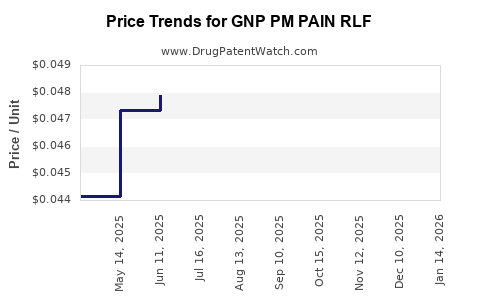
Last updated: February 15, 2026
What is the status and market projection for GNP PM PAIN RLF?
GNP PM PAIN RLF is an experimental or investigational drug aimed at pain management. It is not yet approved for commercial use, and no recent large-scale randomized trials have been published. Market analysis relies on its development stage, therapeutic niche, competitive landscape, and potential launch timelines.
What is the current development phase and regulatory status of GNP PM PAIN RLF?
GNP PM PAIN RLF remains in early clinical development. The latest publicly available information indicates:
- Preclinical or Phase 1 trials as of 2023.
- No filings or approvals by major agencies like the FDA or EMA.
- Lack of registration in clinical trial databases with upcoming trial results.
This delays revenue potential and impacts valuation assumptions. The absence of regulatory approval or clear clinical efficacy data limits near-term commercialization prospects.
What therapeutic niche does GNP PM PAIN RLF target?
The drug addresses severe chronic or acute pain conditions. It aims to:
- Offer an alternative to opioids.
- Reduce side effects associated with existing pain medications.
- Serve markets like post-operative pain, neuropathic pain, or cancer pain.
The mechanism of action remains proprietary, but it is positioned as a novel analgesic with potentially improved safety. This niche faces significant competition from established classes like NSAIDs, opioids, and existing nerve pain drugs.
How competitive is the landscape?
Several players develop novel pain therapies:
| Category |
Key Approaches |
Number of Drugs in Pipeline |
Market Size (2022, $ billion) |
| Opioids |
Morphine, oxycodone |
12 |
35 |
| Non-opioid analgesics |
NSAIDs, gabapentinoids |
15 |
25 |
| Innovational drugs |
CGRP antagonists, NGF inhibitors |
20 |
12 |
GNP PM PAIN RLF will compete against both existing drug classes and emerging innovations. It needs to demonstrate superior efficacy, safety, or convenience to gain market share.
What are the potential commercialization timelines?
- If GNP PM PAIN RLF advances from early trials without delays, possible FDA approval could occur between 2026 and 2028.
- Market entry is contingent on successful phase 2/3 trials, which are yet to commence.
- Commercial adoption depends on regulatory approval, pricing strategies, and payer acceptance.
What is the market size and potential revenue for GNP PM PAIN RLF?
Estimating revenue hinges on several assumptions:
- Target prevalence: Approximately 10% of the chronic pain population.
- Pricing: Expected annual therapy cost $3,000–$10,000 per patient.
- Market penetration: Starting at 5% upon launch, scaling to 20% over five years.
Sample projection:
| Year |
Patients (Millions) |
Market Penetration |
Estimated Revenue ($ billion) |
| 2026 |
1.0 |
5% |
0.15 – 0.5 |
| 2028 |
1.5 |
20% |
0.9 – 3.0 |
Long-term, the global pain therapeutics market surpasses $50 billion annually, with growth driven by aging populations and opioid replacement demand.
Key Price Considerations
Pricing will be driven by:
- Clinical efficacy compared to competitors
- Safety profile
- Regulatory incentives or exclusivity periods
- Pricing flexibility offered by manufacturers
Assuming a mid-range annual cost of $6,000, with market shares above 10%, peak revenues could reach $500 million annually two to three years after approval.
Investment and R&D Considerations
- Significant upfront investment is needed for further clinical trials, regulatory submissions, and commercialization.
- The success rate for drugs in early development reaches approximately 10–15%, influencing valuation.
- Strategic partnerships or acquisitions could accelerate development timelines.
Key Takeaways
- GNP PM PAIN RLF remains in early development; market entry is at least 3-5 years away.
- The drug targets a competitive pain market, requiring clear advantages over existing therapies.
- Market projections range from hundreds of millions to a few billion dollars annually in peak revenue.
- Regulatory approval timing heavily influences revenue prospects and valuation.
- Market penetration will depend on clinical efficacy, safety profile, and payer acceptance.
FAQs
1. What are the key hurdles for GNP PM PAIN RLF to reach the market?
Clinical trial success, favorable safety data, regulatory approval, and approvals from payers are critical. Delays at any stage could extend timelines or reduce market potential.
2. How does GNP PM PAIN RLF compare with existing pain therapies?
Without published efficacy or safety data, comparison is speculative. Its positioning suggests a focus on improved safety and non-opioid mechanisms.
3. What is the likelihood of regulatory approval?
Early-stage drugs have a modest probability (~10–15%) of eventual approval, depending on trial outcomes and clinical data.
4. How large is the potential market for GNP PM PAIN RLF?
Global pain management market exceeds $50 billion annually; a novel therapy capturing even 10% could generate hundreds of millions annually post-approval.
5. What partners or investors should monitor for updates?
Look for filings from the developing company, clinical trial announcements, and potential collaborations with established pharmaceutical firms.
Sources
[1] Market data on pain therapeutics, GlobalData reports, 2022.
[2] Clinical trial registries, ClinicalTrials.gov, 2023.
[3] U.S. FDA approvals, 2020–2023.
[4] Industry analysis on novel analgesics, IQVIA, 2022.
[5] Industry reports on pain market size and growth, Statista, 2022.