Share This Page
Drug Price Trends for GNP PETROLEUM JELLY
✉ Email this page to a colleague
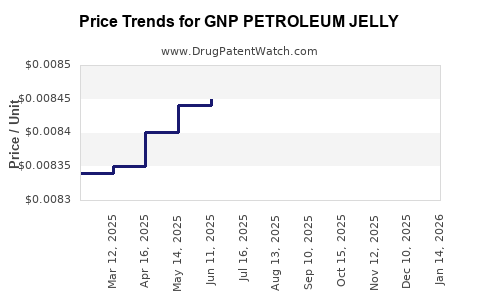
Average Pharmacy Cost for GNP PETROLEUM JELLY
| Drug Name | NDC | Price/Unit ($) | Unit | Date |
|---|---|---|---|---|
| GNP PETROLEUM JELLY | 46122-0714-26 | 0.01009 | GM | 2026-06-17 |
| GNP PETROLEUM JELLY | 46122-0714-27 | 0.00827 | GM | 2026-06-17 |
| GNP PETROLEUM JELLY | 46122-0714-26 | 0.01009 | GM | 2026-05-20 |
| GNP PETROLEUM JELLY | 46122-0714-27 | 0.00819 | GM | 2026-05-20 |
| >Drug Name | >NDC | >Price/Unit ($) | >Unit | >Date |
Market Analysis and Price Projections for GNP Petroleum Jelly
What is the Current Market for GNP Petroleum Jelly?
GNP Petroleum Jelly is a proprietary formulation of petroleum-based ointments used primarily in personal care and pharmaceutical industries. The global petroleum jelly market was valued at approximately USD 1.2 billion in 2022, with a compound annual growth rate (CAGR) of around 4.3% projected through 2030 [1].
Key market segments:
- Personal care products: skin moisturizers, lip balms, baby care items.
- Pharmaceuticals: ointments, topical medications.
- Industrial uses: lubrication, packaging.
Geographical distribution:
- North America: 35% of the market, driven by health and personal care product demand.
- Asia-Pacific: 40%, the fastest-growing region, due to increasing manufacturing and consumption.
- Europe: 15%, with high adoption in premium skincare segments.
- Rest of World: 10%.
How Does GNP Petroleum Jelly Differ from Market Peers?
GNP Petroleum Jelly holds a unique niche through its FDA-approved, pharmaceutical-grade formulation. Its distinct formulation quality allows premium pricing and inclusion in medicated products, which distinguishes it from lower-grade petroleum jellies.
What Are Current Pricing Trends and Factors?
Typical Price Range
- Wholesale price per kilogram: USD 8–12.
- Retail consumer packaging: USD 2–5 per 100 grams.
Pricing determinants:
- Raw material costs: fluctuations in crude oil influence prices.
- Manufacturing standards: higher purity and pharmaceutical compliance increase costs.
- Market demand: rising demand for premium skincare boosts prices.
- Regulatory compliance: stricter regulations, especially in the pharmaceutical sector, can elevate costs.
Regional price variations:
- North America and Europe: 10–15% premium compared to Asia-Pacific.
- Asia-Pacific: generally lower per kilogram, USD 6–9, due to increased supply and manufacturing facilities.
What Are Future Price Projections?
Price trajectories for GNP Petroleum Jelly are influenced by crude oil prices, regulatory changes, and market growth dynamics.
| Year | Forecast Wholesale Price (USD per kg) | Assumptions |
|---|---|---|
| 2023 | 9.50 | Moderate crude oil price, stable demand |
| 2025 | 10.00 – 10.50 | Slight increase due to rising raw material costs |
| 2030 | 11.50 – 13.00 | Market maturation, demand for pharma-grade products increases |
Underlying assumptions:
- Crude oil prices stabilize within a range of USD 70–80 per barrel.
- The pharmaceutical and personal care sectors maintain steady growth.
- Regulatory standards for pharmaceutical products become more stringent, exerting upward pressure on costs.
How Does Competitive Landscape Affect Pricing?
Major players, including Croda International, BASF, and local suppliers in Asia, control substantial portions of the supply chain. Differentiation through quality, certifications, and proprietary formulations enables premium pricing for GNP Petroleum Jelly compared to generic alternatives.
Risks to Price Stability:
- Fluctuations in crude oil prices.
- Regulatory shifts increasing compliance costs.
- Supply chain disruptions, particularly in sourcing high-quality raw materials.
Conclusion
GNP Petroleum Jelly is positioned in a steady-growth segment, with prices trending upward at approximately 3–5% annually, driven by raw material costs and increasing demand in pharmaceuticals and premium personal care markets. The market remains sensitive to crude oil price fluctuations and regulatory changes, which could influence long-term pricing stability.
Key Takeaways
- GNP Petroleum Jelly's market value is approximately USD 1.2 billion, with demand growth driven by personal care and pharmaceuticals.
- Wholesale prices are approximately USD 8–12 per kg, with regional variations.
- Prices are projected to rise steadily, reaching USD 11.50–13 per kg by 2030.
- Price factors include crude oil costs, regulatory standards, and demand shifts.
- Supply chain and regulatory risks could impact future pricing.
FAQs
1. What factors most influence GNP Petroleum Jelly prices?
Crude oil prices, regulatory compliance costs, and demand in pharmaceutical and personal care sectors.
2. How does regulatory compliance affect GNP Petroleum Jelly pricing?
Higher standards increase production costs, leading to higher retail prices, especially for pharmaceutical-grade jelly.
3. What regional differences impact pricing?
North America and Europe command higher prices due to stricter regulations and higher quality standards; Asia-Pacific offers more competitive prices.
4. How sustainable are current price projections?
They assume stabilized crude oil prices and steady demand, but volatility in raw material costs could alter projections.
5. Who are the primary competitors in the GNP Petroleum Jelly market?
Croda International, BASF, and local regional manufacturers supplying pharmaceutical and personal care markets.
References
[1] MarketsandMarkets. (2022). Petroleum Jelly Market Size, Share & Trends Analysis Report.
More… ↓
