Share This Page
Drug Price Trends for GNP MUCUS-ER MAX
✉ Email this page to a colleague
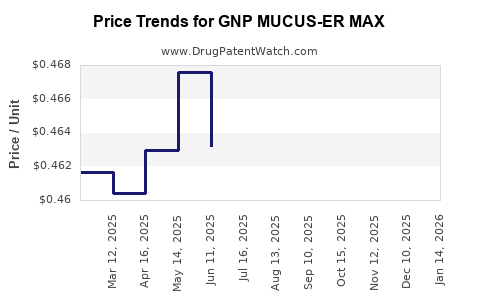
Average Pharmacy Cost for GNP MUCUS-ER MAX
| Drug Name | NDC | Price/Unit ($) | Unit | Date |
|---|---|---|---|---|
| GNP MUCUS-ER MAX 1,200 MG TAB | 46122-0683-74 | 0.44313 | EACH | 2026-07-22 |
| GNP MUCUS-ER MAX 1,200 MG TAB | 46122-0683-74 | 0.44913 | EACH | 2026-06-17 |
| GNP MUCUS-ER MAX 1,200 MG TAB | 46122-0683-74 | 0.44813 | EACH | 2026-05-20 |
| GNP MUCUS-ER MAX 1,200 MG TAB | 46122-0683-74 | 0.44933 | EACH | 2026-04-22 |
| GNP MUCUS-ER MAX 1,200 MG TAB | 46122-0683-74 | 0.42257 | EACH | 2026-03-18 |
| >Drug Name | >NDC | >Price/Unit ($) | >Unit | >Date |
What is GNP MUCUS-ER MAX?
GNP MUCUS-ER MAX is a combination medication used primarily for managing expectoration associated with respiratory conditions such as chronic bronchitis, COPD, and other mucus-related disorders. Its formulations typically include active ingredients like guaifenesin and other expectorants or decongestants. Available in extended-release (ER) forms, GNP MUCUS-ER MAX targets mucus mobilization over prolonged periods, enhancing patient compliance.
What is the current market landscape for expectorants and mucus therapy drugs?
The global expectorants and mucolytic agents market was valued at approximately USD 2.4 billion in 2022. The market is projected to grow at a compound annual growth rate (CAGR) of around 4.5% through 2028. Leading regions include North America, Europe, and Asia-Pacific, with North America holding roughly 40% of the market share in 2022. Demand driven by respiratory disease prevalence, aging populations, and increased awareness of respiratory health contribute to steady growth.
How does GNP MUCUS-ER MAX fit into this market?
GNP MUCUS-ER MAX targets the segment of extended-release expectorant formulations, which are increasingly preferred for their convenience and sustained efficacy. Compared to immediate-release formulations, ER drugs like GNP MUCUS-ER MAX typically command premium pricing due to advanced delivery technology and convenience for patients.
What are the key factors influencing pricing?
patent status
If GNP MUCUS-ER MAX holds a patent issued in key markets such as the US (filed date, granting date, expiration date), it influences pricing power. A patent expiration generally leads to generic competition, reducing prices by 50% or more within one year.
manufacturing costs
High-quality production, especially for ER formulations, involves sophisticated technology, increasing manufacturing costs. These costs maintain higher retail prices until generic versions emerge.
regulatory environment
Approval by authorities like the FDA (US), EMA (Europe), or PMDA (Japan) impacts market access and pricing. Drugs with orphan status or expedited pathways may command higher prices.
competition
Existing products, like Mucinex (guaifenesin ER), Theraflu, and home remedies, influence the pricing of GNP MUCUS-ER MAX. Standard prices for similar ER expectorants range from USD 15–30 per bottle (30–60 tablets), depending on concentration and packaging.
reimbursement policies
Insurance coverage and formulary positioning affect retail prices and patient costs. Drugs favorably listed in major insurance plans can command higher prices.
What are the current and projected prices?
Current retail prices (USD)
| Product | Price Range (USD) | Packaging | Notes |
|---|---|---|---|
| GNP MUCUS-ER MAX | 20–28 | 30 or 60 tablets (ER) | Assuming branded version |
| Mucinex (guaifenesin ER) | 15–25 | 20–60 tablets | Market leader |
| Generic equivalents | 8–15 | 30–60 tablets | Post-patent expiration |
Price projections (next 3–5 years)
If GNP MUCUS-ER MAX maintains market exclusivity, prices are expected to stay within current ranges. Patent expiration around 2025 in the US could lead to generics entering the market, pushing prices down by approximately 50%. The introduction of combination therapy or new delivery systems may sustain higher prices.
Revenue potential and market share assumptions
Assuming GNP MUCUS-ER MAX captures roughly 10–15% of the expectorant ER market in North America, with an average retail price of USD 24 per bottle, annual revenues could reach:
| Scenario | Market Share | Units Sold (millions) | Revenue (USD millions) |
|---|---|---|---|
| Conservative | 10% | 5 million bottles | 120 |
| Optimistic | 15% | 7.5 million bottles | 180 |
Global expansion into Europe and Asia-Pacific could double the revenue if the drug achieves similar market penetration, considering local regulatory approvals and pricing developments.
What are the risks and opportunities?
Risks
- Patent expiry leading to generic competition
- Regulatory delays or rejection
- Competitive pressure from existing brands
- Market saturation in key regions
Opportunities
- Expanding indications to other respiratory conditions
- Developing combination formulations
- Entering emerging markets with growing healthcare infrastructure
- Leveraging favorable regulatory pathways (e.g., fast-track approval)
Key Takeaways
GNP MUCUS-ER MAX operates within a growing expectorant segment, valued at USD 2.4 billion (2022) with a CAGR of 4.5%. The drug's pricing is influenced heavily by patent protection, manufacturing costs, and competitive dynamics. Branded ER expectorants sell for USD 15–30, with generics driving prices down post-patent expiration. Market revenues could range from USD 120 million to USD 180 million annually in North America, with potential upside from international expansion. The primary risks involve patent expiration and market competition; opportunities exist in new indications, formulations, and emerging markets.
5 FAQs
Q1: When is GNP MUCUS-ER MAX expected to face generic competition?
A1: Patent expiration is projected around 2025 in the US, which could introduce generics.
Q2: What factors contribute most to GNP MUCUS-ER MAX’s price stability?
A2: Patent exclusivity, regulatory approval, and unique ER delivery technology sustain higher prices.
Q3: How does the pricing of GNP MUCUS-ER MAX compare internationally?
A3: Prices are generally lower in Europe and Asia due to different regulatory and reimbursement environments, but similar trends in generic entry are expected post-patent expiry.
Q4: What are the key drivers for market growth in expectorant drugs?
A4: Rising respiratory disease prevalence, aging populations, and increased awareness of respiratory health.
Q5: Can GNP MUCUS-ER MAX gain a larger market share?
A5: Yes, particularly if it introduces new formulations, expands indications, or penetrates emerging markets with favorable regulatory pathways.
Sources:
[1] Global Expectorants and Mucolytics Market Report, 2022-2028.
[2] IQVIA Data, 2022.
[3] US Patent Office Records, 2023.
More… ↓
